
YOUR QUESTION. A CLEARER NEXT STEP.
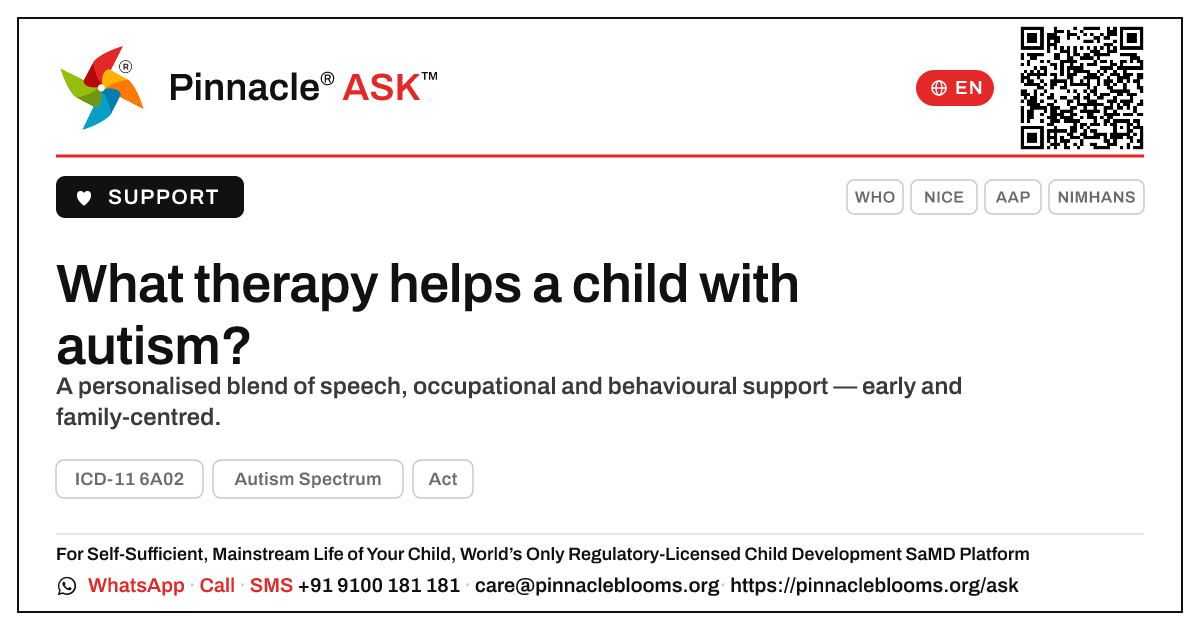
What therapy helps a child with Autism Spectrum?
No single therapy treats autism; the strongest support blends speech and language therapy, occupational therapy and structured behavioural-developmental approaches, matched to a child's needs and started early. Family involvement and consistency across home and school drive the best outcomes. A clinical plan is shaped only at a Pinnacle centre under clinician care.
In this answer 4 sections
When your child is diagnosed with autism, the first relief is knowing there are clear, proven ways to help them flourish.
In short
There isn't one single therapy for autism — the most effective support is a personalised, play-based combination matched to your child's strengths and needs. The core pillars are speech and language therapy (communication), occupational therapy (sensory processing, daily skills and motor coordination) and structured behavioural and developmental support that builds social connection and learning. Started early and delivered consistently, these therapies help a child communicate, regulate and thrive at their own pace.
What helps, and why
Speech & language therapy builds communication — words, gestures, picture systems or devices — so your child can express needs and connect with others. Occupational therapy helps with sensory sensitivities, self-care and the fine-motor skills behind play and writing. Behavioural and developmental approaches teach social and learning skills through your child's interests, in everyday routines. Many children also benefit from special education and parent coaching, so progress carries over at home and school.
The science is consistent: early, intensive, developmentally-grounded intervention that involves families produces the best outcomes. Therapy is never about "fixing" — it is about building independence and confidence on your child's own terms.
The Pinnacle way
AbilityScore® is part of Pinnacle’s developmental assessment. Diagnosis, where needed, requires an appropriately qualified healthcare professional — never from an app or online form. From there, our team designs your child's blended plan. Explore autism therapy, speech therapy, and understand your starting point with the AbilityScore®.
Trusted sources
WHO ICD-11 (6A02, autism spectrum disorder); NICE guidance on autism support; the American Academy of Pediatrics and NIMHANS on early, family-centred intervention.
Next step — Book a developmental assessment so a Pinnacle clinician can shape your child's personalised therapy plan.
This is general information, not a diagnosis — individual assessment and diagnosis require an appropriately qualified healthcare professional.
CONNECT THE ANSWER TO YOUR CHILD’S DAY
Something to notice. Something to discuss.
What to notice
Watch how your child communicates, connects and copes day to day — and whether each therapy is helping them do more independently. Progress in autism is steady and personal; celebrate small, consistent gains rather than comparing to milestones charts.
In everyday life
Follow your child's lead in play for ten minutes a day — copy what they do, name it simply, and pause to invite a response. These small, joyful back-and-forth moments are powerful therapy woven into everyday life.
Bring your observations and questions to your child’s professional. Choose activities that suit your child’s comfort, abilities and agreed plan.
Bring your questions to a first visitQuestions families ask
Is there one best therapy for autism?
No. The most effective support blends several therapies — typically speech and language therapy, occupational therapy and structured behavioural-developmental approaches — chosen for your individual child. A clinician matches the mix to your child's strengths and needs.
When should therapy start?
As early as concerns are identified. Early, consistent, family-involved intervention gives the best outcomes, but therapy helps at any age — it is never too late to build communication, regulation and independence.
Can parents help at home?
Absolutely. Parent coaching is part of good therapy. Following your child's lead in play, narrating daily routines and practising therapist-suggested strategies at home helps skills carry over and accelerates progress.
FOLLOW THE SOURCE
References behind this answer.
- Source referenceWHO ICD-11 — 6A02 Autism spectrum disorder
- Source referenceNICE CG128 — Autism recognition & diagnosis
- Organisation website · further readingAmerican Academy of Pediatrics — HealthyChildren.org
- Organisation website · further readingNIMHANS — autism clinical resources
References are supplied with this answer. An organisation homepage offers further reading; it does not establish an independent review of this page.
Content attribution: SETU Consortium · Pinnacle Blooms Network.
PEOPLE, TOPICS & DEVELOPMENT
See the connections.
Browse the wider question collections connected with this answer’s audience, developmental area and stage.
FROM UNDERSTANDING TO PURPOSEFUL SUPPORT
One question. Your child’s whole life.
Your child’s self-sufficient, mainstream-included life is the purpose from the beginning. At Pinnacle, that purpose shapes what we understand, the goals we choose, the people we bring together, everyday practice and review.
Connect this question with the right support.
Explore how the relevant service contributes to everyday abilities, then speak with us about your child.
Make the next conversation useful.
Bring the situations you notice at home or school. We’ll explain a suitable service, centre and first visit, including availability and fees, before you decide.
How PinnacleAI® connects the journeyExplore the seven stages
- 1Understand abilities
A starting picture of your child’s capabilities.
- 2Choose meaningful goals
Readiness and a plan shaped around the child.
- 3Bring the right support together
Suitable therapies and people for those goals.
- 4Carry practice into everyday life
Guidance for family, home and school.
- 5Track and correct
Use observations to adjust the plan.
- 6Reassess and review
Decide what to continue, change or do next.
- 7Grow independence and participation
The child’s life gives each step its purpose.
Explore the whole PinnacleAI® system → · Participation at school and in the community →
PINNACLE’S EVIDENCE, OPEN TO YOU
Look at the evidence behind our work.
Read our research, inspect the original regulatory documents and check what each institutional measure means.
General information supports a conversation with an appropriately qualified professional. Advice, goals and support depend on the individual child.