
YOUR QUESTION. A CLEARER NEXT STEP.
Common Myths About Autism Spectrum
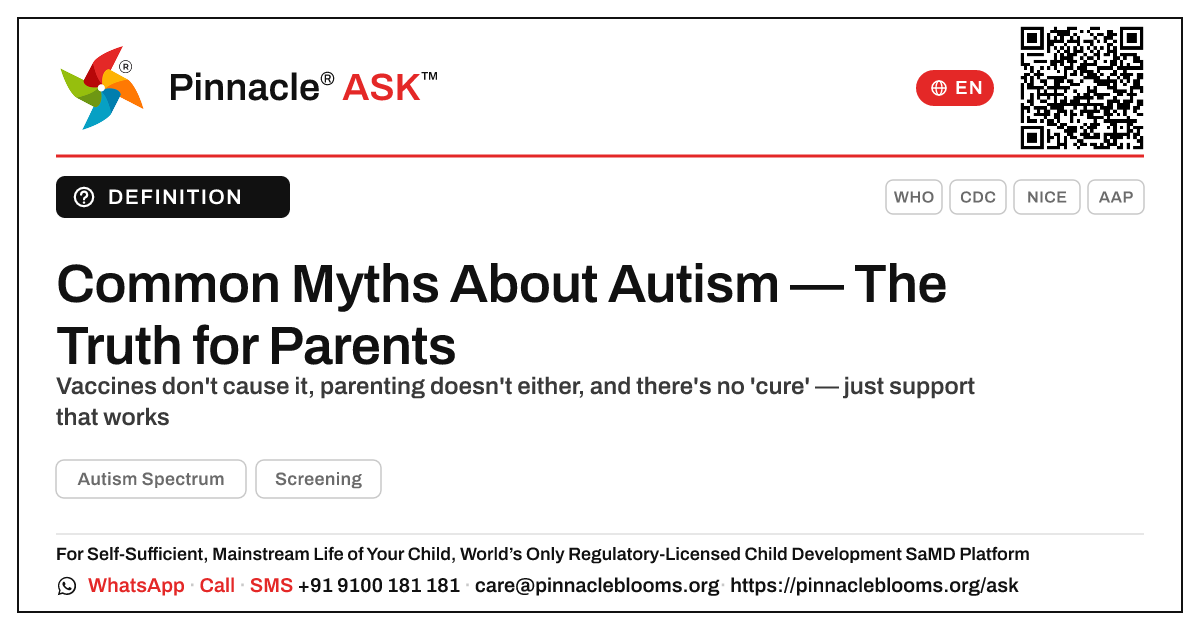
Most beliefs that frighten parents about autism are myths. Vaccines do not cause autism, parenting does not cause it, autistic children do feel and show love, and there is no 'cure' — but timely evidence-based therapy helps at every age. Autism is a lifelong neurodevelopmental spectrum, and each child is unique.
In this answer 4 sections
Few topics carry as many old wives' tales as autism — and the myths can hurt more than the condition itself.
In short
Autism is a lifelong, natural variation in how the brain develops and processes the world — not an illness to be cured, not bad parenting, and certainly not caused by vaccines. Most beliefs that worry parents are simply outdated. Understanding what's true clears the path to early support, which is what genuinely helps a child thrive.
The common myths — gently corrected
"Vaccines cause autism." No. This claim came from a single discredited and retracted study; large global studies since have found no link whatsoever. Vaccinating your child protects them and does not cause autism.
"Cold or distant parenting causes it." The old "refrigerator mother" idea is long disproven. Autism is neurodevelopmental — how a child's brain naturally wires itself — not a result of how much you love or hold your child.
"Autistic children can't feel or show love." Untrue. Autistic children form deep bonds and feel emotions richly; they may simply express affection and connect in their own way.
"It can be cured." Autism isn't a disease, so there is nothing to "cure". What works is timely, evidence-based therapy that builds communication, regulation and everyday independence — and the gains can be remarkable.
"All autistic people are the same" or "all are geniuses." It's a spectrum — each child is unique, with their own strengths and support needs. Savant abilities are rare; differences are the norm.
"They'll grow out of it" or "it's too late after age 5." Neither. Autism is lifelong, but the brain stays adaptable — support helps at every age, and the earlier it begins, the easier the wins.
The Pinnacle way
A clinical AbilityScore® and any diagnosis are formed only at a Pinnacle Blooms Network centre, under qualified clinician care — never from an online list or a single behaviour. If you're curious about autism or wondering where your child stands, a structured developmental check is the calm, clear first step, and speech and developmental therapy meets your child exactly where they are.
Trusted sources
WHO ICD-11 (6A02, autism spectrum disorder); CDC Learn the Signs. Act Early.; NICE CG128 on autism recognition and diagnosis; American Academy of Pediatrics (HealthyChildren.org); NIMHANS autism clinical resources.
Next step — Replace worry with clarity: book a developmental check with a Pinnacle clinician.
This is general information, not a diagnosis — individual assessment and diagnosis require an appropriately qualified healthcare professional.
CONNECT THE ANSWER TO YOUR CHILD’S DAY
Something to notice. Something to discuss.
What to notice
Beyond the myths, watch the real patterns: limited response to name by 12 months, few gestures like pointing or showing, reduced back-and-forth smiling, delayed or lost words, or strong distress at small changes — across settings, not just one tired day.
In everyday life
When relatives offer 'advice' rooted in myths, you don't need to argue. Simply say, 'The doctors have a clear plan and we're following it' — protecting your peace lets you focus your energy on your child.
Bring your observations and questions to your child’s professional. Choose activities that suit your child’s comfort, abilities and agreed plan.
Bring your questions to a first visitQuestions families ask
Do vaccines cause autism?
No. The original claim came from a single study that was retracted and discredited. Many large, high-quality studies worldwide have since found no link between vaccines and autism. Vaccinating protects your child.
Did I cause my child's autism by how I parented?
No. The old 'refrigerator mother' theory is long disproven. Autism is neurodevelopmental — a natural variation in how the brain develops — and is not caused by parenting style or affection.
Can autism be cured?
Autism is not a disease, so there is nothing to cure. It is a lifelong way of experiencing the world. What genuinely helps is timely, evidence-based therapy that builds communication, regulation and everyday independence.
Is it too late to help after age five?
No. While early support brings easier gains, the brain stays adaptable, and meaningful progress is possible at every age. A developmental check is worthwhile whenever a parent has concerns.
FOLLOW THE SOURCE
References behind this answer.
- Source referenceWHO ICD-11 — Autism spectrum disorder
- Source referenceCDC — Learn the Signs. Act Early.
- Source referenceNICE CG128 — Autism recognition and diagnosis
- Organisation website · further readingAmerican Academy of Pediatrics — HealthyChildren.org
- Organisation website · further readingNIMHANS — autism clinical resources
References are supplied with this answer. An organisation homepage offers further reading; it does not establish an independent review of this page.
Content attribution: SETU Consortium · Pinnacle Blooms Network.
PEOPLE, TOPICS & DEVELOPMENT
See the connections.
Browse the wider question collections connected with this answer’s audience, developmental area and stage.
FROM UNDERSTANDING TO PURPOSEFUL SUPPORT
One question. Your child’s whole life.
Your child’s self-sufficient, mainstream-included life is the purpose from the beginning. At Pinnacle, that purpose shapes what we understand, the goals we choose, the people we bring together, everyday practice and review.
Connect this question with the right support.
Explore how the relevant service contributes to everyday abilities, then speak with us about your child.
Make the next conversation useful.
Bring the situations you notice at home or school. We’ll explain a suitable service, centre and first visit, including availability and fees, before you decide.
How PinnacleAI® connects the journeyExplore the seven stages
- 1Understand abilities
A starting picture of your child’s capabilities.
- 2Choose meaningful goals
Readiness and a plan shaped around the child.
- 3Bring the right support together
Suitable therapies and people for those goals.
- 4Carry practice into everyday life
Guidance for family, home and school.
- 5Track and correct
Use observations to adjust the plan.
- 6Reassess and review
Decide what to continue, change or do next.
- 7Grow independence and participation
The child’s life gives each step its purpose.
Explore the whole PinnacleAI® system → · Participation at school and in the community →
PINNACLE’S EVIDENCE, OPEN TO YOU
Look at the evidence behind our work.
Read our research, inspect the original regulatory documents and check what each institutional measure means.
General information supports a conversation with an appropriately qualified professional. Advice, goals and support depend on the individual child.