
YOUR QUESTION. A CLEARER NEXT STEP.
ICD-11 Classification for Autism Spectrum (6A02)
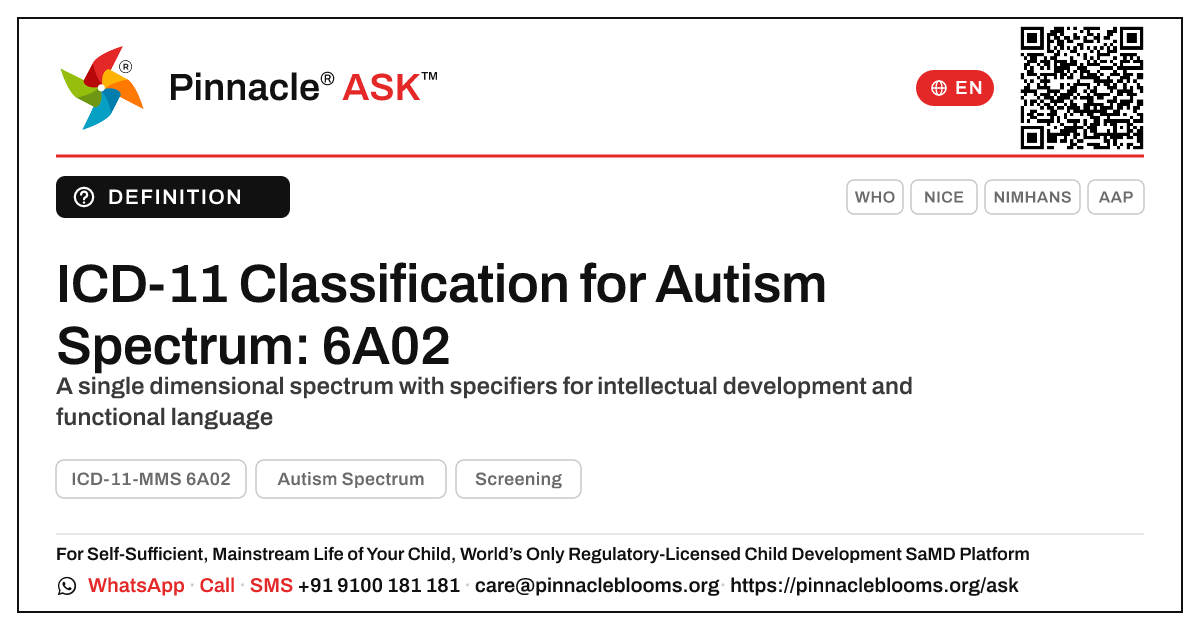
In ICD-11-MMS, Autism spectrum disorder is coded 6A02 within neurodevelopmental disorders, defined by persistent reciprocal social-communication deficits plus restricted, repetitive behaviours with developmental-period onset. ICD-11 replaces older subtypes with a single dimensional spectrum, using specifiers for intellectual development and functional language.
In this answer 4 sections
Clinicians reaching for the right code need precision, not paraphrase — here is exactly where autism sits in ICD-11.
In short
In ICD-11-MMS, Autism spectrum disorder is classified under code 6A02, within the grouping of neurodevelopmental disorders (block 6A0). It is defined by persistent deficits in the capacity to initiate and sustain reciprocal social interaction and social communication, together with a range of restricted, repetitive and inflexible patterns of behaviour, interests or activities, with onset during the developmental period. Unlike DSM-IV/ICD-10, ICD-11 abandons the older subtypes (autistic disorder, Asperger syndrome, PDD-NOS) in favour of a single dimensional spectrum.
How ICD-11 structures the diagnosis
ICD-11 captures clinical heterogeneity not through subtypes but through specifiers appended to 6A02, which is essential for accurate coding:
- Intellectual development — with or without disorder of intellectual development.
- Functional language — with mild or no, impaired, or complete absence of functional language.
- Recognised pattern of loss of previously acquired skills where applicable.
So a child may be coded, for example, as 6A02.0 (without disorder of intellectual development and with mild or no impairment of functional language) through to 6A02.5 and related qualifiers. Symptoms must be present across multiple contexts and cause significant impairment, with the caveat that manifestations may be masked by learned strategies or surface only when social demands exceed capacity. ICD-11 aligns conceptually with the WHO ICF model of functioning, which is why a functional developmental profile complements the categorical code in clinical practice.
The Pinnacle way
Developmental measurement supports care planning; diagnosis requires an appropriately qualified healthcare professional., under qualified clinician care — never from a code lookup, an app or an online form. The ICD-11 6A02 classification tells you what; a clinician-administered structured assessment tells you where this child stands today and what support will help most. Explore our autism developmental support pathway, the AbilityScore® methodology, or refer directly via our network.
Trusted sources
WHO ICD-11 for Mortality and Morbidity Statistics, entity 6A02 (Autism spectrum disorder); NICE clinical guideline CG128 on autism recognition and diagnosis; NIMHANS clinical autism resources; American Academy of Pediatrics (HealthyChildren.org).
Next step — Have a child you suspect meets 6A02 criteria? Refer to a Pinnacle clinician for a structured developmental assessment.
This is general information, not a diagnosis — individual assessment and diagnosis require an appropriately qualified healthcare professional.
CONNECT THE ANSWER TO YOUR CHILD’S DAY
Something to notice. Something to discuss.
What to notice
Code accuracy depends on documenting the correct specifiers: intellectual development status and degree of functional language impairment, plus any loss of previously acquired skills.
In everyday life
When coding 6A02, pair the categorical diagnosis with a functional ICF-aligned profile so the record reflects the child's day-to-day support needs, not just the label.
Bring your observations and questions to your child’s professional. Choose activities that suit your child’s comfort, abilities and agreed plan.
Bring your questions to a first visitQuestions families ask
What is the ICD-11 code for autism spectrum disorder?
Autism spectrum disorder is classified under code 6A02 in ICD-11-MMS, within the neurodevelopmental disorders grouping.
How does ICD-11 differ from ICD-10 for autism?
ICD-11 replaces the older subtypes — autistic disorder, Asperger syndrome and pervasive developmental disorder NOS — with a single dimensional Autism spectrum disorder (6A02), differentiated instead by specifiers for intellectual development and functional language.
What specifiers does ICD-11 use for 6A02?
ICD-11 distinguishes presence or absence of a disorder of intellectual development and the degree of functional language impairment (mild or none, impaired, or complete absence), and notes any loss of previously acquired skills.
Does the ICD-11 code replace clinical assessment?
No. The 6A02 code is a classification; a diagnosis and a clinical AbilityScore® are established only at a Pinnacle Blooms Network centre under qualified clinician care, supported by a structured developmental assessment.
FOLLOW THE SOURCE
References behind this answer.
- Source referenceWHO ICD-11 — Autism spectrum disorder
- Source referenceNICE CG128 — Autism recognition & diagnosis
- Organisation website · further readingNIMHANS — autism clinical resources
- Organisation website · further readingAmerican Academy of Pediatrics (HealthyChildren.org)
References are supplied with this answer. An organisation homepage offers further reading; it does not establish an independent review of this page.
Content attribution: SETU Consortium · Pinnacle Blooms Network.
PEOPLE, TOPICS & DEVELOPMENT
See the connections.
Browse the wider question collections connected with this answer’s audience, developmental area and stage.
FROM UNDERSTANDING TO PURPOSEFUL SUPPORT
One question. Your child’s whole life.
Your child’s self-sufficient, mainstream-included life is the purpose from the beginning. At Pinnacle, that purpose shapes what we understand, the goals we choose, the people we bring together, everyday practice and review.
Connect this question with the right support.
Explore how the relevant service contributes to everyday abilities, then speak with us about your child.
Make the next conversation useful.
Bring the situations you notice at home or school. We’ll explain a suitable service, centre and first visit, including availability and fees, before you decide.
How PinnacleAI® connects the journeyExplore the seven stages
- 1Understand abilities
A starting picture of your child’s capabilities.
- 2Choose meaningful goals
Readiness and a plan shaped around the child.
- 3Bring the right support together
Suitable therapies and people for those goals.
- 4Carry practice into everyday life
Guidance for family, home and school.
- 5Track and correct
Use observations to adjust the plan.
- 6Reassess and review
Decide what to continue, change or do next.
- 7Grow independence and participation
The child’s life gives each step its purpose.
Explore the whole PinnacleAI® system → · Participation at school and in the community →
PINNACLE’S EVIDENCE, OPEN TO YOU
Look at the evidence behind our work.
Read our research, inspect the original regulatory documents and check what each institutional measure means.
General information supports a conversation with an appropriately qualified professional. Advice, goals and support depend on the individual child.