
YOUR QUESTION. A CLEARER NEXT STEP.
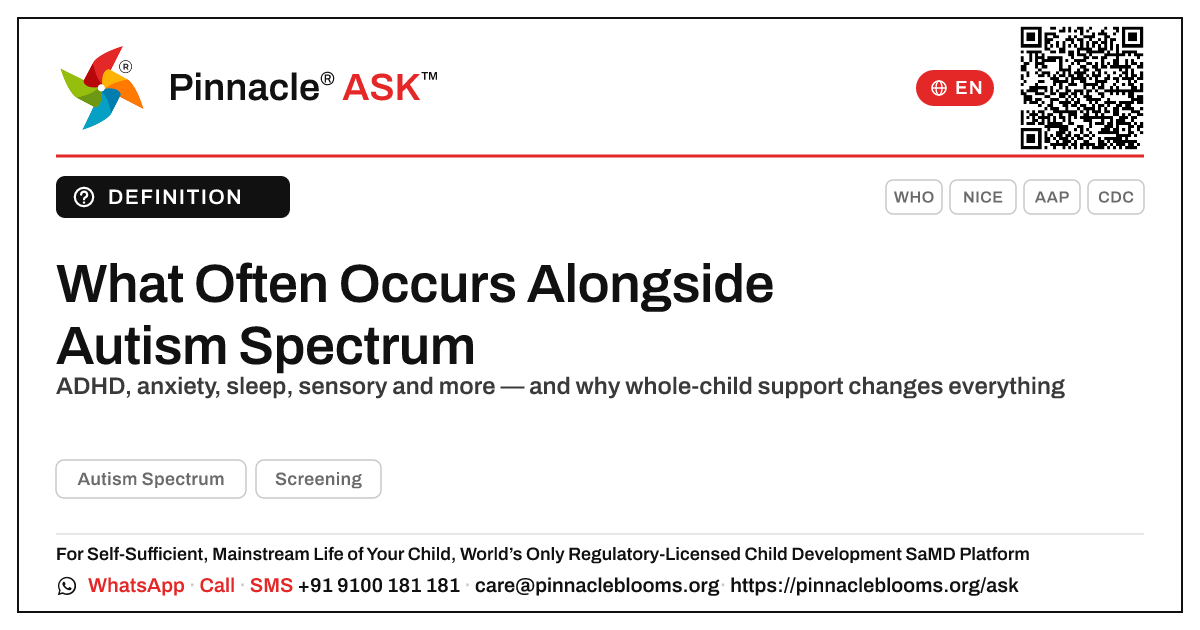
What conditions often occur alongside Autism Spectrum?
Autism often co-occurs with ADHD, anxiety, sleep problems, sensory differences, gastrointestinal issues and speech delay, and sometimes intellectual disability, epilepsy or motor difficulties. Recognising these companions lets support address the whole child. Any identification happens only at a Pinnacle centre under clinician care.
In this answer 5 sections
One of the most useful things to know early: autism rarely travels alone — and understanding its companions is what makes support truly effective.
In short
Autism Spectrum often co-occurs with other conditions, and recognising them is not bad news — it is what lets a plan address the whole child rather than one label. The most common companions are attention difficulties (ADHD), anxiety, sleep problems, sensory processing differences, gastrointestinal issues, and speech or language delays. Some children also have intellectual disability, epilepsy, or motor coordination difficulties. None of this is a verdict — each is simply another area where the right support helps.
What commonly occurs alongside autism
Developmental and learning
- ADHD — difficulty with attention, impulse control or activity levels
- Speech, language and communication delay — very common, and highly responsive to therapy
- Intellectual disability — present in some, but far from all, autistic children
- Motor coordination difficulties — clumsiness, delayed fine-motor skills
Emotional and behavioural
- Anxiety — one of the most frequent companions, especially around change or social demands
- Emotional regulation difficulties — big reactions that settle with the right tools
Physical and sensory
- Sleep problems — trouble falling or staying asleep
- Sensory processing differences — strong responses to sound, texture, light or movement
- Gastrointestinal issues — constipation, reflux, restricted eating
- Epilepsy — less common, but if seizures are ever suspected, this needs prompt medical review, not therapy first
Why this matters
Knowing what co-occurs changes the plan. A child whose anxiety and sleep are addressed often engages far better in communication and learning. This is why a good assessment looks at the whole child across every domain — so support is matched to the real picture, not just the headline label.
The Pinnacle way
A clinical AbilityScore® — and any diagnosis or identification of co-occurring conditions — is formed only at a Pinnacle Blooms Network centre, under qualified clinician care, never from an online form. Our understanding of Autism Spectrum starts with seeing the whole child, mapped through a clinician-administered AbilityScore®, and supported through services such as speech therapy where communication is a focus.
Trusted sources
WHO ICD-11 (6A02, Autism spectrum disorder) notes frequent co-occurring conditions; NICE guidance on autism recognition highlights assessing for co-existing physical and mental health needs; the American Academy of Pediatrics and CDC emphasise whole-child developmental review.
Next step — Curious where your child stands across every area? A Pinnacle clinician can map the full picture.
This is general information, not a diagnosis — individual assessment and diagnosis require an appropriately qualified healthcare professional.
CONNECT THE ANSWER TO YOUR CHILD’S DAY
Something to notice. Something to discuss.
What to notice
Watch for patterns beyond communication — poor sleep, big anxiety around change, strong reactions to sound or texture, tummy troubles or restricted eating. These often travel with autism and respond well to the right support.
In everyday life
Keep a simple notebook of what you notice across the day — sleep, eating, mood, sounds that upset or soothe. This whole-picture view helps a clinician far more than focusing on one worry alone.
Bring your observations and questions to your child’s professional. Choose activities that suit your child’s comfort, abilities and agreed plan.
Bring your questions to a first visitQuestions families ask
Does every autistic child have other conditions too?
No. Co-occurring conditions are common but not universal. Some children have several, others very few. Each child is different, which is exactly why a whole-child assessment matters rather than assumptions.
Is anxiety really linked to autism?
Yes — anxiety is one of the most frequent companions of autism, often around change, social demands or sensory overload. The good news is that it responds well to the right strategies and support.
Should I worry about epilepsy if my child is autistic?
Epilepsy is less common and most autistic children never develop it. But if you ever notice possible seizures — staring spells, sudden stiffening or jerking — seek prompt medical review, as that is a medical matter handled before therapy.
Who identifies these co-occurring conditions?
Only qualified clinicians at a Pinnacle Blooms Network centre, through a structured clinician-administered assessment. There is no online form or app that can do this safely.
FOLLOW THE SOURCE
References behind this answer.
- Source referenceWHO ICD-11 · Autism spectrum disorder
- Source referenceNICE CG128 — Autism recognition & diagnosis
- Organisation website · further readingAmerican Academy of Pediatrics — HealthyChildren.org
- Source referenceCDC — Learn the Signs. Act Early.
References are supplied with this answer. An organisation homepage offers further reading; it does not establish an independent review of this page.
Content attribution: SETU Consortium · Pinnacle Blooms Network.
PEOPLE, TOPICS & DEVELOPMENT
See the connections.
Browse the wider question collections connected with this answer’s audience, developmental area and stage.
FROM UNDERSTANDING TO PURPOSEFUL SUPPORT
One question. Your child’s whole life.
Your child’s self-sufficient, mainstream-included life is the purpose from the beginning. At Pinnacle, that purpose shapes what we understand, the goals we choose, the people we bring together, everyday practice and review.
Connect this question with the right support.
Explore how the relevant service contributes to everyday abilities, then speak with us about your child.
Make the next conversation useful.
Bring the situations you notice at home or school. We’ll explain a suitable service, centre and first visit, including availability and fees, before you decide.
How PinnacleAI® connects the journeyExplore the seven stages
- 1Understand abilities
A starting picture of your child’s capabilities.
- 2Choose meaningful goals
Readiness and a plan shaped around the child.
- 3Bring the right support together
Suitable therapies and people for those goals.
- 4Carry practice into everyday life
Guidance for family, home and school.
- 5Track and correct
Use observations to adjust the plan.
- 6Reassess and review
Decide what to continue, change or do next.
- 7Grow independence and participation
The child’s life gives each step its purpose.
Explore the whole PinnacleAI® system → · Participation at school and in the community →
PINNACLE’S EVIDENCE, OPEN TO YOU
Look at the evidence behind our work.
Read our research, inspect the original regulatory documents and check what each institutional measure means.
General information supports a conversation with an appropriately qualified professional. Advice, goals and support depend on the individual child.