
YOUR QUESTION. A CLEARER NEXT STEP.
What causes Autism Spectrum in children?
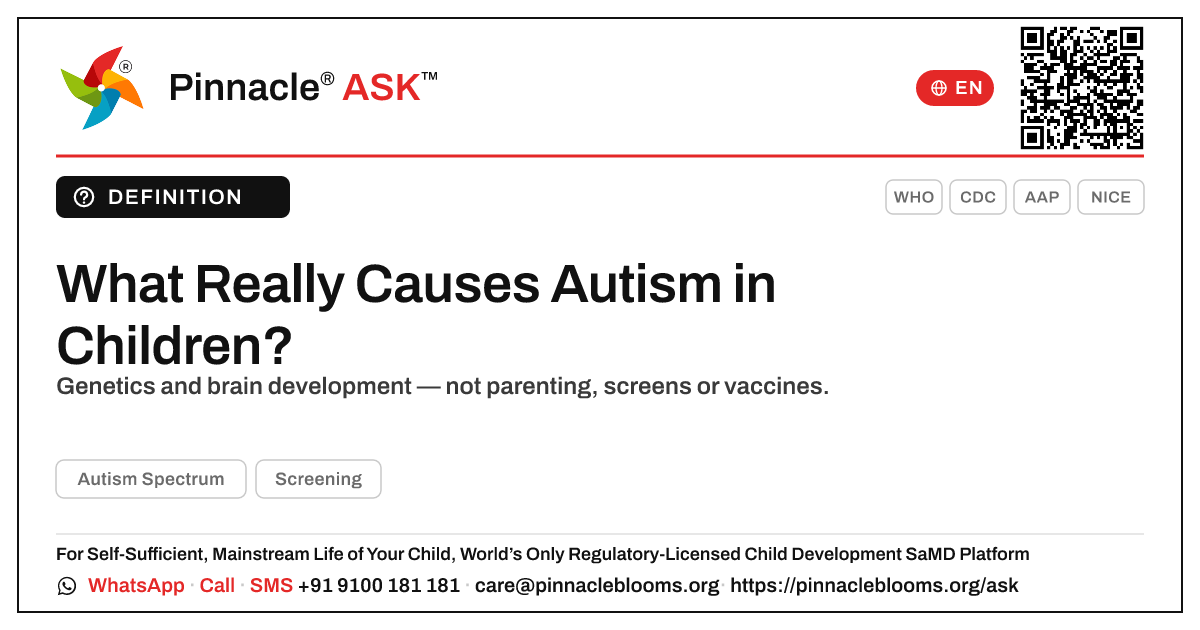
Autism Spectrum is shaped overwhelmingly by genetics and early brain development — not by parenting, screens, diet or vaccines. Most often there is no single cause, but many genetic factors acting together, sometimes alongside prenatal influences. Nothing a parent did caused it, and early support helps regardless of cause.
In this answer 5 sections
Almost every parent who hears the word 'autism' asks the same quiet question — did I cause this? The honest, science-backed answer brings real relief.
In short
Autism Spectrum is best understood as a difference in how the brain develops and connects — and it is overwhelmingly shaped by genetics, present from very early in development. It is not caused by parenting, by screen time, by diet, by any single event, and — clearly and repeatedly proven — not by vaccines. Most often there is no single cause to point to, but a combination of many genetic factors working together, sometimes alongside influences before birth. Nothing you did or didn't do as a parent made your child autistic.
What the science actually shows
Research consistently points to strong genetic influences — autism tends to run in families, and many different genes each contribute a small part. These genetic factors shape how the developing brain forms and communicates, usually well before a child is born. Some prenatal and birth-related factors (such as significant prematurity or certain conditions during pregnancy) can add to the likelihood, but they are contributors, not simple causes.
Just as importantly, here is what does not cause autism: vaccines (this has been studied exhaustively and disproven), parenting style, affection or its absence, screens, or anything in a child's diet. Autism is a natural variation in brain development — a different way of experiencing and connecting with the world, not a fault or a failure.
Why the cause matters less than the next step
Understanding cause brings peace of mind, but it doesn't change what helps your child most: early, warm, structured support tuned to how your child learns and communicates. Children who receive the right therapy and support early often make remarkable progress in connection, communication and independence — regardless of the underlying cause.
The Pinnacle way
A clinical AbilityScore® and any diagnosis are formed only at a Pinnacle Blooms Network centre, under qualified clinician care — never from an online form or guesswork about causes. Across 70+ centres, 700+ therapists and 4.95 lakh+ families served, our focus is simple: meet your child exactly where they are today and build forward. Explore how speech therapy and structured early support can help your child thrive.
Trusted sources
WHO ICD-11 (6A02, Autism spectrum disorder); CDC — Learn the Signs. Act Early.; American Academy of Pediatrics (HealthyChildren.org); NICE guidance on autism recognition; NIMHANS clinical resources. These bodies agree autism has strong genetic roots and is not caused by parenting or vaccines.
Next step — Curious where your child stands today? Book a developmental check with a Pinnacle clinician.
This is general information, not a diagnosis — individual assessment and diagnosis require an appropriately qualified healthcare professional.
CONNECT THE ANSWER TO YOUR CHILD’S DAY
Something to notice. Something to discuss.
What to notice
Rather than searching for a cause, watch how your child connects and communicates: responding to their name, sharing smiles, pointing or showing things, and using words or gestures for their age. Persistent differences across settings — not one-off moments — are what's worth discussing with a clinician.
In everyday life
Follow your child's lead in play and name what they're enjoying in short, simple words. This builds connection and language naturally, whatever the cause of their differences.
Bring your observations and questions to your child’s professional. Choose activities that suit your child’s comfort, abilities and agreed plan.
Bring your questions to a first visitQuestions families ask
Did something I do cause my child's autism?
No. Autism is shaped overwhelmingly by genetics and early brain development. It is not caused by parenting, affection, screen time or diet. Nothing you did or didn't do made your child autistic.
Do vaccines cause autism?
No. This has been studied extensively across very large populations and disproven repeatedly. Vaccines do not cause autism, and major health bodies including the WHO, CDC and AAP confirm this clearly.
Is autism inherited?
Genetics play a strong role and autism often runs in families, with many different genes each contributing a small part. However, it is rarely traced to a single gene or a single cause, and a child can be autistic with no known family history.
Does knowing the cause change how we help my child?
Not really — what helps most is early, warm, structured support tuned to how your child learns and communicates. Children often make remarkable progress regardless of the underlying cause.
FOLLOW THE SOURCE
References behind this answer.
- Source referenceWHO ICD-11 — Autism spectrum disorder
- Source referenceCDC — Learn the Signs. Act Early.
- Organisation website · further readingAmerican Academy of Pediatrics — HealthyChildren.org
- Source referenceNICE CG128 — Autism recognition & diagnosis
- Organisation website · further readingNIMHANS — autism clinical resources
References are supplied with this answer. An organisation homepage offers further reading; it does not establish an independent review of this page.
Content attribution: SETU Consortium · Pinnacle Blooms Network.
PEOPLE, TOPICS & DEVELOPMENT
See the connections.
Browse the wider question collections connected with this answer’s audience, developmental area and stage.
FROM UNDERSTANDING TO PURPOSEFUL SUPPORT
One question. Your child’s whole life.
Your child’s self-sufficient, mainstream-included life is the purpose from the beginning. At Pinnacle, that purpose shapes what we understand, the goals we choose, the people we bring together, everyday practice and review.
Connect this question with the right support.
Explore how the relevant service contributes to everyday abilities, then speak with us about your child.
Make the next conversation useful.
Bring the situations you notice at home or school. We’ll explain a suitable service, centre and first visit, including availability and fees, before you decide.
How PinnacleAI® connects the journeyExplore the seven stages
- 1Understand abilities
A starting picture of your child’s capabilities.
- 2Choose meaningful goals
Readiness and a plan shaped around the child.
- 3Bring the right support together
Suitable therapies and people for those goals.
- 4Carry practice into everyday life
Guidance for family, home and school.
- 5Track and correct
Use observations to adjust the plan.
- 6Reassess and review
Decide what to continue, change or do next.
- 7Grow independence and participation
The child’s life gives each step its purpose.
Explore the whole PinnacleAI® system → · Participation at school and in the community →
PINNACLE’S EVIDENCE, OPEN TO YOU
Look at the evidence behind our work.
Read our research, inspect the original regulatory documents and check what each institutional measure means.
General information supports a conversation with an appropriately qualified professional. Advice, goals and support depend on the individual child.