
YOUR QUESTION. A CLEARER NEXT STEP.
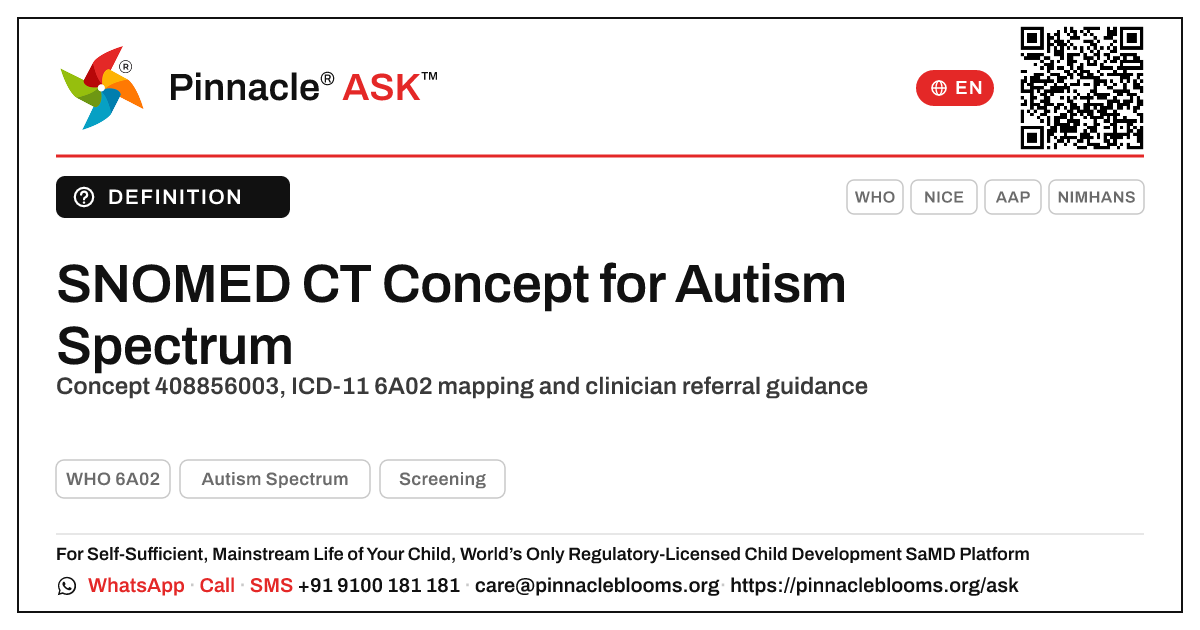
SNOMED CT Concept for Autism Spectrum
In SNOMED CT, autism spectrum is represented by concept 408856003 | Autism spectrum disorder (disorder), historically under 35919005 | Pervasive developmental disorder. It maps to WHO ICD-11 6A02, which unifies the former DSM-IV/ICD-10 subtypes into a single spectrum construct.
In this answer 5 sections
Clinicians coding paediatric developmental presentations need the right concept identifier — here is the SNOMED CT term for autism spectrum and how it maps across systems.
In short
In SNOMED CT, autism spectrum is represented by the concept 35919005 | Pervasive developmental disorder (disorder) as the historical parent, with the contemporary preferred concept being 408856003 | Autism spectrum disorder (disorder). This SNOMED CT concept maps to ICD-11 6A02 Autism spectrum disorder and supersedes the older DSM-IV-era subtypes (autistic disorder, Asperger syndrome, PDD-NOS) now subsumed under a single spectrum construct. Always confirm the exact subtype concept and current SNOMED CT release, as the international edition is updated biannually and country extensions (including the India edition) may differ.
The coding detail
SNOMED CT consolidates the spectrum under 408856003 | Autism spectrum disorder (disorder), with finer-grained children where clinically required. Key cross-references for your records:
- SNOMED CT preferred term: 408856003 · Autism spectrum disorder (disorder)
- ICD-11 (WHO): 6A02 · Autism spectrum disorder, with severity and language/intellectual-functioning qualifiers via the 6A02.0–6A02.5 sub-codes
- Functioning frame: WHO ICF, capturing activity and participation rather than deficit alone
Note that ICD-11 replaced ICD-10's F84 cluster (childhood autism, atypical autism, Asperger syndrome) with the unified 6A02 hierarchy — so when migrating legacy records, map ICD-10 F84.0–F84.9 to the appropriate 6A02 sub-code rather than one-to-one. SNOMED-to-ICD maps are maintained in the official map reference sets; rely on those rather than manual crosswalks for billing and reporting fidelity.
When to refer
Coding aside, refer for structured assessment when social-communication differences and restricted, repetitive behaviours persist across settings and are not better explained by hearing loss or global delay. NICE CG128 supports a multidisciplinary diagnostic pathway; act promptly on any skill regression or persistent parental concern.
The Pinnacle way
Developmental measurement supports care planning; diagnosis requires an appropriately qualified healthcare professional., under qualified clinician care — never from a code lookup or an online tool. For referring clinicians, our network offers structured multidisciplinary assessment and a clinician-administered AbilityScore® to baseline functioning, plus coordinated speech and language therapy pathways. With 2.5 billion+ data points, 25 million+ therapy sessions and 700+ therapists across 70+ centres, we partner with paediatricians to move from recognition to intervention.
Trusted sources
WHO ICD-11 (6A02, Autism spectrum disorder); SNOMED International concept hierarchy; NICE CG128 on autism recognition and diagnosis; American Academy of Pediatrics developmental guidance; NIMHANS autism clinical resources.
Next step — Refer a child for structured assessment, or partner with a Pinnacle centre to streamline your developmental pathway.
This is general information, not a diagnosis — individual assessment and diagnosis require an appropriately qualified healthcare professional.
CONNECT THE ANSWER TO YOUR CHILD’S DAY
Something to notice. Something to discuss.
What to notice
Persistent social-communication differences and restricted, repetitive behaviours across settings; any regression in language or social engagement at any age warrants prompt referral.
In everyday life
When migrating legacy records, map ICD-10 F84.0–F84.9 to the appropriate ICD-11 6A02 sub-code using official map reference sets rather than manual one-to-one crosswalks.
Bring your observations and questions to your child’s professional. Choose activities that suit your child’s comfort, abilities and agreed plan.
Bring your questions to a first visitQuestions families ask
What is the SNOMED CT concept ID for autism spectrum disorder?
The preferred SNOMED CT concept is 408856003 | Autism spectrum disorder (disorder). The broader historical parent is 35919005 | Pervasive developmental disorder (disorder). Always confirm against your current SNOMED CT release and any national extension.
How does the SNOMED CT autism concept map to ICD-11?
It maps to WHO ICD-11 6A02 Autism spectrum disorder, which carries severity and language/intellectual-functioning qualifiers across sub-codes 6A02.0–6A02.5. Use official SNOMED-to-ICD map reference sets for reporting fidelity.
What happened to Asperger syndrome and PDD-NOS in current coding?
Both former DSM-IV/ICD-10 subtypes are now subsumed under the unified autism spectrum construct in SNOMED CT and ICD-11 6A02. ICD-10's F84 cluster should be mapped to the appropriate 6A02 sub-code rather than carried forward as separate categories.
FOLLOW THE SOURCE
References behind this answer.
- Source referenceWHO ICD-11 — Autism spectrum disorder
- Source referenceNICE CG128 — Autism recognition and diagnosis
- Organisation website · further readingAmerican Academy of Pediatrics — HealthyChildren.org
- Organisation website · further readingNIMHANS — autism clinical resources
- Source referenceCDC — Learn the Signs. Act Early.
References are supplied with this answer. An organisation homepage offers further reading; it does not establish an independent review of this page.
Content attribution: SETU Consortium · Pinnacle Blooms Network.
PEOPLE, TOPICS & DEVELOPMENT
See the connections.
Browse the wider question collections connected with this answer’s audience, developmental area and stage.
FROM UNDERSTANDING TO PURPOSEFUL SUPPORT
One question. Your child’s whole life.
Your child’s self-sufficient, mainstream-included life is the purpose from the beginning. At Pinnacle, that purpose shapes what we understand, the goals we choose, the people we bring together, everyday practice and review.
Connect this question with the right support.
Explore how the relevant service contributes to everyday abilities, then speak with us about your child.
Make the next conversation useful.
Bring the situations you notice at home or school. We’ll explain a suitable service, centre and first visit, including availability and fees, before you decide.
How PinnacleAI® connects the journeyExplore the seven stages
- 1Understand abilities
A starting picture of your child’s capabilities.
- 2Choose meaningful goals
Readiness and a plan shaped around the child.
- 3Bring the right support together
Suitable therapies and people for those goals.
- 4Carry practice into everyday life
Guidance for family, home and school.
- 5Track and correct
Use observations to adjust the plan.
- 6Reassess and review
Decide what to continue, change or do next.
- 7Grow independence and participation
The child’s life gives each step its purpose.
Explore the whole PinnacleAI® system → · Participation at school and in the community →
PINNACLE’S EVIDENCE, OPEN TO YOU
Look at the evidence behind our work.
Read our research, inspect the original regulatory documents and check what each institutional measure means.
General information supports a conversation with an appropriately qualified professional. Advice, goals and support depend on the individual child.