
YOUR QUESTION. A CLEARER NEXT STEP.
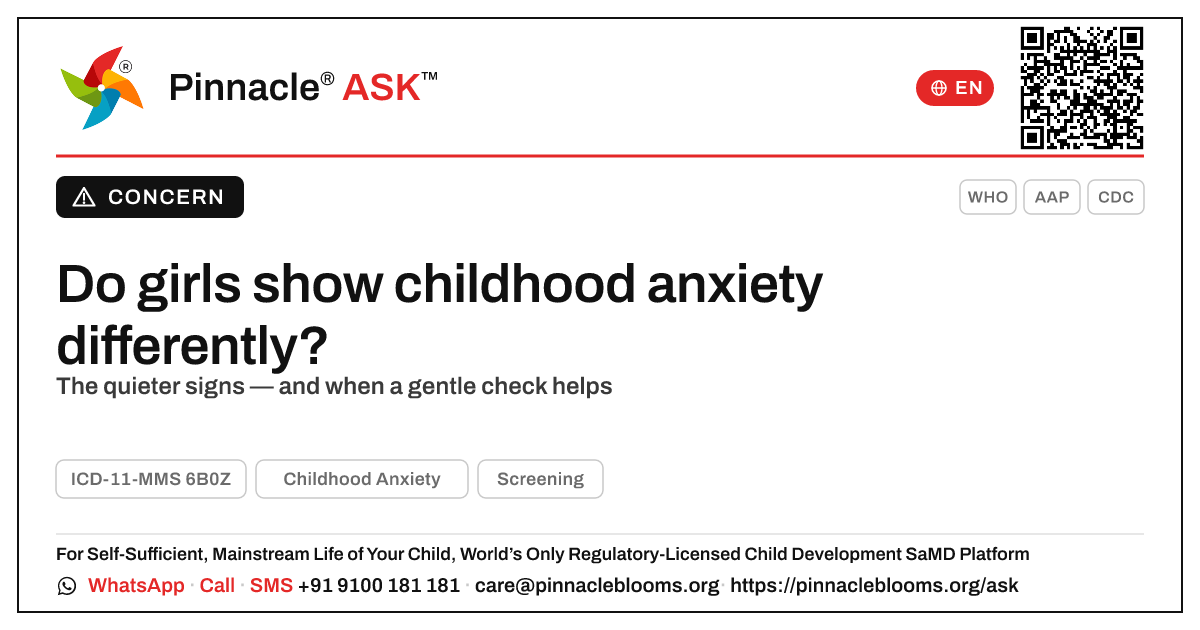
Do girls show childhood anxiety differently?
Yes — girls more often internalise anxiety: physical complaints, perfectionism, people-pleasing and meltdowns only at home, so their distress is easily missed behind 'good behaviour'. The presentation differs but the anxiety is just as real. Only a clinician can confirm it.
In this answer 5 sections
If your daughter seems calm at school but unravels at home, you are not imagining it — anxiety in girls can wear a quieter mask.
In short
Yes, childhood anxiety can look different in girls — though every child is an individual. Girls more often turn anxiety inward: clinginess, tummy aches and headaches with no medical cause, perfectionism, people-pleasing, over-apologising, or holding it together all day and melting down once they are home and feel safe. Because many girls stay outwardly polite and high-achieving, their distress is more easily missed. The feeling, not the presentation, is what matters — and worry that persists deserves a gentle check.
What this can look like
Common ways anxiety may show in girls:
- Body signals — recurring stomachaches, headaches, nausea or trouble sleeping, especially before school or social events
- The "good girl" cover — perfectionism, fear of mistakes, excessive reassurance-seeking, difficulty saying no
- Inward turning — quiet withdrawal, overthinking, ruminating on friendships, or sudden tearfulness at home after a composed day
- Social worry — dread of being judged, avoiding raising her hand, or clinging to one safe friend
Boys more often externalise — irritability, restlessness, defiance — so a worried, well-behaved girl can fly under the radar. The presentation differs; the underlying anxiety is just as real and just as treatable.
When to seek a check
Reach out if the worry lasts beyond a few weeks, shows up across settings (home and school), causes physical symptoms, or starts shrinking her world — avoiding school, friends or activities she once enjoyed. These patterns respond very well to the right support, and early steps make the biggest difference.
The Pinnacle way
No diagnosis is ever made from an online form — Developmental measurement supports care planning; diagnosis requires an appropriately qualified healthcare professional., under a qualified clinician's care. There, the focus is your daughter's own AbilityScore® baseline and a warm, practical plan — often involving child behavioural and emotional therapy — to help her feel safe, confident and herself again.
Trusted sources
WHO ICD-11 (anxiety and fear-related disorders); American Academy of Pediatrics guidance on childhood anxiety; CDC child mental-health resources; Pinnacle Blooms Network clinical studies.
Next step — If the worry keeps returning, the kindest move is to check. Book a developmental and emotional assessment with a Pinnacle clinician.
This is general information, not a diagnosis — individual assessment and diagnosis require an appropriately qualified healthcare professional.
CONNECT THE ANSWER TO YOUR CHILD’S DAY
Something to notice. Something to discuss.
What to notice
Seek a check if worry lasts beyond a few weeks, shows up at both home and school, causes physical symptoms, or makes her avoid school, friends or activities she once enjoyed.
In everyday life
Name feelings out loud together: 'It sounds like your tummy hurts when you think about the spelling test.' Linking body to feeling, without rushing to fix it, helps an anxious girl feel understood and safe.
Bring your observations and questions to your child’s professional. Choose activities that suit your child’s comfort, abilities and agreed plan.
Bring your questions to a first visitQuestions families ask
Why is anxiety harder to spot in girls?
Girls more often internalise — staying polite, high-achieving and outwardly calm while worry builds inside. They may hold it together all day, then melt down at home where they feel safe. Because the behaviour looks 'good', the distress is easily overlooked.
Are tummy aches and headaches a sign of anxiety?
They can be. Recurring stomachaches or headaches with no medical cause, especially before school or social events, are a common way anxiety shows up in the body in girls. A check helps rule out medical causes and understand the pattern.
When should I seek help for my daughter's worry?
Reach out if the worry lasts beyond a few weeks, appears at both home and school, causes physical symptoms, or starts shrinking her world. These patterns respond very well to early support.
FOLLOW THE SOURCE
References behind this answer.
- Organisation website · further readingWHO ICD-11 — anxiety and fear-related disorders
- Organisation website · further readingAmerican Academy of Pediatrics — childhood anxiety guidance
- Organisation website · further readingCDC — children's mental health
References are supplied with this answer. An organisation homepage offers further reading; it does not establish an independent review of this page.
Content attribution: SETU Consortium · Pinnacle Blooms Network.
PEOPLE, TOPICS & DEVELOPMENT
See the connections.
Browse the wider question collections connected with this answer’s audience, developmental area and stage.
FROM UNDERSTANDING TO PURPOSEFUL SUPPORT
One question. Your child’s whole life.
Your child’s self-sufficient, mainstream-included life is the purpose from the beginning. At Pinnacle, that purpose shapes what we understand, the goals we choose, the people we bring together, everyday practice and review.
Connect this question with the right support.
Start with your child’s strengths, your observations and what you want everyday life to become.
Make the next conversation useful.
Bring the situations you notice at home or school. We’ll explain a suitable service, centre and first visit, including availability and fees, before you decide.
How PinnacleAI® connects the journeyExplore the seven stages
- 1Understand abilities
A starting picture of your child’s capabilities.
- 2Choose meaningful goals
Readiness and a plan shaped around the child.
- 3Bring the right support together
Suitable therapies and people for those goals.
- 4Carry practice into everyday life
Guidance for family, home and school.
- 5Track and correct
Use observations to adjust the plan.
- 6Reassess and review
Decide what to continue, change or do next.
- 7Grow independence and participation
The child’s life gives each step its purpose.
Explore the whole PinnacleAI® system → · Participation at school and in the community →
PINNACLE’S EVIDENCE, OPEN TO YOU
Look at the evidence behind our work.
Read our research, inspect the original regulatory documents and check what each institutional measure means.
General information supports a conversation with an appropriately qualified professional. Advice, goals and support depend on the individual child.