
YOUR QUESTION. A CLEARER NEXT STEP.
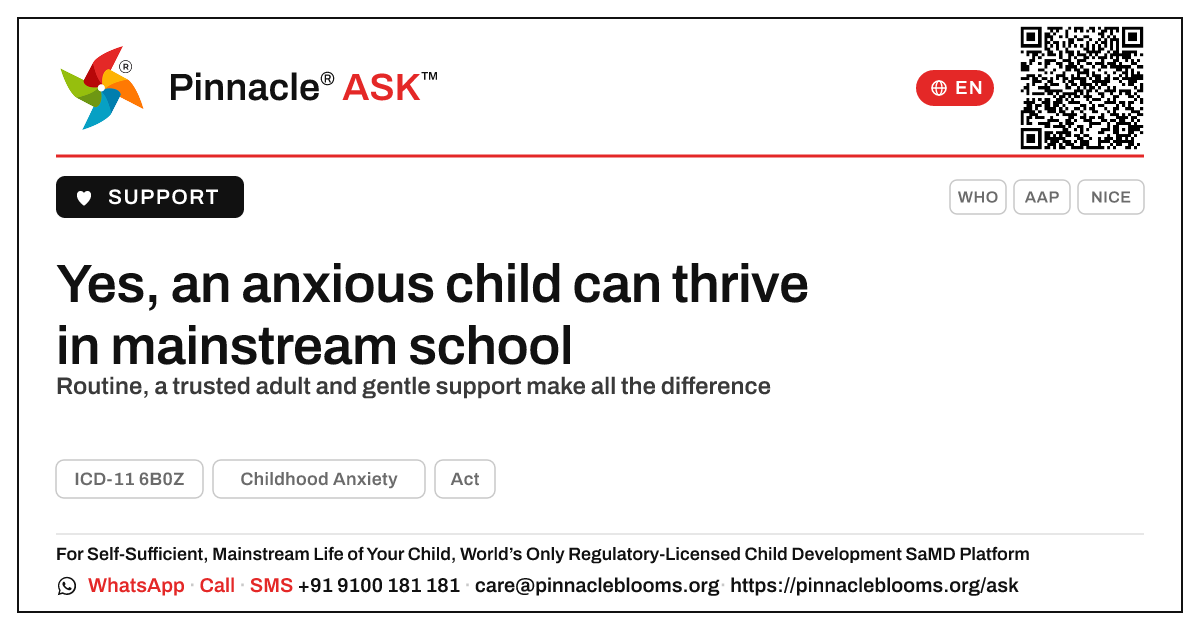
Can a child with childhood anxiety attend mainstream school?
Yes — most children with anxiety attend mainstream school successfully. Anxiety affects how a child feels, not their ability to learn. Predictable routines, a trusted safe adult, and gentle graded exposure help them settle and thrive; supported attendance, not avoidance, is what shrinks worry.
In this answer 4 sections
Yes — most children with anxiety thrive in a mainstream classroom, especially when worry is understood and gently supported.
In short
Absolutely — a child with childhood anxiety can attend, and flourish in, a mainstream school. Anxiety affects how a child feels, not their ability to learn alongside their peers. With a few thoughtful supports — a predictable routine, a trusted adult to turn to, and calm, gradual exposure to the things that worry them — most anxious children settle, make friends, and do well. The goal is never to remove every worry, but to help your child face the school day with growing confidence.
What helps at school
- A warm, predictable routine — knowing what comes next lowers worry far more than reassurance alone.
- A named safe adult — a teacher or counsellor your child can quietly check in with on hard mornings.
- Gentle, graded steps — letting school separations or new tasks happen in small, achievable stages rather than all at once.
- Avoiding accidental avoidance — staying home or skipping the worrying activity feels kind but quietly grows the anxiety; supported attendance shrinks it.
- A simple home–school plan so parents and teachers respond the same way.
Most school-based anxiety eases with this consistency. If worry causes frequent absence, panic, or physical symptoms most mornings, a developmental check helps shape the right support.
The Pinnacle way
Developmental measurement supports care planning; diagnosis requires an appropriately qualified healthcare professional., under qualified clinician care — never from a form or an app. Our therapists work with your child's school, building practical, child-led plans. Explore childhood anxiety support, child counselling and behavioural therapy, and how the AbilityScore® works.
Trusted sources
WHO ICD-11 (anxiety and fear-related disorders); American Academy of Pediatrics guidance on childhood anxiety and school; NICE guidance on anxiety in children and young people.
Next step — Worried about school mornings? Book a developmental check with a Pinnacle clinician and we'll build a plan with you and your child's teacher.
This is general information, not a diagnosis — individual assessment and diagnosis require an appropriately qualified healthcare professional.
CONNECT THE ANSWER TO YOUR CHILD’S DAY
Something to notice. Something to discuss.
What to notice
Frequent morning refusal, panic, or physical symptoms (tummy aches, headaches) most school days; growing avoidance of specific lessons or activities; or worry that stops your child making friends — these signal it's time for a developmental check.
In everyday life
On worried mornings, keep goodbyes short, warm and confident — a long, anxious farewell signals there's something to fear. A quick, certain 'See you at 3, you've got this' helps far more.
Bring your observations and questions to your child’s professional. Choose activities that suit your child’s comfort, abilities and agreed plan.
Bring your questions to a first visitQuestions families ask
Will school make my child's anxiety worse?
For most children, supported attendance actually reduces anxiety over time, because it gives them repeated proof that the feared situation is manageable. Staying home feels kind in the moment but tends to grow the worry. The key is the right support at school, not avoidance.
Should I tell my child's teacher about their anxiety?
Yes — a brief, honest conversation helps enormously. When a teacher knows your child may need a quiet check-in or a moment to settle, they can offer steady, consistent support, and you all respond to worries the same way.
When should I seek professional help for school anxiety?
If anxiety causes frequent absence, panic, physical symptoms most mornings, or stops your child joining in and making friends, a developmental check helps. A clinician can shape practical, school-based support tailored to your child.
FOLLOW THE SOURCE
References behind this answer.
- Source referenceWHO ICD-11: Anxiety and fear-related disorders
- Organisation website · further readingAAP HealthyChildren: childhood anxiety and school
- Organisation website · further readingNICE: anxiety in children and young people
References are supplied with this answer. An organisation homepage offers further reading; it does not establish an independent review of this page.
Content attribution: SETU Consortium · Pinnacle Blooms Network.
PEOPLE, TOPICS & DEVELOPMENT
See the connections.
Browse the wider question collections connected with this answer’s audience, developmental area and stage.
FROM UNDERSTANDING TO PURPOSEFUL SUPPORT
One question. Your child’s whole life.
Your child’s self-sufficient, mainstream-included life is the purpose from the beginning. At Pinnacle, that purpose shapes what we understand, the goals we choose, the people we bring together, everyday practice and review.
Connect this question with the right support.
Explore how the relevant service contributes to everyday abilities, then speak with us about your child.
Make the next conversation useful.
Bring the situations you notice at home or school. We’ll explain a suitable service, centre and first visit, including availability and fees, before you decide.
How PinnacleAI® connects the journeyExplore the seven stages
- 1Understand abilities
A starting picture of your child’s capabilities.
- 2Choose meaningful goals
Readiness and a plan shaped around the child.
- 3Bring the right support together
Suitable therapies and people for those goals.
- 4Carry practice into everyday life
Guidance for family, home and school.
- 5Track and correct
Use observations to adjust the plan.
- 6Reassess and review
Decide what to continue, change or do next.
- 7Grow independence and participation
The child’s life gives each step its purpose.
Explore the whole PinnacleAI® system → · Participation at school and in the community →
PINNACLE’S EVIDENCE, OPEN TO YOU
Look at the evidence behind our work.
Read our research, inspect the original regulatory documents and check what each institutional measure means.
General information supports a conversation with an appropriately qualified professional. Advice, goals and support depend on the individual child.