
YOUR QUESTION. A CLEARER NEXT STEP.
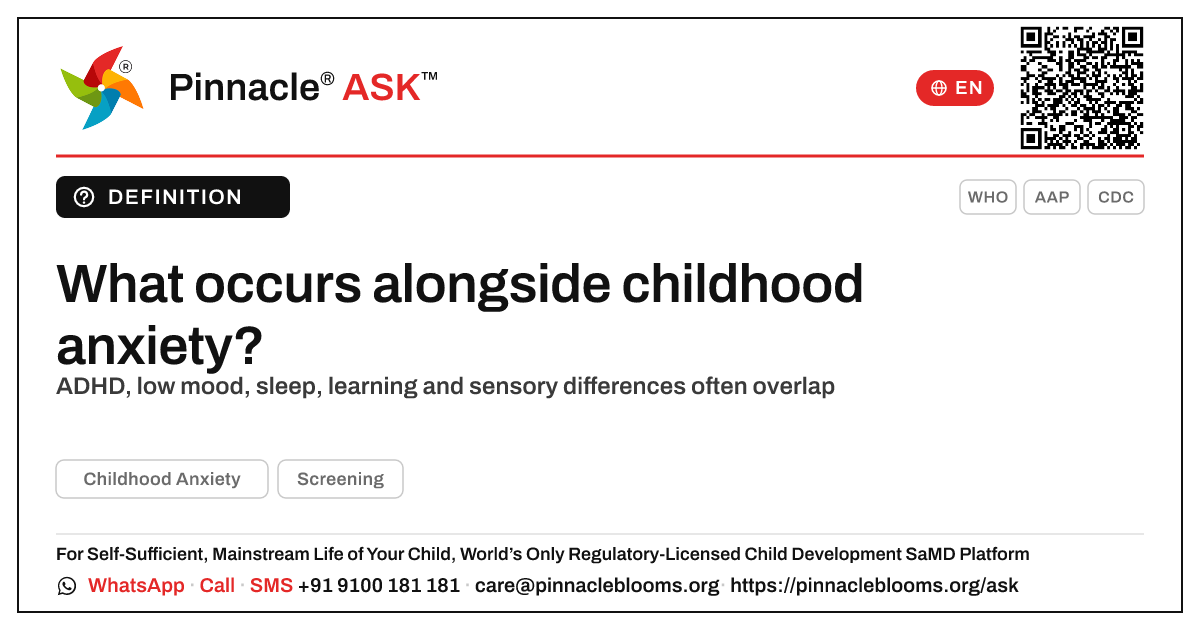
What conditions often occur alongside childhood anxiety?
Childhood anxiety frequently co-occurs with other anxiety types, ADHD, low mood or depression, sleep difficulties, learning and speech-language differences, and autism or sensory processing differences. Because these overlap so often, a whole-child review gives the clearest picture. Developmental measurement supports care planning; diagnosis requires an appropriately qualified healthcare professional.
In this answer 5 sections
Anxiety rarely travels alone — and knowing its companions helps you support the whole child, not just the worry.
In short
Childhood anxiety often appears alongside other conditions rather than on its own. The most common companions are other anxiety types (separation, social, generalised), ADHD, depression or low mood, sleep difficulties, and learning or speech-language differences. It also frequently overlaps with autism and sensory processing differences. None of this is cause for alarm — it simply means a careful, whole-child look gives the clearest picture and the most useful support plan.
What commonly occurs alongside
- Another anxiety type — a child anxious about separation may also have social fears; anxiety types cluster together.
- ADHD — restlessness and difficulty focusing can sit alongside worry, and sometimes the anxiety is partly a response to daily struggles with attention.
- Low mood or depression — especially in older children, when ongoing anxiety wears them down.
- Sleep problems — trouble falling asleep, night waking and bedtime fears are very common partners.
- Speech, language or learning differences — a child who finds communication or schoolwork hard may carry extra worry about it.
- Autism and sensory differences — anxiety is frequently heightened by changes in routine or sensory overwhelm.
Because these overlap so often, anxiety in one area is best understood by looking gently across a child's whole development — not in isolation.
When to seek a closer look
If worry is persistent across settings (home, school, play), interferes with sleep, friendships or learning, or shows up alongside any of the patterns above, a structured developmental review helps untangle what is driving what — so support targets the right things.
The Pinnacle way
Developmental measurement supports care planning; diagnosis requires an appropriately qualified healthcare professional., under qualified clinician care — never from an online form or app. A structured, clinician-administered review looks across communication, learning, emotion and sensory processing together, so overlapping conditions are seen clearly. Explore more about childhood anxiety, how behavioural therapy supports anxious children, and what the AbilityScore is and how it is formed.
Trusted sources
WHO ICD-11 framework for childhood mental and behavioural conditions; American Academy of Pediatrics guidance on childhood anxiety and co-occurring conditions; CDC children's mental health resources.
Next step — Curious whether your child's worry overlaps with anything else? A Pinnacle clinician can take a clear, whole-child look.
This is general information, not a diagnosis — individual assessment and diagnosis require an appropriately qualified healthcare professional.
CONNECT THE ANSWER TO YOUR CHILD’S DAY
Something to notice. Something to discuss.
What to notice
Worry that persists across home, school and play, disrupts sleep, friendships or learning, or appears alongside attention difficulties, low mood, or strong reactions to routine and sensory changes.
In everyday life
Keep a simple two-week note of when worry shows up — bedtime, school, new places — and what else you notice (focus, mood, sleep). Patterns across settings are exactly what a clinician finds most useful.
Bring your observations and questions to your child’s professional. Choose activities that suit your child’s comfort, abilities and agreed plan.
Bring your questions to a first visitQuestions families ask
Does childhood anxiety usually occur with other conditions?
Quite often, yes. Anxiety commonly appears alongside other anxiety types, ADHD, low mood, sleep difficulties, learning or speech-language differences, and sometimes autism or sensory processing differences. This is normal and simply means a whole-child look gives the clearest picture.
Can anxiety and ADHD happen together?
Yes. Restlessness and difficulty focusing can sit alongside worry, and sometimes anxiety partly grows from the daily challenges of managing attention. A clinician can help tell which patterns are driving which.
Should I worry if my child has more than one of these?
No — overlap is common and very manageable. Identifying all the pieces simply helps support target the right things. A structured, clinician-administered review at a Pinnacle centre untangles what is happening.
FOLLOW THE SOURCE
References behind this answer.
- Organisation website · further readingWHO ICD-11 classification framework
- Organisation website · further readingAAP HealthyChildren — childhood anxiety guidance
- Organisation website · further readingCDC children's mental health resources
References are supplied with this answer. An organisation homepage offers further reading; it does not establish an independent review of this page.
Content attribution: SETU Consortium · Pinnacle Blooms Network.
PEOPLE, TOPICS & DEVELOPMENT
See the connections.
Browse the wider question collections connected with this answer’s audience, developmental area and stage.
FROM UNDERSTANDING TO PURPOSEFUL SUPPORT
One question. Your child’s whole life.
Your child’s self-sufficient, mainstream-included life is the purpose from the beginning. At Pinnacle, that purpose shapes what we understand, the goals we choose, the people we bring together, everyday practice and review.
Connect this question with the right support.
Start with your child’s strengths, your observations and what you want everyday life to become.
Make the next conversation useful.
Bring the situations you notice at home or school. We’ll explain a suitable service, centre and first visit, including availability and fees, before you decide.
How PinnacleAI® connects the journeyExplore the seven stages
- 1Understand abilities
A starting picture of your child’s capabilities.
- 2Choose meaningful goals
Readiness and a plan shaped around the child.
- 3Bring the right support together
Suitable therapies and people for those goals.
- 4Carry practice into everyday life
Guidance for family, home and school.
- 5Track and correct
Use observations to adjust the plan.
- 6Reassess and review
Decide what to continue, change or do next.
- 7Grow independence and participation
The child’s life gives each step its purpose.
Explore the whole PinnacleAI® system → · Participation at school and in the community →
PINNACLE’S EVIDENCE, OPEN TO YOU
Look at the evidence behind our work.
Read our research, inspect the original regulatory documents and check what each institutional measure means.
General information supports a conversation with an appropriately qualified professional. Advice, goals and support depend on the individual child.