
YOUR QUESTION. A CLEARER NEXT STEP.
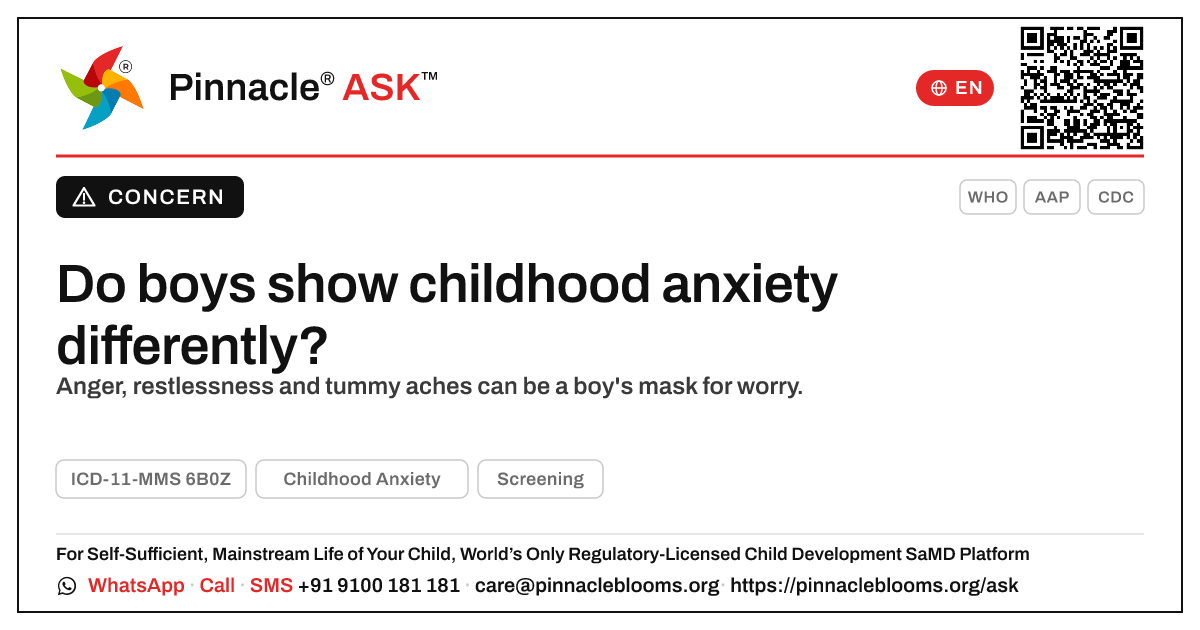
Do boys show childhood anxiety differently?
Anxiety in boys often shows as anger, restlessness, physical complaints or avoidance rather than visible fear — the feeling is the same, the signal differs. A persistent pattern over weeks is worth checking. Only a Pinnacle clinician can assess; this is not a diagnosis.
In this answer 5 sections
You've noticed something in your son — maybe not tears, but a temper, a clinginess, a stomach ache before school. Anxiety in boys can wear a different mask.
In short
Yes — anxiety often looks different in boys, though the underlying feeling is the same. Where worry in some children shows as visible fear or tearfulness, in many boys it surfaces as irritability, anger, restlessness, physical complaints (tummy aches, headaches), avoidance, or sudden refusal to do things. The emotion is identical; the outward signal differs. Childhood anxiety is treatable at any presentation — and noticing it is the first kind step.
How anxiety can present differently
Many boys are gently socialised away from saying "I'm scared," so the anxiety leaks out sideways. Things worth gently watching:
- Anger over fear — meltdowns, short fuse or defiance that appear before stressful situations rather than obvious worry
- Physical symptoms — recurring stomach aches, headaches or trouble sleeping with no medical cause
- Avoidance disguised as "I don't want to" — dodging school, parties, sport or new places
- Restlessness and fidgeting — which can look like inattention but is really nervous energy
- Reassurance-seeking or sudden clinginess in a child who was previously independent
A single nervous phase is ordinary childhood. A pattern that lasts weeks, distresses your child, or shrinks his world — that is the flag worth checking. Remember: these are observations, never a self-diagnosis.
When to seek a check
Consider an assessment if worry or its disguises persist most days for several weeks, interfere with school, friendships or sleep, or if your son seems unusually angry, withdrawn or unwell with no physical cause. Earlier support means simpler, gentler help.
The Pinnacle way
A clinical AbilityScore® and any diagnosis are formed only at a Pinnacle Blooms Network centre, under qualified clinician care — never from an online form or a checklist. Our clinicians look at the whole child, rule out other causes first, and build a plan around your son's strengths through child counselling and emotional support. Worry, met early, becomes a child who feels safe again — and that is always the goal. Start by understanding how we help.
Trusted sources
WHO ICD-11 (anxiety and fear-related disorders, 6B0Z); American Academy of Pediatrics guidance on childhood anxiety via healthychildren.org; CDC children's mental health resources. All paraphrased for parents.
Next step — The kindest thing to do with a worry is to check it. Book a developmental and emotional check with a Pinnacle clinician.
This is general information, not a diagnosis — individual assessment and diagnosis require an appropriately qualified healthcare professional.
CONNECT THE ANSWER TO YOUR CHILD’S DAY
Something to notice. Something to discuss.
What to notice
Seek a check sooner if your son shows anger, withdrawal or physical complaints (stomach aches, headaches) most days for several weeks, avoids school or friends, or seems unwell with no medical cause.
In everyday life
Name feelings out loud during calm moments: "That looked frustrating — sometimes big feelings sit in our tummy." Giving boys words for worry, without forcing it, helps the feeling come out as words instead of anger.
Bring your observations and questions to your child’s professional. Choose activities that suit your child’s comfort, abilities and agreed plan.
Bring your questions to a first visitQuestions families ask
Is anxiety really more common in boys, or just hidden?
Both can be true. Anxiety is sometimes under-recognised in boys because it shows as anger, restlessness or physical complaints rather than obvious fear — so it gets missed rather than being absent. Noticing the disguise is the first step to helping.
My son gets angry before school — could that be anxiety?
It can be. Anger and irritability before a stressful event are common ways anxiety surfaces in boys. A short-lived phase is normal, but anger that recurs and shrinks his world is worth a gentle clinical check.
Will my son grow out of it on his own?
Some worries pass naturally. But anxiety that persists for weeks, distresses your child or affects school and sleep tends to respond best to early, gentle support rather than waiting. A clinician can tell you which it is.
FOLLOW THE SOURCE
References behind this answer.
- Organisation website · further readingWHO ICD-11 — anxiety and fear-related disorders
- Organisation website · further readingAAP healthychildren.org — childhood anxiety guidance
- Organisation website · further readingCDC — children's mental health
References are supplied with this answer. An organisation homepage offers further reading; it does not establish an independent review of this page.
Content attribution: SETU Consortium · Pinnacle Blooms Network.
PEOPLE, TOPICS & DEVELOPMENT
See the connections.
Browse the wider question collections connected with this answer’s audience, developmental area and stage.
FROM UNDERSTANDING TO PURPOSEFUL SUPPORT
One question. Your child’s whole life.
Your child’s self-sufficient, mainstream-included life is the purpose from the beginning. At Pinnacle, that purpose shapes what we understand, the goals we choose, the people we bring together, everyday practice and review.
Connect this question with the right support.
Start with your child’s strengths, your observations and what you want everyday life to become.
Make the next conversation useful.
Bring the situations you notice at home or school. We’ll explain a suitable service, centre and first visit, including availability and fees, before you decide.
How PinnacleAI® connects the journeyExplore the seven stages
- 1Understand abilities
A starting picture of your child’s capabilities.
- 2Choose meaningful goals
Readiness and a plan shaped around the child.
- 3Bring the right support together
Suitable therapies and people for those goals.
- 4Carry practice into everyday life
Guidance for family, home and school.
- 5Track and correct
Use observations to adjust the plan.
- 6Reassess and review
Decide what to continue, change or do next.
- 7Grow independence and participation
The child’s life gives each step its purpose.
Explore the whole PinnacleAI® system → · Participation at school and in the community →
PINNACLE’S EVIDENCE, OPEN TO YOU
Look at the evidence behind our work.
Read our research, inspect the original regulatory documents and check what each institutional measure means.
General information supports a conversation with an appropriately qualified professional. Advice, goals and support depend on the individual child.