
YOUR QUESTION. A CLEARER NEXT STEP.
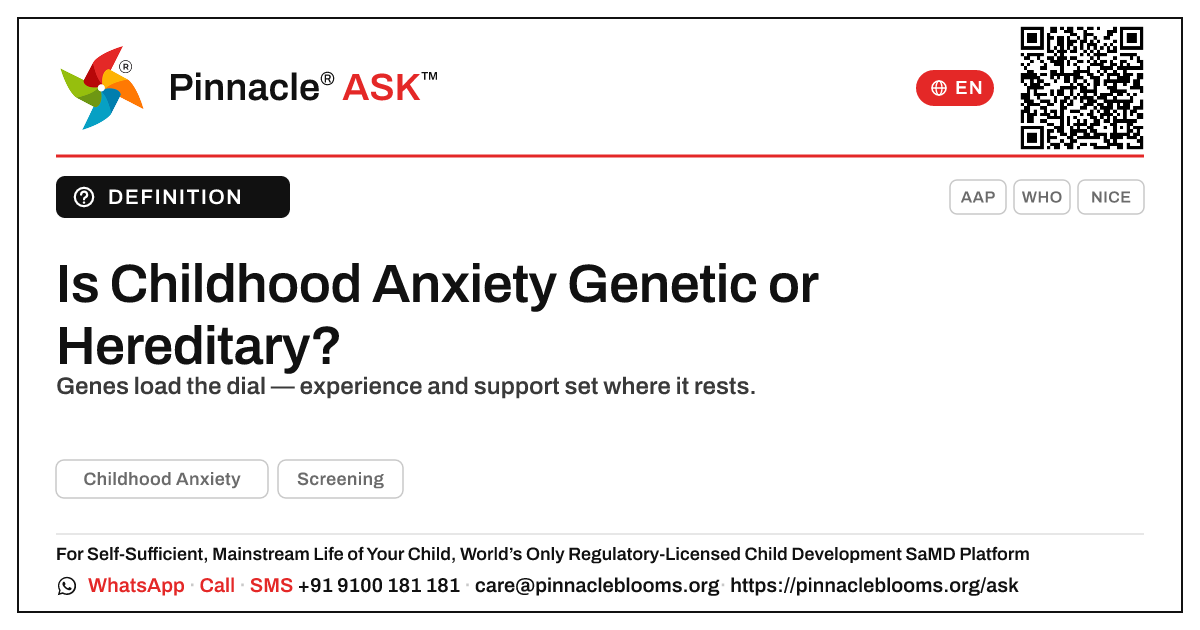
Is Childhood Anxiety Genetic or Hereditary?
Childhood anxiety has a moderate genetic component — about a third of the picture — so it runs in families but is not purely inherited. Temperament, learned responses and environment matter just as much, which means anxiety responds well to support. Developmental measurement supports care planning; diagnosis requires an appropriately qualified healthcare professional., under clinician care.
In this answer 5 sections
Many parents who live with their own worry quietly wonder: did I pass this on to my child? The honest, reassuring answer is that genes are only part of the story.
In short
Childhood anxiety does run in families — children with an anxious parent are somewhat more likely to be anxious themselves — but it is not simply inherited like eye colour. Research suggests genes account for roughly a third of the picture; the rest is shaped by temperament, learned responses, life experiences and the home environment. That means your child's anxiety is never your fault, and — crucially — it is highly responsive to support and learning.
What the science actually says
Twin and family studies show that anxiety has a moderate genetic component — a child may inherit a more sensitive, cautious temperament rather than "an anxiety disorder" itself. What turns that sensitivity into lasting anxiety usually involves environment: stressful events, modelled worry, over-protection, or big life changes. The encouraging flip-side is that the same environmental levers work for a child too. Calm, predictable routines, gentle exposure to feared situations, and warm coaching in naming feelings genuinely reduce anxiety — regardless of family history. Genes load the dial; experience and support set where it rests.
When to seek help
Reach out for a developmental check if worry is intense or daily, stops your child sleeping, eating, attending school or playing with friends, shows up as tummy aches or headaches with no medical cause, or has lasted several weeks and isn't easing. A family history of anxiety is a good reason to act earlier rather than wait — not to be alarmed.
The Pinnacle way
A clinical AbilityScore® and any diagnosis are formed only at a Pinnacle Blooms Network centre, under qualified clinician care — never from an online form or a family-history hunch. From there your family receives a clear baseline and a practical plan. Explore more about childhood anxiety and how child counselling and therapy build calm, confident coping skills.
Trusted sources
American Academy of Pediatrics (healthychildren.org) on childhood anxiety and family factors; WHO ICD-11 framing of anxiety in children; NICE guidance on anxiety in children and young people.
Next step — A short, friendly screening can show where your child stands today — book a Pinnacle developmental check.
This is general information, not a diagnosis — individual assessment and diagnosis require an appropriately qualified healthcare professional.
CONNECT THE ANSWER TO YOUR CHILD’S DAY
Something to notice. Something to discuss.
What to notice
Worry that is intense or daily, disrupts sleep, eating, school or play, shows as unexplained tummy aches or headaches, or persists for several weeks without easing — especially if anxiety runs in your family.
In everyday life
Name feelings out loud and model calm: "I feel a bit nervous too, and here's what helps me." Children learn to manage worry by watching how the adults they love handle it.
Bring your observations and questions to your child’s professional. Choose activities that suit your child’s comfort, abilities and agreed plan.
Bring your questions to a first visitQuestions families ask
If I have anxiety, will my child definitely be anxious too?
No. A family history raises the likelihood somewhat, but it is far from a certainty. Genes contribute roughly a third of the picture, and the calm routines, gentle exposure and emotional coaching you provide can strongly shift the outcome in your child's favour.
Can a child outgrow anxiety, or is it permanent?
Childhood anxiety is one of the most responsive areas of development. With the right support — predictable routines, gradual practice facing fears, and skills to name and manage feelings — many children learn to cope so well that worry no longer holds them back.
Should I get my child checked just because anxiety runs in our family?
A family history is a good reason to act earlier rather than wait, not a reason to be alarmed. If worry is interfering with sleep, school, eating or friendships, a friendly developmental check can clarify where your child stands and what would help most.
FOLLOW THE SOURCE
References behind this answer.
- Source referenceAAP HealthyChildren — Anxiety in children
- Organisation website · further readingWHO ICD-11 — anxiety classification
- Organisation website · further readingNICE — anxiety in children and young people
References are supplied with this answer. An organisation homepage offers further reading; it does not establish an independent review of this page.
Content attribution: SETU Consortium · Pinnacle Blooms Network.
PEOPLE, TOPICS & DEVELOPMENT
See the connections.
Browse the wider question collections connected with this answer’s audience, developmental area and stage.
FROM UNDERSTANDING TO PURPOSEFUL SUPPORT
One question. Your child’s whole life.
Your child’s self-sufficient, mainstream-included life is the purpose from the beginning. At Pinnacle, that purpose shapes what we understand, the goals we choose, the people we bring together, everyday practice and review.
Connect this question with the right support.
Start with your child’s strengths, your observations and what you want everyday life to become.
Make the next conversation useful.
Bring the situations you notice at home or school. We’ll explain a suitable service, centre and first visit, including availability and fees, before you decide.
How PinnacleAI® connects the journeyExplore the seven stages
- 1Understand abilities
A starting picture of your child’s capabilities.
- 2Choose meaningful goals
Readiness and a plan shaped around the child.
- 3Bring the right support together
Suitable therapies and people for those goals.
- 4Carry practice into everyday life
Guidance for family, home and school.
- 5Track and correct
Use observations to adjust the plan.
- 6Reassess and review
Decide what to continue, change or do next.
- 7Grow independence and participation
The child’s life gives each step its purpose.
Explore the whole PinnacleAI® system → · Participation at school and in the community →
PINNACLE’S EVIDENCE, OPEN TO YOU
Look at the evidence behind our work.
Read our research, inspect the original regulatory documents and check what each institutional measure means.
General information supports a conversation with an appropriately qualified professional. Advice, goals and support depend on the individual child.