
YOUR QUESTION. A CLEARER NEXT STEP.
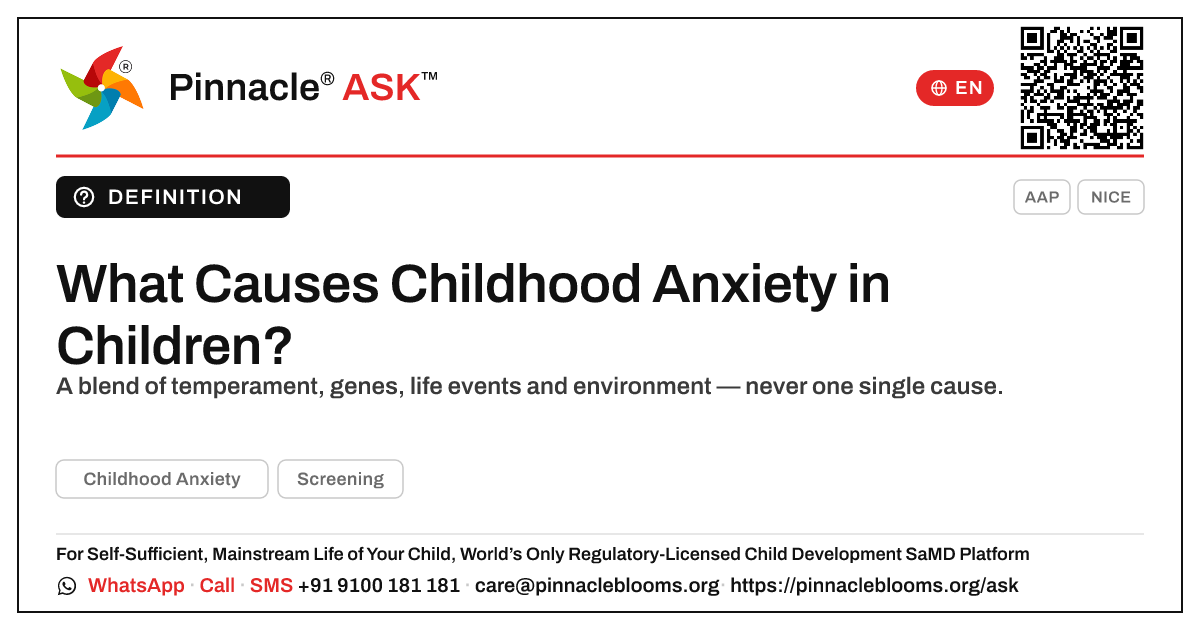
What causes childhood anxiety in children?
Childhood anxiety rarely has one cause. It grows from a blend of temperament, genetics, life events, learned patterns and developmental differences — not from any single parenting mistake. Any clinical assessment and diagnosis are formed only at a Pinnacle Blooms Network centre under qualified clinician care.
In this answer 5 sections
When a child worries more than seems usual, parents often ask one quiet question: what made this happen — and was it something we did? The honest answer is reassuring.
In short
Childhood anxiety almost never has a single cause. It usually grows from a blend of temperament, genetics, life experiences and environment working together — not from any one mistake a parent made. Some children are simply born more cautious or sensitive, and when that meets stress, big changes, or a worry they cannot yet name, anxiety can take hold. The good news: with understanding and the right support, anxious children learn to feel safe and capable again.
What contributes to childhood anxiety
Think of it as several threads woven together rather than one root cause:
- Temperament — some children are naturally more cautious, shy or quick to feel overwhelmed; this is a trait, not a fault.
- Family history — anxiety often runs in families, so a child may inherit a tendency to worry more easily.
- Life events and stress — a new school, a house move, family illness, a frightening experience, or loss can all spark anxious feelings.
- Learned patterns — children watch how the adults around them handle worry, and they absorb those responses.
- Communication and developmental differences — when a child struggles to express needs or process the world (for example with speech, sensory or social differences), everyday situations can feel harder and more anxiety-provoking.
None of these guarantee anxiety, and many anxious children have loving, steady homes. Anxiety is a signal that a child needs support to feel safe — not evidence of poor parenting.
When to seek support
Gentle worries are part of growing up. Reach out for a developmental check when anxiety is frequent, intense, lasts for weeks, or stops your child from doing everyday things — sleeping, eating, going to school, playing or separating from you. Early, warm support makes a real difference and prevents small worries from growing.
The Pinnacle way
A clinical AbilityScore® and any diagnosis are formed only at a Pinnacle Blooms Network centre, under qualified clinician care — never from an online form or an app. Our clinicians look at the whole child — emotional regulation, communication, sensory processing and daily life — to understand what is feeding the worry and how to ease it. Explore more on childhood anxiety and how behavioural and emotional therapy gently builds a child's sense of safety and confidence.
Trusted sources
Guidance from the American Academy of Pediatrics (healthychildren.org) and NICE on anxiety in children describes it as arising from interacting genetic, temperamental and environmental factors, and emphasises early, supportive intervention.
Next step — Worried about your child's anxiety? Book a developmental screen with a Pinnacle clinician to understand what's behind it.
This is general information, not a diagnosis — individual assessment and diagnosis require an appropriately qualified healthcare professional.
CONNECT THE ANSWER TO YOUR CHILD’S DAY
Something to notice. Something to discuss.
What to notice
Watch for worry that is frequent, intense, lasts for weeks, or stops everyday life — trouble sleeping, eating, separating from you, or going to school.
In everyday life
Name the feeling calmly with your child — 'It looks like your tummy feels worried' — and stay close rather than rushing to fix it. Feeling understood is what helps a worry settle.
Bring your observations and questions to your child’s professional. Choose activities that suit your child’s comfort, abilities and agreed plan.
Bring your questions to a first visitQuestions families ask
Is childhood anxiety caused by bad parenting?
No. Anxiety grows from a mix of temperament, genetics, life events and environment. Many anxious children come from warm, steady homes — anxiety is a signal that a child needs support to feel safe, not evidence of a parenting mistake.
Can anxiety run in families?
Yes. A tendency to worry more easily can be inherited, so anxiety often appears across family members. Having the trait does not mean a child will definitely develop an anxiety problem — support and environment matter a great deal.
When should I seek help for my child's anxiety?
Reach out when worry is frequent, intense, lasts for weeks, or stops your child from sleeping, eating, going to school, playing or separating from you. Early, warm support helps prevent small worries from growing.
FOLLOW THE SOURCE
References behind this answer.
- Organisation website · further readingAAP HealthyChildren — anxiety in children
- Organisation website · further readingNICE — anxiety guidance for children and young people
References are supplied with this answer. An organisation homepage offers further reading; it does not establish an independent review of this page.
Content attribution: SETU Consortium · Pinnacle Blooms Network.
PEOPLE, TOPICS & DEVELOPMENT
See the connections.
Browse the wider question collections connected with this answer’s audience, developmental area and stage.
FROM UNDERSTANDING TO PURPOSEFUL SUPPORT
One question. Your child’s whole life.
Your child’s self-sufficient, mainstream-included life is the purpose from the beginning. At Pinnacle, that purpose shapes what we understand, the goals we choose, the people we bring together, everyday practice and review.
Connect this question with the right support.
Start with your child’s strengths, your observations and what you want everyday life to become.
Make the next conversation useful.
Bring the situations you notice at home or school. We’ll explain a suitable service, centre and first visit, including availability and fees, before you decide.
How PinnacleAI® connects the journeyExplore the seven stages
- 1Understand abilities
A starting picture of your child’s capabilities.
- 2Choose meaningful goals
Readiness and a plan shaped around the child.
- 3Bring the right support together
Suitable therapies and people for those goals.
- 4Carry practice into everyday life
Guidance for family, home and school.
- 5Track and correct
Use observations to adjust the plan.
- 6Reassess and review
Decide what to continue, change or do next.
- 7Grow independence and participation
The child’s life gives each step its purpose.
Explore the whole PinnacleAI® system → · Participation at school and in the community →
PINNACLE’S EVIDENCE, OPEN TO YOU
Look at the evidence behind our work.
Read our research, inspect the original regulatory documents and check what each institutional measure means.
General information supports a conversation with an appropriately qualified professional. Advice, goals and support depend on the individual child.