
YOUR QUESTION. A CLEARER NEXT STEP.
When to worry about feeding selectivity in your 3-year-old
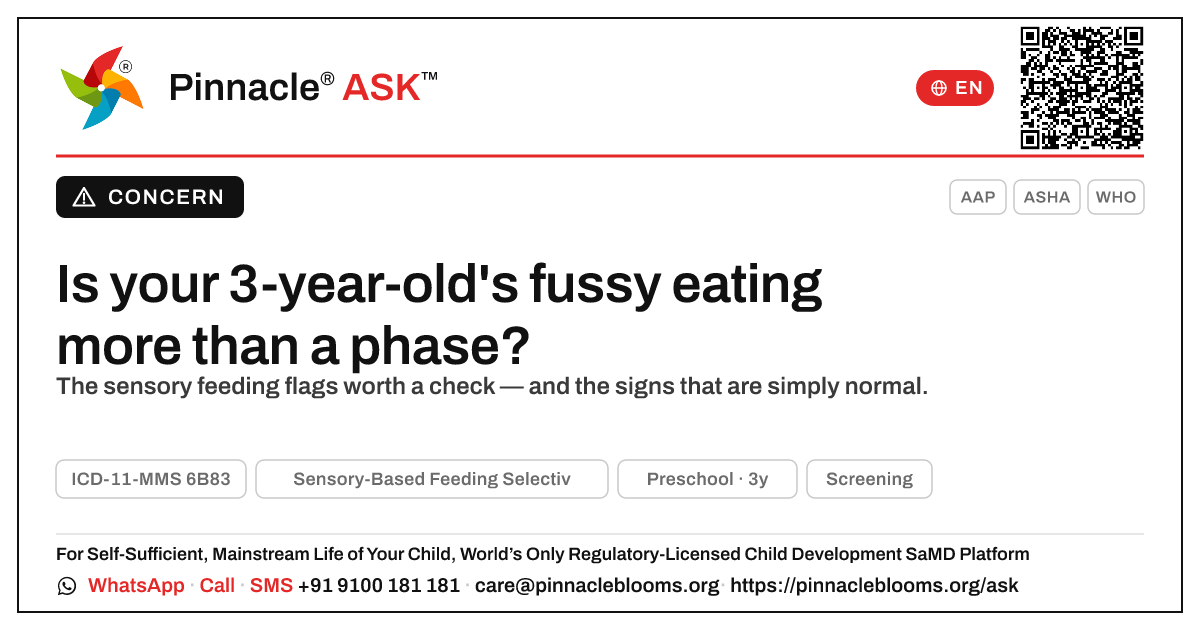
Most 3-year-olds have fussy, narrow-eating phases that pass. It is worth a check when selectivity is driven by the senses (textures, smells, colours, appearance) rather than simple preference, and when it persists, sharply narrows the diet, or affects growth, nutrition or family life. This is a reason to assess early, not a diagnosis — gentle early support works best.
In this answer 5 sections
If mealtimes with your 3-year-old feel like a daily negotiation, your watchfulness is already a loving form of care.
In short
Most 3-year-olds go through fussy, narrow-eating phases — this is a normal part of growing up and usually passes. It becomes worth a clinician's eye when the selectivity is driven by the senses (textures, smells, colours, the look or sound of food) rather than simple preference, and when it persists, narrows the diet sharply, or affects your child's growth, nutrition or family life. Noticing this is not a diagnosis — it simply means a developmental and feeding check is wise now, because gentle early support works best.
What to watch at age 3
Sensory-based feeding selectivity is more than picky eating — it is when a child's nervous system finds certain food qualities genuinely distressing. Gentle flags worth reviewing include:
- Very few accepted foods — a steadily shrinking list (often under ~20 foods), with no new foods added for months, or whole food groups refused.
- Strong sensory reactions — gagging, retching, distress or refusal at the texture, smell, colour or appearance of food, not just the taste.
- Rigid food rules — only one brand, one shape, one colour; food not touching; foods rejected if the recipe or packaging changes.
- Mealtime distress — crying, tantrums, leaving the table, or significant family stress around every meal.
- Impact on the child — poor weight gain, low energy, frequent constipation, or reliance on supplements or milk for most nutrition.
A short-lived phase that still allows a reasonably varied, growing diet is usually nothing to worry about. The combination of strong sensory aversion plus a narrowing diet plus impact on growth or daily life is the pattern that deserves a professional look.
When to seek a check
Arrange a developmental and feeding review if several of these persist beyond a few months, if the diet is shrinking rather than slowly widening, if growth or energy is affected — or simply if mealtimes have become a source of real worry. Parent instinct is good clinical information.
The Pinnacle way
A clinical AbilityScore® and any diagnosis are formed only at a Pinnacle Blooms Network centre, under qualified clinician care — never from an online list. Our clinicians look at why your child eats the way they do, building a picture of their sensory profile and feeding skills before shaping playful, pressure-free support. You can learn more about sensory-based feeding selectivity and how our occupational therapy team gently widens a child's comfort with food.
Trusted sources
WHO ICD-11 framing of feeding difficulties in childhood; American Academy of Pediatrics (healthychildren.org) guidance on picky eating and when to seek help; ASHA resources on paediatric feeding and swallowing differences.
Next step — Trust what you've noticed at the table. Book a developmental and feeding assessment with a Pinnacle clinician so your child's eating is understood with clarity and care.
This is general information, not a diagnosis — individual assessment and diagnosis require an appropriately qualified healthcare professional.
CONNECT THE ANSWER TO YOUR CHILD’S DAY
Something to notice. Something to discuss.
What to notice
Seek a feeding and developmental check if your 3-year-old accepts very few foods (and the list is shrinking), gags or is distressed by the texture, smell, colour or look of food, follows rigid food rules, has high mealtime distress, or shows poor weight gain, low energy or reliance on milk and supplements for most nutrition — especially if several of these persist beyond a few months.
In everyday life
Keep a simple one-week food log of everything your child accepts, plus any foods that trigger gagging or upset. Offer new foods playfully alongside familiar favourites with zero pressure to eat — just to touch, smell or see. This calm record and approach help both you and any clinician spot real patterns.
Bring your observations and questions to your child’s professional. Choose activities that suit your child’s comfort, abilities and agreed plan.
Bring your questions to a first visitQuestions families ask
Is my 3-year-old just being a picky eater?
Very likely — narrow, fussy eating is a normal stage at this age and usually passes. The difference with sensory-based feeding selectivity is that food qualities like texture, smell, colour or appearance cause genuine distress, the diet keeps shrinking, and it affects growth or family life. If you see that pattern, a check is wise.
How many foods should a 3-year-old eat?
There is no fixed number, but a steadily shrinking list — or refusing whole food groups for months with no new foods added — is more concerning than a child who happily eats a modest but slowly widening range. A clinician looks at the trend and the nutrition, not just a count.
Will my child grow out of it?
Many short-lived fussy phases do resolve on their own. When the selectivity is sensory-driven and persistent, gentle professional support helps far more than waiting — and it is never about forcing food, but about slowly building comfort and confidence around eating.
Should I force my child to eat new foods?
No — pressure usually increases distress and narrows the diet further. Offering new foods playfully, with no expectation to eat, and letting your child explore by touching or smelling first, is far kinder and more effective. A clinician can guide this step by step.
FOLLOW THE SOURCE
References behind this answer.
- Organisation website · further readingAAP guidance on picky eating and when to seek help (healthychildren.org)
- Organisation website · further readingASHA on paediatric feeding and swallowing
- Organisation website · further readingWHO ICD-11 on feeding difficulties in childhood
References are supplied with this answer. An organisation homepage offers further reading; it does not establish an independent review of this page.
Content attribution: SETU Consortium · Pinnacle Blooms Network.
PEOPLE, TOPICS & DEVELOPMENT
See the connections.
Browse the wider question collections connected with this answer’s audience, developmental area and stage.
FROM UNDERSTANDING TO PURPOSEFUL SUPPORT
One question. Your child’s whole life.
Your child’s self-sufficient, mainstream-included life is the purpose from the beginning. At Pinnacle, that purpose shapes what we understand, the goals we choose, the people we bring together, everyday practice and review.
Connect this question with the right support.
Explore how the relevant service contributes to everyday abilities, then speak with us about your child.
Make the next conversation useful.
Bring the situations you notice at home or school. We’ll explain a suitable service, centre and first visit, including availability and fees, before you decide.
How PinnacleAI® connects the journeyExplore the seven stages
- 1Understand abilities
A starting picture of your child’s capabilities.
- 2Choose meaningful goals
Readiness and a plan shaped around the child.
- 3Bring the right support together
Suitable therapies and people for those goals.
- 4Carry practice into everyday life
Guidance for family, home and school.
- 5Track and correct
Use observations to adjust the plan.
- 6Reassess and review
Decide what to continue, change or do next.
- 7Grow independence and participation
The child’s life gives each step its purpose.
Explore the whole PinnacleAI® system → · Participation at school and in the community →
PINNACLE’S EVIDENCE, OPEN TO YOU
Look at the evidence behind our work.
Read our research, inspect the original regulatory documents and check what each institutional measure means.
General information supports a conversation with an appropriately qualified professional. Advice, goals and support depend on the individual child.