
YOUR QUESTION. A CLEARER NEXT STEP.
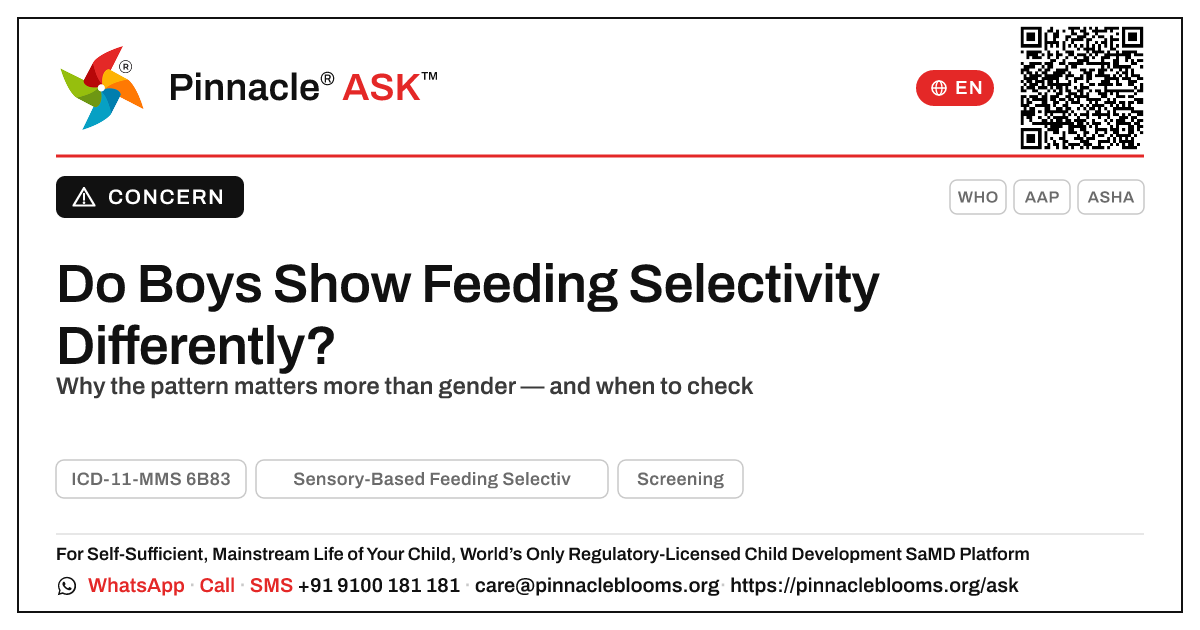
Do Boys Show Sensory-Based Feeding Selectivity Differently?
Sensory-based feeding selectivity can affect any child. Boys are sometimes identified more often, but this likely reflects referral patterns, not a real gender rule. Watch the pattern — a shrinking food list, distress or growth concerns — not your child's sex. Only a Pinnacle clinician can assess.
In this answer 5 sections
If you've noticed your son turning his nose up at most foods, you're not imagining it — and you're not alone in wondering whether boys do this differently.
In short
Sensory-based feeding selectivity — strong, persistent avoidance of foods because of their texture, smell, look or temperature — can affect any child, regardless of sex. Some studies note feeding and sensory differences are identified slightly more often in boys, but this likely reflects how often boys are referred and assessed rather than a true gender rule. What matters far more than your child's sex is the pattern: how restricted the diet is, whether it's affecting growth or family mealtimes, and whether it's getting tighter over time.
What this actually looks like
Sensory-based selectivity is usually less about stubbornness and more about a nervous system that finds certain food sensations genuinely overwhelming. In children of any sex, you may notice:
- Texture is the dealbreaker — accepting crunchy but refusing mushy (or vice versa), gagging at mixed textures
- A shrinking 'safe list' — relying on the same handful of foods, often beige and dry
- Strong reactions to smell or appearance — refusing a food before it touches the lips
- Distress, not defiance — real anxiety at new foods, not simple bargaining
Where apparent gender differences show up, it is often because boys are referred earlier when feeding overlaps with other developmental concerns, while girls' selectivity can be quieter and missed. So the honest answer is: trust the behaviour in front of you, not a statistic about boys.
When to seek a check
Reach out if the food list is shrinking rather than growing, if mealtimes are causing real distress, if you see weight or growth concerns, or if selectivity continues well past the toddler years. Early support is gentle and effective.
The Pinnacle way
No diagnosis or AbilityScore® is ever made from an online answer — a clinical assessment is formed only at a Pinnacle Blooms Network centre, under qualified clinician care. Our feeding and occupational therapy teams look at your child's sensory profile, not a gender label, and build a step-by-step plan that grows the safe-food list without battles. Start anytime at Pinnacle Blooms Network.
Trusted sources
WHO ICD-11 framework for feeding and eating disorders; American Academy of Pediatrics guidance on selective eating; American Speech-Language-Hearing Association resources on paediatric feeding; Pinnacle Blooms Network clinical studies.
Next step — If feeding feels like a daily struggle, the kindest move is to check. Book a feeding and sensory assessment with a Pinnacle clinician.
This is general information, not a diagnosis — individual assessment and diagnosis require an appropriately qualified healthcare professional.
CONNECT THE ANSWER TO YOUR CHILD’S DAY
Something to notice. Something to discuss.
What to notice
Seek a check if the safe-food list is shrinking rather than growing, if mealtimes cause genuine distress, if you notice weight or growth concerns, or if selectivity persists well beyond the toddler years.
In everyday life
Offer one new food beside a trusted favourite, with zero pressure to eat it — just to see, smell or touch. Repeated calm exposure, not insistence, is how nervous systems slowly learn a food is safe.
Bring your observations and questions to your child’s professional. Choose activities that suit your child’s comfort, abilities and agreed plan.
Bring your questions to a first visitQuestions families ask
Are boys more likely to be picky eaters than girls?
Sensory-based selectivity can affect any child. Some studies identify it slightly more often in boys, but this often reflects how frequently boys are referred and assessed rather than a true gender difference. The pattern of avoidance matters far more than your child's sex.
Is sensory feeding selectivity the same as being fussy?
Not quite. Sensory-based selectivity is usually driven by a nervous system that finds certain textures, smells or appearances genuinely overwhelming — it tends to be distress, not defiance. A clinician can help tell the difference.
When should I worry about my son's eating?
Reach out if his safe-food list is shrinking, if mealtimes cause real distress, if there are growth or weight concerns, or if selectivity continues well past the toddler years. Early support is gentle and effective.
FOLLOW THE SOURCE
References behind this answer.
- Organisation website · further readingWHO ICD-11 — feeding and eating disorders
- Organisation website · further readingAAP HealthyChildren — selective eating in children
- Organisation website · further readingASHA — paediatric feeding and swallowing
References are supplied with this answer. An organisation homepage offers further reading; it does not establish an independent review of this page.
Content attribution: SETU Consortium · Pinnacle Blooms Network.
PEOPLE, TOPICS & DEVELOPMENT
See the connections.
Browse the wider question collections connected with this answer’s audience, developmental area and stage.
FROM UNDERSTANDING TO PURPOSEFUL SUPPORT
One question. Your child’s whole life.
Your child’s self-sufficient, mainstream-included life is the purpose from the beginning. At Pinnacle, that purpose shapes what we understand, the goals we choose, the people we bring together, everyday practice and review.
Connect this question with the right support.
Explore how the relevant service contributes to everyday abilities, then speak with us about your child.
Make the next conversation useful.
Bring the situations you notice at home or school. We’ll explain a suitable service, centre and first visit, including availability and fees, before you decide.
How PinnacleAI® connects the journeyExplore the seven stages
- 1Understand abilities
A starting picture of your child’s capabilities.
- 2Choose meaningful goals
Readiness and a plan shaped around the child.
- 3Bring the right support together
Suitable therapies and people for those goals.
- 4Carry practice into everyday life
Guidance for family, home and school.
- 5Track and correct
Use observations to adjust the plan.
- 6Reassess and review
Decide what to continue, change or do next.
- 7Grow independence and participation
The child’s life gives each step its purpose.
Explore the whole PinnacleAI® system → · Participation at school and in the community →
PINNACLE’S EVIDENCE, OPEN TO YOU
Look at the evidence behind our work.
Read our research, inspect the original regulatory documents and check what each institutional measure means.
General information supports a conversation with an appropriately qualified professional. Advice, goals and support depend on the individual child.