
YOUR QUESTION. A CLEARER NEXT STEP.
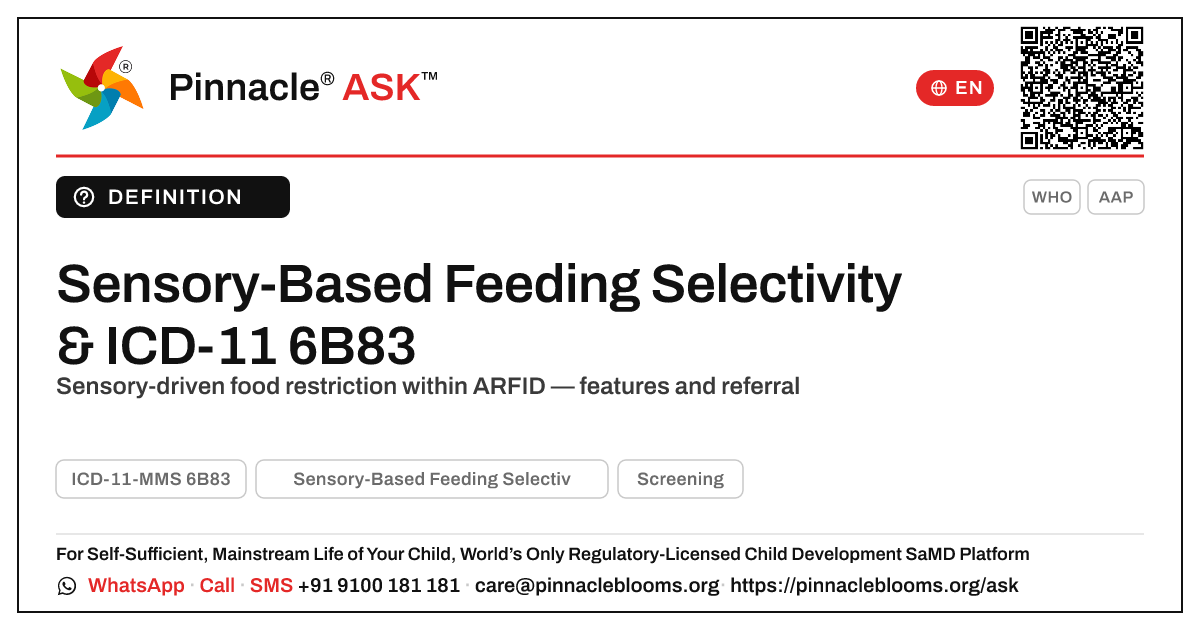
Sensory-Based Feeding Selectivity: ICD-11 Features
Sensory-Based Feeding Selectivity is persistent food restriction driven by aversive sensory responses to texture, taste, smell or appearance. ICD-11 captures it within ARFID (6B83); early-childhood features include narrowed intake, sensory-based avoidance, and consequences such as faltering growth, nutritional deficiency or supplement dependence, not explained by illness or weight concerns.
In this answer 4 sections
A toddler who gags at certain textures or eats only a handful of foods is often dismissed as "fussy" — but a recognisable clinical pattern may sit underneath.
In short
Sensory-Based Feeding Selectivity describes a persistent restriction of food intake driven by aversive sensory responses — to texture, taste, smell, temperature or appearance — rather than by appetite, medical illness or food unavailability. In ICD-11 it is captured within Avoidant-Restrictive Food Intake Disorder (ARFID, 6B83), where the sensory-characteristics presentation is one recognised driver of avoidance. It is distinguished from ordinary developmental neophobia by its persistence, narrowness and functional impact.
The science, briefly
Under ICD-11 6B83, the clinical features in early childhood include: a markedly restricted range or volume of intake; avoidance based on sensory features of food; and resulting consequences — faltering growth or weight, nutritional deficiency, dependence on supplements, or significant interference with feeding, family routine and psychosocial functioning. Critically, the avoidance is not explained by lack of food, a culturally sanctioned practice, a concurrent medical condition, or by weight-and-shape concerns (which would point to other eating disorders). Sensory over-responsivity frequently co-occurs with neurodevelopmental conditions, so a feeding history is rarely isolated. Differentiate from transient picky eating, oral-motor dysphagia, and post-traumatic food refusal.
The Pinnacle way
Developmental measurement supports care planning; diagnosis requires an appropriately qualified healthcare professional., under qualified clinician care — never from an online form. Our integrated feeding and sensory pathway pairs structured assessment with occupational therapy, and the clinician-administered AbilityScore® tracks functional change across feeding, sensory and self-care domains.
Trusted sources
WHO ICD-11 Mortality and Morbidity Statistics (6B83, Avoidant-Restrictive Food Intake Disorder); American Academy of Pediatrics guidance on early feeding and growth.
Next step — Refer a child with persistent sensory-driven food restriction for structured feeding assessment.
This is general information, not a diagnosis — individual assessment and diagnosis require an appropriately qualified healthcare professional.
CONNECT THE ANSWER TO YOUR CHILD’S DAY
Something to notice. Something to discuss.
What to notice
Markedly narrow food range, avoidance tied to texture/smell/appearance, gagging on new foods, mealtime distress, faltering growth or nutritional gaps persisting beyond ordinary toddler fussiness.
In everyday life
Note which sensory properties trigger refusal — wet versus dry, smooth versus lumpy, temperature — as this history sharpens differentiation from oral-motor dysphagia.
Bring your observations and questions to your child’s professional. Choose activities that suit your child’s comfort, abilities and agreed plan.
Bring your questions to a first visitQuestions families ask
How is Sensory-Based Feeding Selectivity classified in ICD-11?
It is captured within Avoidant-Restrictive Food Intake Disorder (ARFID, 6B83), where avoidance based on the sensory characteristics of food is a recognised driver of restricted intake.
How does it differ from ordinary picky eating?
Developmental neophobia is transient and limited in impact. Sensory-Based Feeding Selectivity is persistent and narrow, with functional consequences such as faltering growth, nutritional deficiency or supplement dependence.
What must be excluded before attributing food restriction to this pattern?
Lack of available food, culturally sanctioned practices, a concurrent medical condition, oral-motor dysphagia, and weight-or-shape concerns characteristic of other eating disorders.
FOLLOW THE SOURCE
References behind this answer.
- Organisation website · further readingWHO ICD-11 MMS — Avoidant-Restrictive Food Intake Disorder
- Organisation website · further readingAmerican Academy of Pediatrics — early feeding and growth
References are supplied with this answer. An organisation homepage offers further reading; it does not establish an independent review of this page.
Content attribution: SETU Consortium · Pinnacle Blooms Network.
PEOPLE, TOPICS & DEVELOPMENT
See the connections.
Browse the wider question collections connected with this answer’s audience, developmental area and stage.
FROM UNDERSTANDING TO PURPOSEFUL SUPPORT
One question. Your child’s whole life.
Your child’s self-sufficient, mainstream-included life is the purpose from the beginning. At Pinnacle, that purpose shapes what we understand, the goals we choose, the people we bring together, everyday practice and review.
Connect this question with the right support.
Explore how the relevant service contributes to everyday abilities, then speak with us about your child.
Make the next conversation useful.
Bring the situations you notice at home or school. We’ll explain a suitable service, centre and first visit, including availability and fees, before you decide.
How PinnacleAI® connects the journeyExplore the seven stages
- 1Understand abilities
A starting picture of your child’s capabilities.
- 2Choose meaningful goals
Readiness and a plan shaped around the child.
- 3Bring the right support together
Suitable therapies and people for those goals.
- 4Carry practice into everyday life
Guidance for family, home and school.
- 5Track and correct
Use observations to adjust the plan.
- 6Reassess and review
Decide what to continue, change or do next.
- 7Grow independence and participation
The child’s life gives each step its purpose.
Explore the whole PinnacleAI® system → · Participation at school and in the community →
PINNACLE’S EVIDENCE, OPEN TO YOU
Look at the evidence behind our work.
Read our research, inspect the original regulatory documents and check what each institutional measure means.
General information supports a conversation with an appropriately qualified professional. Advice, goals and support depend on the individual child.