
YOUR QUESTION. A CLEARER NEXT STEP.
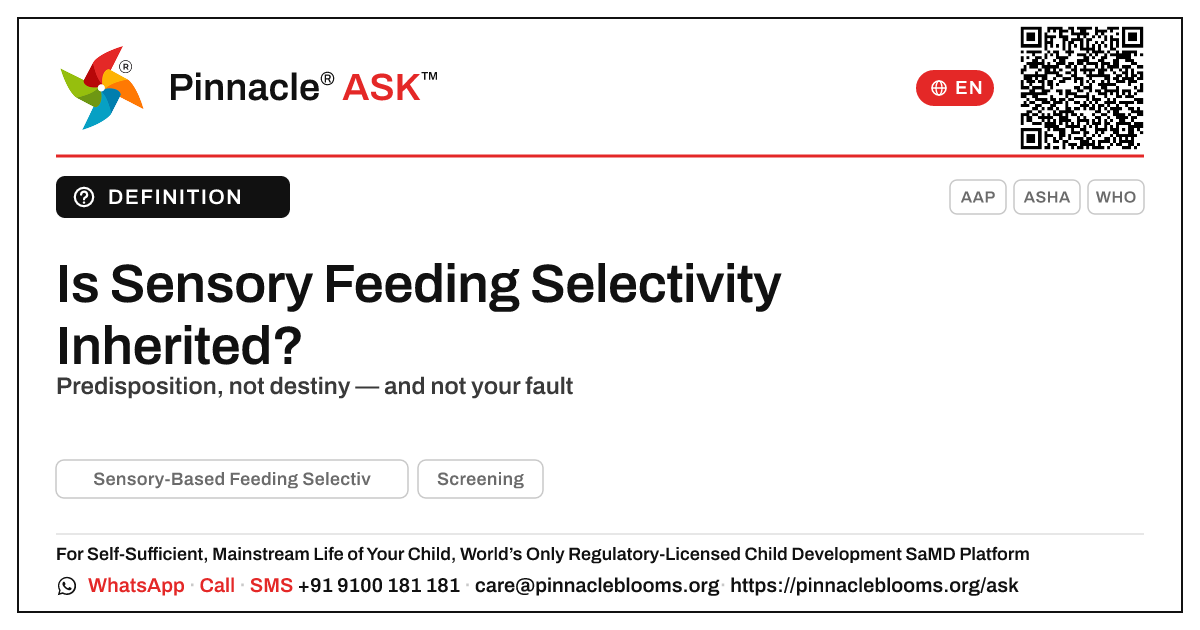
Is Sensory-Based Feeding Selectivity Genetic or Hereditary?
Sensory-Based Feeding Selectivity is not a single inherited disease. A child's inborn sensory temperament has a heritable component, but feeding selectivity arises from a mix of temperament, early experiences and sometimes co-occurring conditions — predisposition, not destiny. It responds well to support.
In this answer 5 sections
"Did my child inherit this, or did I do something wrong?" — neither answer is the whole story, and the honest one is kinder than you might expect.
In short
Sensory-Based Feeding Selectivity is not a single inherited disease passed down like eye colour, and it is not caused by anything you did. It usually emerges from a mix of influences — a child's inborn sensory temperament (how strongly they react to taste, smell, texture and sight), early feeding experiences, and sometimes a co-occurring developmental or medical picture. Family patterns can make a child more likely to be a sensitive eater, but "more likely" is not destiny — and feeding selectivity responds very well to the right support.
What the science actually says
Think of it as predisposition, not prediction. Several threads come together:
- Temperament and sensory sensitivity have a real heritable component — sensitive parents often have sensitive children. A child may be born noticing textures, smells and temperatures more intensely than peers, which narrows what feels "safe" to eat.
- Experience shapes the rest — a difficult early feed, reflux, an aversive choking moment, or limited exposure to varied textures can all steer a child toward a narrow, predictable menu.
- It can travel alongside autism, sensory processing differences, or oral-motor difficulties — in which case the feeding pattern is part of a wider profile rather than a stand-alone inherited trait.
So if a parent or sibling was a famously fussy eater, your child carrying a similar tendency is unsurprising — but it tells you about likelihood and support needs, not a fixed outcome.
When to seek a developmental check
Look closer if your child eats fewer than ~15–20 foods, drops foods without replacing them, gags or distresses at whole food groups, or if mealtimes are consistently stressful for the family. These are reasons to observe and assess — never to panic.
The Pinnacle way
A clinical AbilityScore® and any diagnosis are formed only at a Pinnacle Blooms Network centre, under qualified clinician care — never from a web page or a family history alone. Our team looks at the whole child — sensory profile, oral-motor skills and mealtime patterns together — to build a plan that gently widens what your child will accept. Explore Sensory-Based Feeding Selectivity, how occupational therapy supports sensory feeding, and what the AbilityScore is and how it is calculated.
Trusted sources
American Academy of Pediatrics guidance on feeding and sensory development (healthychildren.org); American Speech-Language-Hearing Association resources on paediatric feeding (asha.org); WHO frameworks on early childhood functioning.
Next step — Curious where your child's eating sits today? Book a developmental check with a Pinnacle clinician.
This is general information, not a diagnosis — individual assessment and diagnosis require an appropriately qualified healthcare professional.
CONNECT THE ANSWER TO YOUR CHILD’S DAY
Something to notice. Something to discuss.
What to notice
Fewer than ~15–20 accepted foods, dropping foods without replacing them, gagging or distress at whole food groups, or consistently stressful mealtimes — reasons to seek a developmental check.
In everyday life
Offer a new food beside a familiar 'safe' one with zero pressure to eat it. Repeated calm exposure — even just touching or smelling — builds acceptance far better than coaxing or bargaining.
Bring your observations and questions to your child’s professional. Choose activities that suit your child’s comfort, abilities and agreed plan.
Bring your questions to a first visitQuestions families ask
If I was a fussy eater as a child, will my child be too?
Possibly more likely, but not certainly. Sensory sensitivity has a heritable component, so a sensitive parent often has a sensitive child — yet experience and support strongly shape the outcome. A family history simply means it is worth watching gently, not a fixed verdict.
Did I cause my child's feeding selectivity?
No. This pattern is not caused by parenting mistakes. It usually reflects a child's inborn sensory temperament combined with early feeding experiences, and sometimes a wider developmental picture. The helpful question is not what caused it, but what support will widen what your child happily eats.
Is sensory feeding selectivity always linked to autism?
No. It can occur on its own in otherwise typically developing children. It can also travel alongside autism, sensory processing differences or oral-motor difficulties. A clinician-led assessment helps tell which picture fits your child.
FOLLOW THE SOURCE
References behind this answer.
- Organisation website · further readingAAP — feeding & sensory development (healthychildren.org)
- Organisation website · further readingASHA — paediatric feeding resources
- Organisation website · further readingWHO — early childhood functioning
References are supplied with this answer. An organisation homepage offers further reading; it does not establish an independent review of this page.
Content attribution: SETU Consortium · Pinnacle Blooms Network.
PEOPLE, TOPICS & DEVELOPMENT
See the connections.
Browse the wider question collections connected with this answer’s audience, developmental area and stage.
FROM UNDERSTANDING TO PURPOSEFUL SUPPORT
One question. Your child’s whole life.
Your child’s self-sufficient, mainstream-included life is the purpose from the beginning. At Pinnacle, that purpose shapes what we understand, the goals we choose, the people we bring together, everyday practice and review.
Connect this question with the right support.
Explore how the relevant service contributes to everyday abilities, then speak with us about your child.
Make the next conversation useful.
Bring the situations you notice at home or school. We’ll explain a suitable service, centre and first visit, including availability and fees, before you decide.
How PinnacleAI® connects the journeyExplore the seven stages
- 1Understand abilities
A starting picture of your child’s capabilities.
- 2Choose meaningful goals
Readiness and a plan shaped around the child.
- 3Bring the right support together
Suitable therapies and people for those goals.
- 4Carry practice into everyday life
Guidance for family, home and school.
- 5Track and correct
Use observations to adjust the plan.
- 6Reassess and review
Decide what to continue, change or do next.
- 7Grow independence and participation
The child’s life gives each step its purpose.
Explore the whole PinnacleAI® system → · Participation at school and in the community →
PINNACLE’S EVIDENCE, OPEN TO YOU
Look at the evidence behind our work.
Read our research, inspect the original regulatory documents and check what each institutional measure means.
General information supports a conversation with an appropriately qualified professional. Advice, goals and support depend on the individual child.