
YOUR QUESTION. A CLEARER NEXT STEP.
SNOMED CT concept for Down syndrome
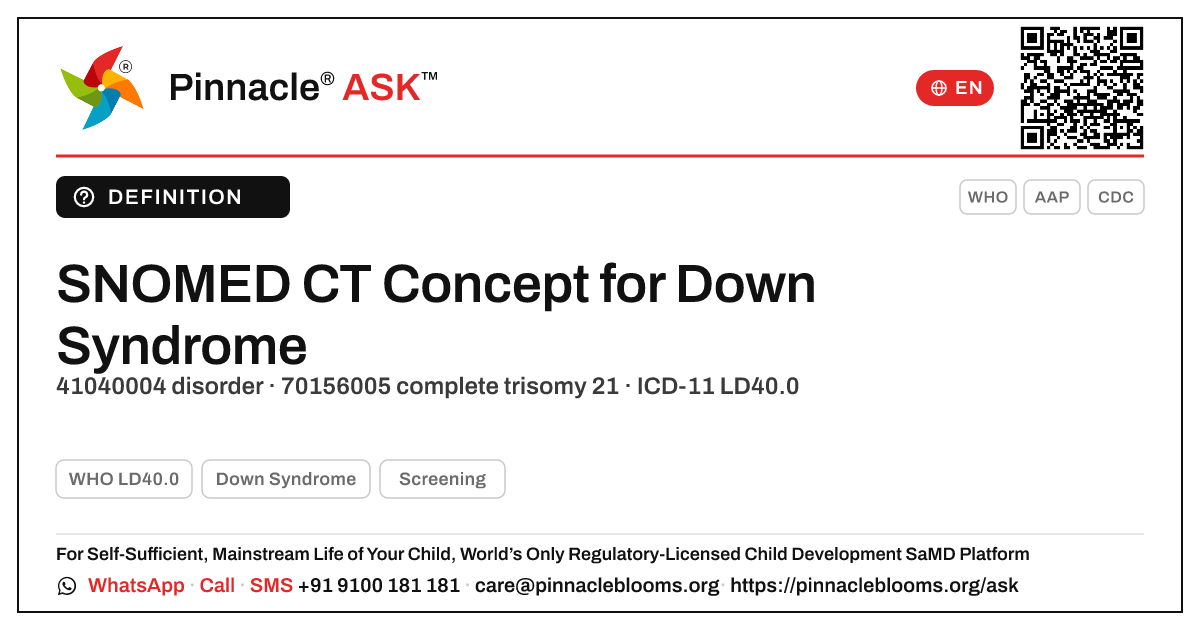
In SNOMED CT, Down syndrome maps to 41040004 | Down syndrome (disorder) |, with 70156005 for complete trisomy 21 and distinct concepts for translocation and mosaic forms. It corresponds to ICD-11 LD40.0 (Trisomy 21). SNOMED CT drives EHR problem lists and interoperability; ICD-11 serves classification — reconcile both.
In this answer 4 sections
A clean terminology crosswalk is what lets a Down syndrome diagnosis travel safely from your clinic note to the registry, the lab and the care plan.
In short
In SNOMED CT, Down syndrome maps to the fully specified concept 41040004 | Down syndrome (disorder) |, the parent concept under which the trisomy-21 variants sit. The most common form, complete trisomy 21, is represented by 70156005 | Complete trisomy 21 syndrome (disorder) |, with separate concepts for translocation and mosaic forms. For classification and morbidity coding, this corresponds to ICD-11 LD40.0 — Trisomy 21 (and to ICD-10 Q90.- ).
Mapping in practice
- 41040004 — Down syndrome (disorder) — the principal clinical concept; use as the problem-list anchor.
- 70156005 — Complete trisomy 21 syndrome — the karyotype-confirmed full trisomy.
- Translocation and mosaic trisomy 21 carry their own distinct SNOMED CT concepts; record the cytogenetically confirmed subtype where known.
- SNOMED CT (the disorder concept) and ICD-11 LD40.0 are complementary, not interchangeable — SNOMED CT drives EHR problem lists, clinical decision support and interoperability, while ICD-11 serves statistical and reimbursement classification. Always reconcile both in the record.
A practical note for the early-intervention pathway: the terminology code documents what the condition is; it does not capture functioning. Two children sharing 41040004 may differ widely across communication, motor, cognition and self-care — which is where a structured developmental profile, not the diagnostic code, guides therapy planning.
The Pinnacle way
A clinical AbilityScore® and any diagnosis are formed only at a Pinnacle Blooms Network centre, under qualified clinician care — never from a code, a form or an app. For a child with confirmed trisomy 21, our teams translate the diagnosis into a functioning-led plan spanning speech therapy and early developmental support, coordinated across our centres. Across 70+ centres, 700+ therapists and 25 million+ therapy sessions, the terminology code is simply the entry point — the developmental profile drives the work.
Trusted sources
WHO ICD-11 (LD40.0, Trisomy 21) for statistical classification; AAP / HealthyChildren.org for clinical care of children with Down syndrome; CDC developmental-milestone guidance for early monitoring. SNOMED CT concept identifiers should be verified against the current national edition release.
Next step — Confirm the diagnostic subtype cytogenetically, then refer for a functioning-led developmental assessment to anchor the care plan.
This is general information, not a diagnosis — individual assessment and diagnosis require an appropriately qualified healthcare professional.
CONNECT THE ANSWER TO YOUR CHILD’S DAY
Something to notice. Something to discuss.
What to notice
Record the cytogenetically confirmed subtype (complete, translocation or mosaic) — distinct SNOMED CT concepts apply, and the subtype carries recurrence-risk implications for counselling.
In everyday life
Anchor the problem list with the SNOMED CT disorder concept, but plan therapy from the functioning profile, not the code — children sharing one code differ widely in support needs.
Bring your observations and questions to your child’s professional. Choose activities that suit your child’s comfort, abilities and agreed plan.
Bring your questions to a first visitQuestions families ask
What is the SNOMED CT concept ID for Down syndrome?
The principal concept is 41040004 | Down syndrome (disorder) |. The full-trisomy form is 70156005 | Complete trisomy 21 syndrome (disorder) |, with separate concepts for translocation and mosaic types. Always verify against the current national edition release.
How does the SNOMED CT concept relate to ICD-11?
SNOMED CT 41040004 corresponds to ICD-11 LD40.0 (Trisomy 21). They are complementary: SNOMED CT supports EHR problem lists, decision support and interoperability, while ICD-11 serves statistical and reimbursement classification. Record both.
Does the SNOMED CT code determine therapy needs?
No. The terminology code documents the condition, not the child's functioning. Two children with the same code can differ markedly across communication, motor and cognitive domains, so therapy is planned from a structured developmental profile rather than the diagnostic code.
FOLLOW THE SOURCE
References behind this answer.
- Source referenceWHO ICD-11 — Trisomy 21
- Organisation website · further readingAAP — Care of children with Down syndrome
- Source referenceCDC — Learn the Signs. Act Early.
References are supplied with this answer. An organisation homepage offers further reading; it does not establish an independent review of this page.
Content attribution: SETU Consortium · Pinnacle Blooms Network.
PEOPLE, TOPICS & DEVELOPMENT
See the connections.
Browse the wider question collections connected with this answer’s audience, developmental area and stage.
FROM UNDERSTANDING TO PURPOSEFUL SUPPORT
One question. Your child’s whole life.
Your child’s self-sufficient, mainstream-included life is the purpose from the beginning. At Pinnacle, that purpose shapes what we understand, the goals we choose, the people we bring together, everyday practice and review.
Connect this question with the right support.
Start with your child’s strengths, your observations and what you want everyday life to become.
Make the next conversation useful.
Bring the situations you notice at home or school. We’ll explain a suitable service, centre and first visit, including availability and fees, before you decide.
How PinnacleAI® connects the journeyExplore the seven stages
- 1Understand abilities
A starting picture of your child’s capabilities.
- 2Choose meaningful goals
Readiness and a plan shaped around the child.
- 3Bring the right support together
Suitable therapies and people for those goals.
- 4Carry practice into everyday life
Guidance for family, home and school.
- 5Track and correct
Use observations to adjust the plan.
- 6Reassess and review
Decide what to continue, change or do next.
- 7Grow independence and participation
The child’s life gives each step its purpose.
Explore the whole PinnacleAI® system → · Participation at school and in the community →
PINNACLE’S EVIDENCE, OPEN TO YOU
Look at the evidence behind our work.
Read our research, inspect the original regulatory documents and check what each institutional measure means.
General information supports a conversation with an appropriately qualified professional. Advice, goals and support depend on the individual child.