
YOUR QUESTION. A CLEARER NEXT STEP.
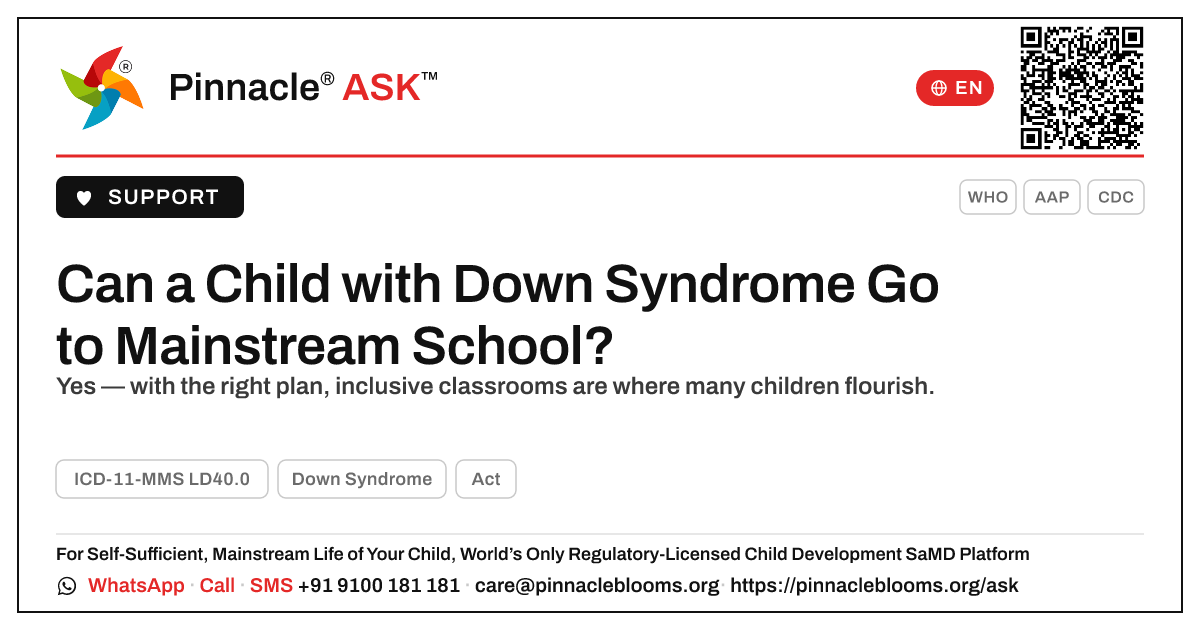
Can a Child with Down Syndrome Attend a Mainstream School?
Yes. Children with Down syndrome attend mainstream schools and often thrive there. With an individualised education plan, a coordinated team, therapy support and reasonable classroom adjustments, inclusive education works well — the key is the right scaffolding, planned early.
In this answer 4 sections
Yes — with the right support, mainstream school is not only possible but often where children with Down syndrome flourish.
In short
Absolutely. Children with Down syndrome attend mainstream schools across India and around the world, learning alongside their peers and thriving socially and academically. Inclusive education is a recognised right, and with thoughtful planning — an individualised education plan, classroom supports and a school that welcomes diversity — most children do well. The key is the right scaffolding, not a separate path by default.
What helps it work
Success usually rests on a few practical pillars:
- An individualised education plan (IEP) that sets realistic, stretching goals and reviews them regularly.
- A team around the child — teacher, parents, and therapists working from the same plan.
- Targeted therapy support — speech and language for communication, occupational therapy for fine-motor and self-care skills, so learning at school is reinforced.
- Peer relationships — inclusive classrooms benefit every child, building empathy and friendship.
- Reasonable adjustments — extra time, visual supports, simplified instructions and a patient, structured routine.
Children with Down syndrome learn at their own pace; with consistency and high expectations, they keep progressing. Early developmental support before school age makes the transition smoother.
The Pinnacle way
Developmental measurement supports care planning; diagnosis requires an appropriately qualified healthcare professional., under qualified clinician care — never from an app or a form. From there we build a school-readiness plan with your family, coordinating speech therapy and special education supports and an AbilityScore® baseline so the school team knows exactly where to begin. Learn more about Down syndrome and the journey to independence.
Trusted sources
WHO ICD-11 (developmental conditions framework); American Academy of Pediatrics guidance on health and learning for children with Down syndrome; CDC developmental milestone resources.
Next step — Talk to a Pinnacle clinician about a school-readiness plan tailored to your child.
This is general information, not a diagnosis — individual assessment and diagnosis require an appropriately qualified healthcare professional.
CONNECT THE ANSWER TO YOUR CHILD’S DAY
Something to notice. Something to discuss.
What to notice
Watch how your child responds to group routines, follows simple instructions and connects with peers — these everyday signals help the school team set the right supports.
In everyday life
Build small school-like routines at home — sitting for a short activity, packing a bag, taking turns. Familiar habits make the classroom feel safer and reduce first-day anxiety.
Bring your observations and questions to your child’s professional. Choose activities that suit your child’s comfort, abilities and agreed plan.
Bring your questions to a first visitQuestions families ask
Will my child need a special school instead?
Not by default. Many children with Down syndrome do well in mainstream settings with the right support plan. A separate school is one option among several, chosen on what suits your child best — not a foregone conclusion.
What support should I ask the school for?
Ask about an individualised education plan, reasonable adjustments like extra time and visual supports, a coordinated approach with your therapists, and a welcoming, structured classroom routine.
Does therapy still matter once school starts?
Yes. Speech, language and occupational therapy reinforce the skills your child uses in class — communication, fine-motor and self-care — so learning at school and progress in therapy support each other.
FOLLOW THE SOURCE
References behind this answer.
- Source referenceWHO ICD-11
- Organisation website · further readingAmerican Academy of Pediatrics — HealthyChildren.org
- Source referenceCDC — Learn the Signs. Act Early.
References are supplied with this answer. An organisation homepage offers further reading; it does not establish an independent review of this page.
Content attribution: SETU Consortium · Pinnacle Blooms Network.
PEOPLE, TOPICS & DEVELOPMENT
See the connections.
Browse the wider question collections connected with this answer’s audience, developmental area and stage.
FROM UNDERSTANDING TO PURPOSEFUL SUPPORT
One question. Your child’s whole life.
Your child’s self-sufficient, mainstream-included life is the purpose from the beginning. At Pinnacle, that purpose shapes what we understand, the goals we choose, the people we bring together, everyday practice and review.
Connect this question with the right support.
Explore how the relevant service contributes to everyday abilities, then speak with us about your child.
Make the next conversation useful.
Bring the situations you notice at home or school. We’ll explain a suitable service, centre and first visit, including availability and fees, before you decide.
How PinnacleAI® connects the journeyExplore the seven stages
- 1Understand abilities
A starting picture of your child’s capabilities.
- 2Choose meaningful goals
Readiness and a plan shaped around the child.
- 3Bring the right support together
Suitable therapies and people for those goals.
- 4Carry practice into everyday life
Guidance for family, home and school.
- 5Track and correct
Use observations to adjust the plan.
- 6Reassess and review
Decide what to continue, change or do next.
- 7Grow independence and participation
The child’s life gives each step its purpose.
Explore the whole PinnacleAI® system → · Participation at school and in the community →
PINNACLE’S EVIDENCE, OPEN TO YOU
Look at the evidence behind our work.
Read our research, inspect the original regulatory documents and check what each institutional measure means.
General information supports a conversation with an appropriately qualified professional. Advice, goals and support depend on the individual child.