
YOUR QUESTION. A CLEARER NEXT STEP.
ICD-11 Classification for Down Syndrome (LD40.0)
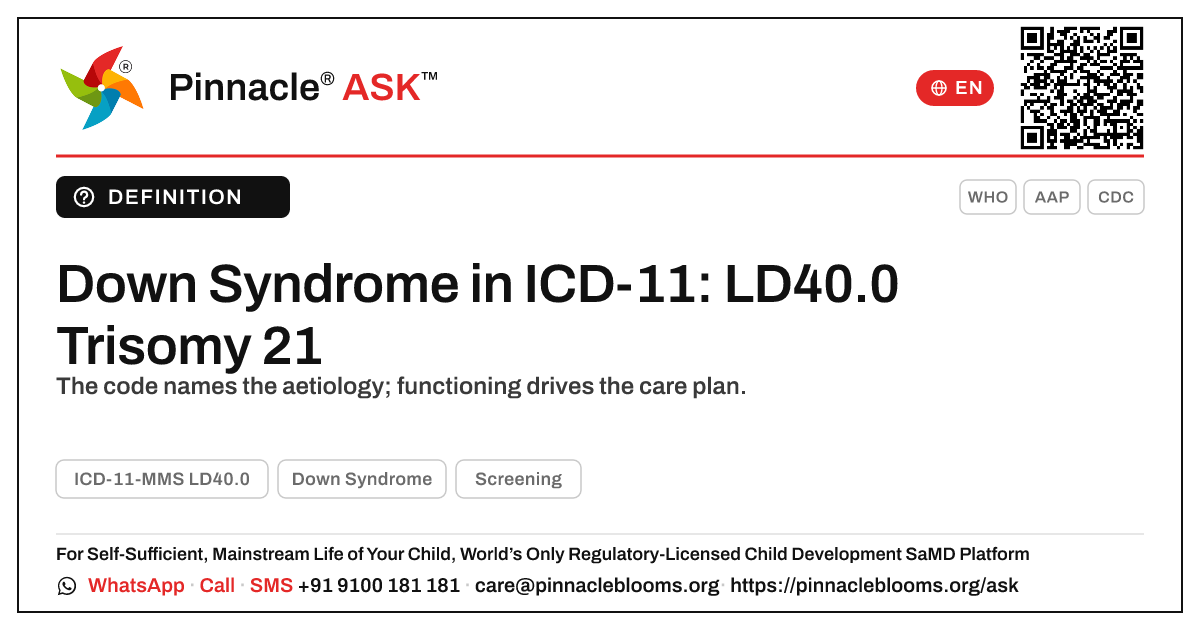
In ICD-11-MMS, Down syndrome is coded LD40.0 (Trisomy 21) under the parent LD40 Down syndrome, in the developmental anomalies chapter. The code names the chromosomal aetiology; associated intellectual, cardiac, hearing and thyroid features are coded alongside, with care driven by functioning rather than the label.
In this answer 5 sections
A precise code anchors every shared decision — here is exactly where Down syndrome sits in ICD-11.
In short
In ICD-11-MMS, Down syndrome is classified under LD40.0 — Trisomy 21, within the parent category LD40 Down syndrome in the chapter on Developmental anomalies (chromosomal abnormalities, excluding gene mutations). The code captures the underlying genetic basis — three copies of chromosome 21 — rather than a developmental label. ICD-11 then expects associated functional features (intellectual development, congenital cardiac, hearing or thyroid involvement) to be coded alongside, reflecting the WHO move toward multi-parent classification and functioning-led description.
The classification, in detail
LD40 encompasses the recognised cytogenetic variants — complete trisomy 21 (the LD40.0 stem), translocation Down syndrome and mosaic forms — so the diagnosis should be paired with the karyotype where available. ICD-11's design encourages clustering: alongside LD40.0, clinicians commonly add codes for disorders of intellectual development (6A00 spectrum) and any structural or endocrine comorbidity, because the chromosomal code alone does not convey functional status.
For a child, this distinction matters clinically: the code names the aetiology, but the care plan is driven by functioning — communication, motor, cognition, feeding, hearing and cardiac surveillance. That is where a structured developmental profile, not the ICD code, guides therapy intensity and goals.
When to act
Down syndrome is recognised at or near birth, so the pathway is early confirmation (karyotype), routine AAP/IAP surveillance for cardiac, thyroid, hearing and vision needs, and early intervention from infancy — speech, occupational and physiotherapy initiated as soon as the infant is medically stable yields the strongest developmental trajectory.
The Pinnacle way
A clinical AbilityScore® and any diagnosis are formed only at a Pinnacle Blooms Network centre, under qualified clinician care — never from a code or an online form. With 25 million+ therapy sessions and 700+ therapists across 70+ centres, our teams translate a confirmed Down syndrome diagnosis into a functioning-led plan spanning speech therapy and early developmental support. Begin with a structured developmental assessment to set the baseline.
Trusted sources
WHO ICD-11 for Mortality and Morbidity Statistics (LD40 Down syndrome, LD40.0 Trisomy 21); American Academy of Pediatrics health-supervision guidance for children with Down syndrome; CDC developmental milestone resources.
Next step — Confirm the diagnosis with your geneticist or paediatrician, then book a Pinnacle developmental assessment to start a functioning-led care plan.
This is general information, not a diagnosis — individual assessment and diagnosis require an appropriately qualified healthcare professional.
CONNECT THE ANSWER TO YOUR CHILD’S DAY
Something to notice. Something to discuss.
What to notice
Pair LD40.0 with the karyotype variant and add codes for intellectual development, congenital cardiac, hearing and thyroid involvement — the chromosomal code alone does not convey functional status.
In everyday life
When documenting, remember the ICD code names the cause; the child's care plan is driven by their functional profile across communication, motor, cognition and feeding.
Bring your observations and questions to your child’s professional. Choose activities that suit your child’s comfort, abilities and agreed plan.
Bring your questions to a first visitQuestions families ask
What is the ICD-11 code for Down syndrome?
Down syndrome is classified as LD40.0 (Trisomy 21) within the parent category LD40 Down syndrome in ICD-11-MMS, in the chapter on developmental anomalies.
Does LD40 distinguish between types of Down syndrome?
Yes. LD40 encompasses the cytogenetic variants — complete trisomy 21 (the LD40.0 stem), translocation and mosaic forms — so the code should be paired with the karyotype where available.
Should other conditions be coded alongside LD40.0?
ICD-11 encourages clustering. Clinicians commonly add codes for disorders of intellectual development and any cardiac, hearing, vision or thyroid involvement, since the chromosomal code alone does not convey functional status.
When should early intervention begin?
As soon as the infant is medically stable. Early speech, occupational and physiotherapy from infancy supports the strongest developmental trajectory, alongside routine AAP/IAP surveillance.
FOLLOW THE SOURCE
References behind this answer.
- Source referenceWHO ICD-11 for Mortality and Morbidity Statistics
- Organisation website · further readingAmerican Academy of Pediatrics — HealthyChildren.org
- Source referenceCDC — Learn the Signs. Act Early.
References are supplied with this answer. An organisation homepage offers further reading; it does not establish an independent review of this page.
Content attribution: SETU Consortium · Pinnacle Blooms Network.
PEOPLE, TOPICS & DEVELOPMENT
See the connections.
Browse the wider question collections connected with this answer’s audience, developmental area and stage.
FROM UNDERSTANDING TO PURPOSEFUL SUPPORT
One question. Your child’s whole life.
Your child’s self-sufficient, mainstream-included life is the purpose from the beginning. At Pinnacle, that purpose shapes what we understand, the goals we choose, the people we bring together, everyday practice and review.
Connect this question with the right support.
Start with your child’s strengths, your observations and what you want everyday life to become.
Make the next conversation useful.
Bring the situations you notice at home or school. We’ll explain a suitable service, centre and first visit, including availability and fees, before you decide.
How PinnacleAI® connects the journeyExplore the seven stages
- 1Understand abilities
A starting picture of your child’s capabilities.
- 2Choose meaningful goals
Readiness and a plan shaped around the child.
- 3Bring the right support together
Suitable therapies and people for those goals.
- 4Carry practice into everyday life
Guidance for family, home and school.
- 5Track and correct
Use observations to adjust the plan.
- 6Reassess and review
Decide what to continue, change or do next.
- 7Grow independence and participation
The child’s life gives each step its purpose.
Explore the whole PinnacleAI® system → · Participation at school and in the community →
PINNACLE’S EVIDENCE, OPEN TO YOU
Look at the evidence behind our work.
Read our research, inspect the original regulatory documents and check what each institutional measure means.
General information supports a conversation with an appropriately qualified professional. Advice, goals and support depend on the individual child.