
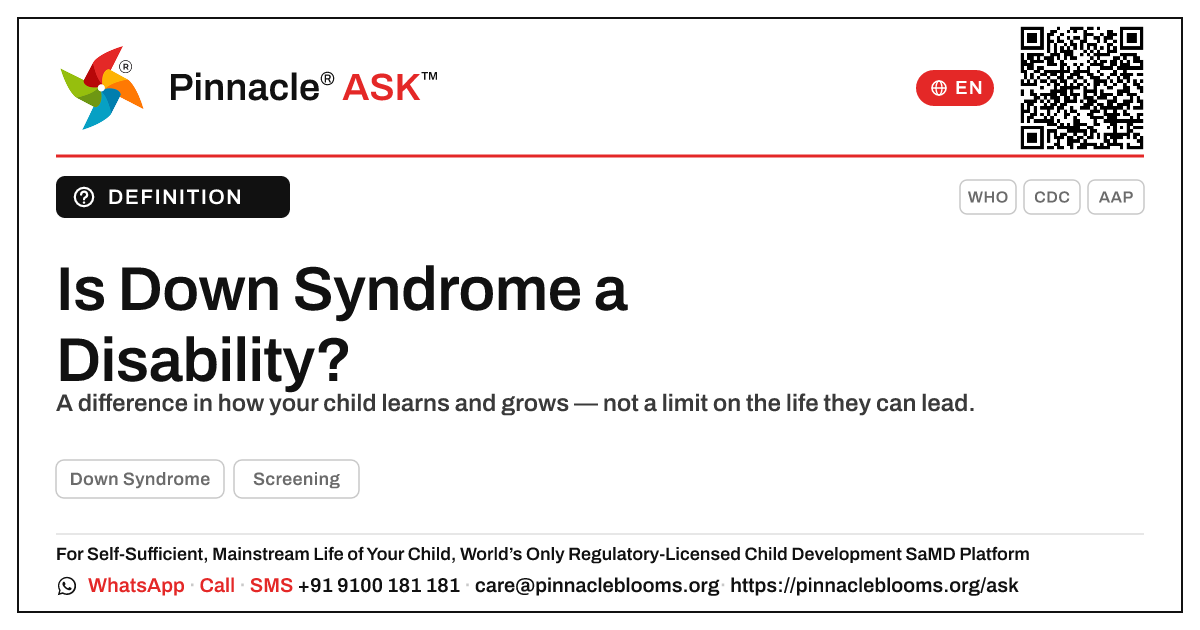
YOUR QUESTION. A CLEARER NEXT STEP.
Is Down Syndrome Considered a Disability?
Yes, Down syndrome is recognised as a developmental disability — a genetic condition usually identified at birth, associated with learning and developmental differences that vary widely. The label unlocks support; with early therapy children learn, attend school and build real independence. A clinical AbilityScore® and diagnosis are formed only at a Pinnacle centre.
In this answer 4 sections
When a family first hears the words "Down syndrome," the next question is often simply: what does this mean for my child's life ahead?
In short
Yes — Down syndrome is recognised as a developmental disability, but that word describes a difference in how your child learns and grows, not a limit on the life they can lead. It is a genetic condition (an extra copy of chromosome 21) usually identified at or around birth, and it is associated with learning differences and developmental delay that vary widely from child to child. With early support, children with Down syndrome learn, communicate, attend school, form friendships and build real independence. The disability label exists to unlock support and entitlements, not to define your child.
What "disability" really means here
The word can sound heavier than it should. In the WHO's framework, disability describes the everyday support a person may need in communication, learning, movement or self-care — it is about functioning, not worth. Children with Down syndrome typically show:
- Some degree of learning and developmental delay, mild to moderate in most children
- Differences in speech and language clarity (often helped greatly by speech therapy)
- Lower muscle tone in early life, which affects motor milestones
- A wide, individual range — no two children with Down syndrome are the same
What matters most is that these are areas where the right therapy makes a measurable difference. Early intervention in the first years — speech, occupational and physiotherapy — strengthens the foundations for school and independence.
The Pinnacle way
Developmental measurement supports care planning; diagnosis requires an appropriately qualified healthcare professional., under qualified clinician care — never from an online form. For a child with Down syndrome, our team builds a clear developmental baseline and an individual plan you can follow. Therapies like speech therapy and a clinician-led AbilityScore® assessment turn a daunting label into practical, week-by-week progress.
Trusted sources
WHO ICD-11 classifies Down syndrome as a chromosomal condition; the WHO ICF framework frames disability as functioning and support needs rather than deficit. The CDC and the American Academy of Pediatrics both emphasise early developmental support and regular monitoring for children with Down syndrome.
Next step — Begin with a clinician-led developmental check at a Pinnacle centre to map your child's strengths and plan early support. Book your child's assessment.
This is general information, not a diagnosis — individual assessment and diagnosis require an appropriately qualified healthcare professional.
CONNECT THE ANSWER TO YOUR CHILD’S DAY
Something to notice. Something to discuss.
What to notice
In early childhood, watch your child's individual milestones rather than comparing — progress in babble, gesture, sitting, walking and first words. Note any feeding, hearing or vision concerns, as these are common and treatable, and share them at every developmental review.
In everyday life
Talk, sing and read to your child every day, pausing to let them respond in their own way — these simple back-and-forth moments build communication powerfully, whatever the pace.
Bring your observations and questions to your child’s professional. Choose activities that suit your child’s comfort, abilities and agreed plan.
Bring your questions to a first visitQuestions families ask
Is Down syndrome a disability or a disease?
It is neither an illness nor something that can be "cured" — it is a genetic condition (an extra copy of chromosome 21) recognised as a developmental disability. The disability label describes support needs in areas like learning and communication, not your child's worth or potential.
Can a child with Down syndrome go to school and live independently?
Yes. With early therapy and the right support, many children with Down syndrome attend school, learn to read, form friendships and grow into meaningful independence. Outcomes vary, but early intervention measurably strengthens these foundations.
When should support and therapy begin?
As early as possible — the first years offer the greatest opportunity. A clinician-led developmental check can establish your child's baseline and plan speech, occupational and physiotherapy support straight away.
Does the disability label limit my child?
No — it exists to unlock support, services and entitlements. The right plan focuses on your child's strengths and the areas where help makes the biggest difference.
FOLLOW THE SOURCE
References behind this answer.
- Source referenceWHO ICD-11
- Source referenceCDC — Learn the Signs. Act Early.
- Organisation website · further readingAmerican Academy of Pediatrics (HealthyChildren.org)
References are supplied with this answer. An organisation homepage offers further reading; it does not establish an independent review of this page.
Content attribution: SETU Consortium · Pinnacle Blooms Network.
PEOPLE, TOPICS & DEVELOPMENT
See the connections.
Browse the wider question collections connected with this answer’s audience, developmental area and stage.
FROM UNDERSTANDING TO PURPOSEFUL SUPPORT
One question. Your child’s whole life.
Your child’s self-sufficient, mainstream-included life is the purpose from the beginning. At Pinnacle, that purpose shapes what we understand, the goals we choose, the people we bring together, everyday practice and review.
Connect this question with the right support.
Start with your child’s strengths, your observations and what you want everyday life to become.
Make the next conversation useful.
Bring the situations you notice at home or school. We’ll explain a suitable service, centre and first visit, including availability and fees, before you decide.
How PinnacleAI® connects the journeyExplore the seven stages
- 1Understand abilities
A starting picture of your child’s capabilities.
- 2Choose meaningful goals
Readiness and a plan shaped around the child.
- 3Bring the right support together
Suitable therapies and people for those goals.
- 4Carry practice into everyday life
Guidance for family, home and school.
- 5Track and correct
Use observations to adjust the plan.
- 6Reassess and review
Decide what to continue, change or do next.
- 7Grow independence and participation
The child’s life gives each step its purpose.
Explore the whole PinnacleAI® system → · Participation at school and in the community →
PINNACLE’S EVIDENCE, OPEN TO YOU
Look at the evidence behind our work.
Read our research, inspect the original regulatory documents and check what each institutional measure means.
General information supports a conversation with an appropriately qualified professional. Advice, goals and support depend on the individual child.