
YOUR QUESTION. A CLEARER NEXT STEP.
Autism screening & diagnostic pathway under 7
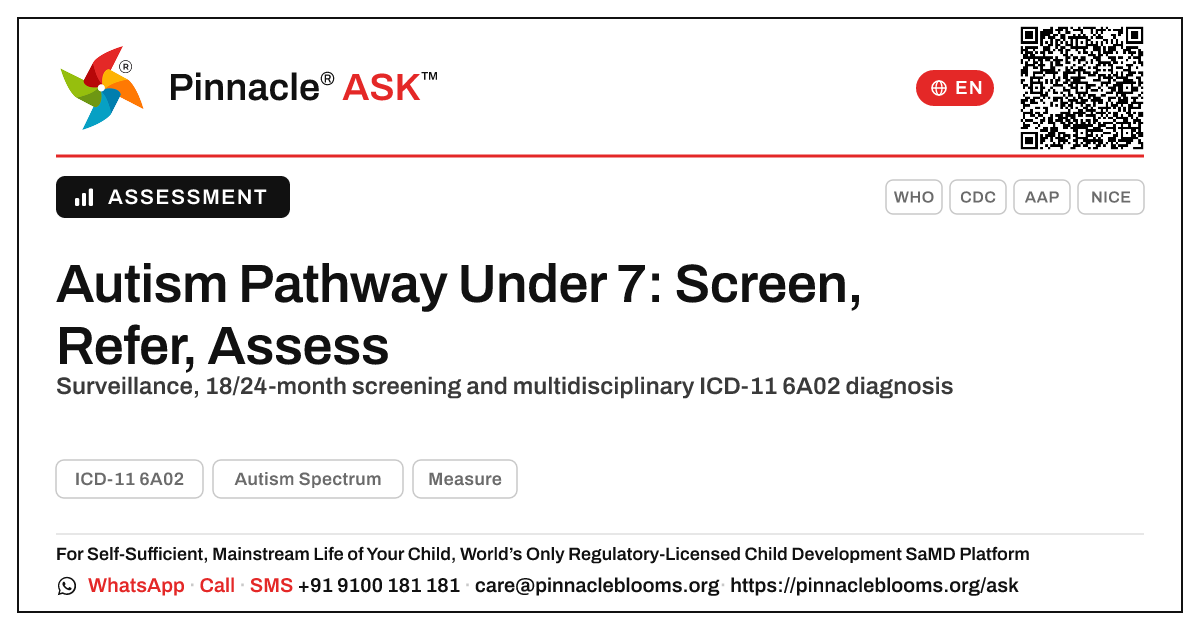
For children under 7, the pathway is developmental surveillance at every visit, autism-specific screening at 18 and 24 months (and at any concern), prompt referral on a positive screen, and multidisciplinary diagnostic assessment against ICD-11 6A02. Screening flags risk; it never diagnoses. A clinical AbilityScore and diagnosis are formed only at a Pinnacle centre.
In this answer 4 sections
A child rarely presents with a diagnosis — they present with a pattern, and a clear pathway turns that pattern into timely support.
In short
For children under 7, the recommended pathway is surveillance at every visit, structured screening at defined ages, and prompt referral to a multidisciplinary team for diagnostic assessment when concern persists. AAP/IAP advocate developmental surveillance at all well-child visits with formal autism-specific screening (e.g. M-CHAT-R/F) at 18 and 24 months, plus screening at any point of parental or clinician concern. A positive screen is a trigger for referral — not a diagnosis. Diagnosis is established by clinical history, direct observation against ICD-11 6A02 criteria, and standardised tools, never by screen alone.
The pathway
1. Surveillance — track milestones at every contact; act on regression at any age. 2. Screening — autism-specific tool at 18 and 24 months, or whenever flags emerge; pair with a hearing check to exclude sensory cause. 3. Referral — on a positive screen or persistent concern, route to a multidisciplinary developmental team without waiting. 4. Diagnostic assessment — detailed developmental and family history, multi-setting behavioural observation, and instruments such as ADOS-2/ADI-R, mapped to ICD-11 6A02 (NICE CG128). Co-occurring needs — language, cognition, sensory, sleep, feeding — are profiled in parallel. 5. Intervention — early evidence-based support begins alongside, not after, formal diagnosis.
NICE CG128 and NIMHANS resources reinforce that delay to assessment should never delay support.
The Pinnacle way
A clinical AbilityScore® — a clinician-administered structured developmental assessment — and any diagnosis are formed only at a Pinnacle Blooms Network centre, under qualified clinician care, never from a screen or an app. Across 70+ centres in 4 states, our multidisciplinary teams convert a positive screen into a profiled plan. See how the AbilityScore® works and our autism therapy pathway.
Trusted sources
WHO ICD-11 6A02; CDC Learn the Signs. Act Early.; AAP (HealthyChildren.org); NICE CG128; Indian Academy of Pediatrics; NIMHANS clinical resources.
Next step — Refer a child or partner with us — connect your practice to a Pinnacle multidisciplinary team.
CONNECT THE ANSWER TO YOUR CHILD’S DAY
Something to notice. Something to discuss.
What to notice
Persistent social-communication differences and restricted, repetitive behaviour across settings; any regression at any age; a positive M-CHAT-R/F that warrants follow-up interview and referral.
In everyday life
Document parental concern verbatim — caregiver report is a strong early signal and should escalate surveillance to formal screening, even between scheduled visits.
Bring your observations and questions to your child’s professional. Choose activities that suit your child’s comfort, abilities and agreed plan.
Bring your questions to a first visitQuestions families ask
At what ages should autism-specific screening occur?
AAP and IAP recommend autism-specific screening at 18 and 24 months, alongside developmental surveillance at every well-child visit and screening at any point of parental or clinician concern.
Does a positive screen mean a diagnosis?
No. A positive screen indicates raised likelihood and triggers referral for diagnostic assessment. Diagnosis requires clinical history, multi-setting observation and standardised tools mapped to ICD-11 6A02 criteria.
Should support wait until diagnosis is confirmed?
No. NICE CG128 and NIMHANS resources stress that early evidence-based intervention should begin alongside the diagnostic process, not after it. Diagnostic delay should never delay support.
FOLLOW THE SOURCE
References behind this answer.
- Source referenceWHO ICD-11 — Autism spectrum disorder
- Source referenceCDC — Learn the Signs. Act Early.
- Organisation website · further readingAAP — HealthyChildren.org
- Source referenceNICE CG128 — Autism recognition & diagnosis
- Organisation website · further readingNIMHANS — autism clinical resources
References are supplied with this answer. An organisation homepage offers further reading; it does not establish an independent review of this page.
Content attribution: SETU Consortium · Pinnacle Blooms Network.
PEOPLE, TOPICS & DEVELOPMENT
See the connections.
Browse the wider question collections connected with this answer’s audience, developmental area and stage.
FROM UNDERSTANDING TO PURPOSEFUL SUPPORT
One question. Your child’s whole life.
Your child’s self-sufficient, mainstream-included life is the purpose from the beginning. At Pinnacle, that purpose shapes what we understand, the goals we choose, the people we bring together, everyday practice and review.
Connect this question with the right support.
Explore how the relevant service contributes to everyday abilities, then speak with us about your child.
Make the next conversation useful.
Bring the situations you notice at home or school. We’ll explain a suitable service, centre and first visit, including availability and fees, before you decide.
How PinnacleAI® connects the journeyExplore the seven stages
- 1Understand abilities
A starting picture of your child’s capabilities.
- 2Choose meaningful goals
Readiness and a plan shaped around the child.
- 3Bring the right support together
Suitable therapies and people for those goals.
- 4Carry practice into everyday life
Guidance for family, home and school.
- 5Track and correct
Use observations to adjust the plan.
- 6Reassess and review
Decide what to continue, change or do next.
- 7Grow independence and participation
The child’s life gives each step its purpose.
Explore the whole PinnacleAI® system → · Participation at school and in the community →
PINNACLE’S EVIDENCE, OPEN TO YOU
Look at the evidence behind our work.
Read our research, inspect the original regulatory documents and check what each institutional measure means.
General information supports a conversation with an appropriately qualified professional. Advice, goals and support depend on the individual child.