
YOUR QUESTION. A CLEARER NEXT STEP.
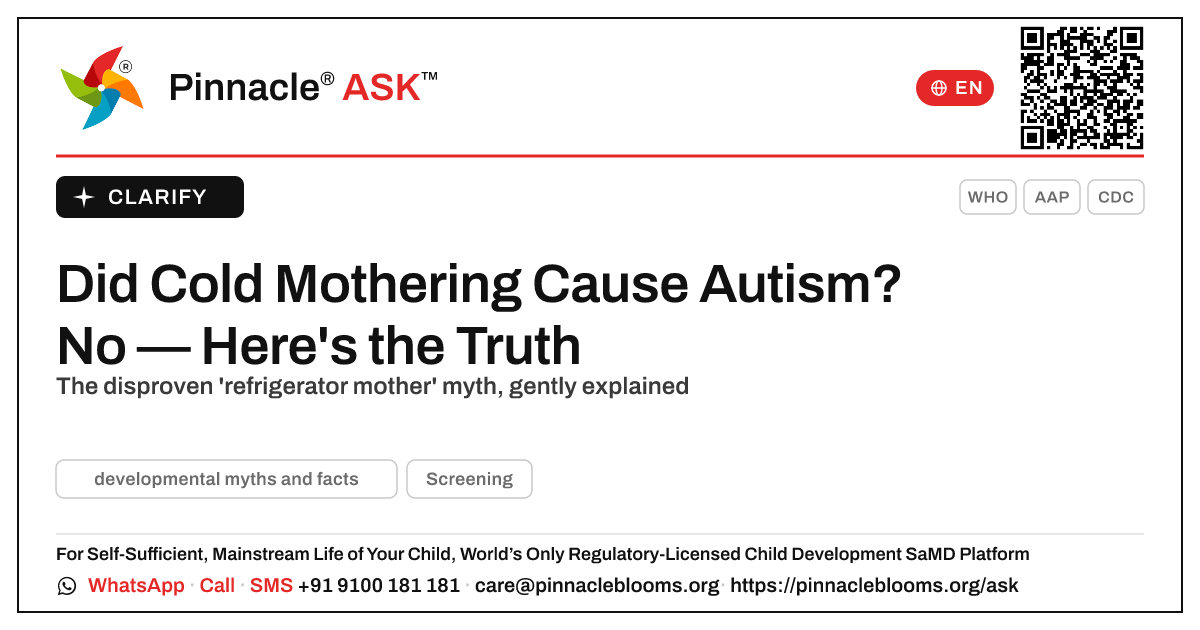
Did cold or distant mothering cause autism?
No. The "refrigerator mother" theory blaming cold or distant mothering for autism has been firmly disproven. Autism is a neurodevelopmental difference shaped largely by genetics and early brain development — not by a parent's warmth, personality or affection. A parent's love remains one of a child's strongest supports.
In this answer 5 sections
If anyone ever told you a child's autism was caused by how warmly you held or loved them, please set that idea down gently — it was wrong, and it was never your fault.
In short
No. Cold or distant mothering does not cause autism — and warm, loving mothering does not prevent it. This idea, the so-called "refrigerator mother" theory from the 1940s–60s, has been firmly disproven by decades of science. Autism is a neurodevelopmental difference shaped largely by genetics and early brain development, not by a parent's affection or personality.
Where this myth came from — and why it's wrong
In the mid-20th century, some early writers wrongly blamed mothers for their child's autism, suggesting emotional coldness caused it. This caused immense, undeserved guilt for a generation of parents — and it has been completely overturned by modern research.
What we now understand:
- Autism is highly heritable. Twin and family studies show genetics play a major role; many genes interact with early brain development.
- It is present from very early development, well before parenting style could shape personality.
- Parenting does not cause autism — not coldness, not screen time, not working mothers, not a lack of cuddles.
- Your warmth still matters enormously — responsive, loving interaction supports every child's communication, regulation and confidence, autistic or not.
So the truth is freeing: you did not cause your child's autism, and your love is one of the most powerful supports they have.
What actually helps
Rather than searching for blame, the hopeful next step is understanding your child's unique profile and starting the right support early. Early, play-based, relationship-centred autism therapy and speech therapy build on a child's strengths and help skills grow.
The Pinnacle way
At Pinnacle Blooms Network, support always begins with understanding, never blame. A clinical AbilityScore® and any diagnosis are formed only at a Pinnacle Blooms Network centre, under the care of qualified clinicians — never from a checklist or an online article. Across 70+ centres in 4 states, 700+ therapists walk this journey alongside families like yours. Explore more developmental myths and facts to feel confident and informed.
Trusted sources
This reflects the position of the World Health Organization (ICD-11) and major paediatric bodies including the American Academy of Pediatrics and CDC, which describe autism as a neurodevelopmental condition with strong genetic contributions — not one caused by parenting.
Next step — if you'd like to understand your child's strengths and support needs, book a developmental assessment with Pinnacle Blooms Network on WhatsApp: +91 91001 81181.
This is general information, not a diagnosis — individual assessment and diagnosis require an appropriately qualified healthcare professional.
CONNECT THE ANSWER TO YOUR CHILD’S DAY
Something to notice. Something to discuss.
What to notice
Watch for guilt or self-blame — it's understandable but unfounded. If you notice differences in your child's communication, eye contact, play or response to name persisting across settings, that's a reason for a gentle developmental check, not for blaming yourself.
In everyday life
Let go of the blame and lean into connection: follow your child's lead in play, narrate what they enjoy, and celebrate small back-and-forth moments. Warm, responsive interaction helps every child — and it was never the cause of autism.
Bring your observations and questions to your child’s professional. Choose activities that suit your child’s comfort, abilities and agreed plan.
Bring your questions to a first visitQuestions families ask
What was the 'refrigerator mother' theory?
It was a mid-20th-century idea that wrongly blamed autism on mothers being emotionally cold or distant. It caused deep, undeserved guilt and has since been completely disproven by genetic and developmental research.
What actually causes autism?
Autism is a neurodevelopmental difference with strong genetic contributions, shaped by early brain development. Many genes interact with development very early in life — long before parenting style could play any role.
Does my parenting affect my autistic child at all?
Yes, in a wonderful way — your warmth and responsive interaction support your child's communication, regulation and confidence. Parenting doesn't cause autism, but loving, attuned parenting genuinely helps your child thrive.
My child has been diagnosed with autism. Did I do something wrong?
No. Nothing you did or didn't do caused your child's autism. You can let go of that worry entirely and focus your energy on understanding and supporting your child's unique strengths.
FOLLOW THE SOURCE
References behind this answer.
- Organisation website · further readingWHO ICD-11 — Autism spectrum disorder (6A02)
- Organisation website · further readingAAP HealthyChildren — Understanding autism
- Organisation website · further readingCDC — Autism spectrum disorder facts
References are supplied with this answer. An organisation homepage offers further reading; it does not establish an independent review of this page.
Content attribution: SETU Consortium · Pinnacle Blooms Network.
PEOPLE, TOPICS & DEVELOPMENT
See the connections.
Browse the wider question collections connected with this answer’s audience, developmental area and stage.
FROM UNDERSTANDING TO PURPOSEFUL SUPPORT
One question. Your child’s whole life.
Your child’s self-sufficient, mainstream-included life is the purpose from the beginning. At Pinnacle, that purpose shapes what we understand, the goals we choose, the people we bring together, everyday practice and review.
Connect this question with the right support.
Explore how the relevant service contributes to everyday abilities, then speak with us about your child.
Make the next conversation useful.
Bring the situations you notice at home or school. We’ll explain a suitable service, centre and first visit, including availability and fees, before you decide.
How PinnacleAI® connects the journeyExplore the seven stages
- 1Understand abilities
A starting picture of your child’s capabilities.
- 2Choose meaningful goals
Readiness and a plan shaped around the child.
- 3Bring the right support together
Suitable therapies and people for those goals.
- 4Carry practice into everyday life
Guidance for family, home and school.
- 5Track and correct
Use observations to adjust the plan.
- 6Reassess and review
Decide what to continue, change or do next.
- 7Grow independence and participation
The child’s life gives each step its purpose.
Explore the whole PinnacleAI® system → · Participation at school and in the community →
PINNACLE’S EVIDENCE, OPEN TO YOU
Look at the evidence behind our work.
Read our research, inspect the original regulatory documents and check what each institutional measure means.
General information supports a conversation with an appropriately qualified professional. Advice, goals and support depend on the individual child.