
YOUR QUESTION. A CLEARER NEXT STEP.
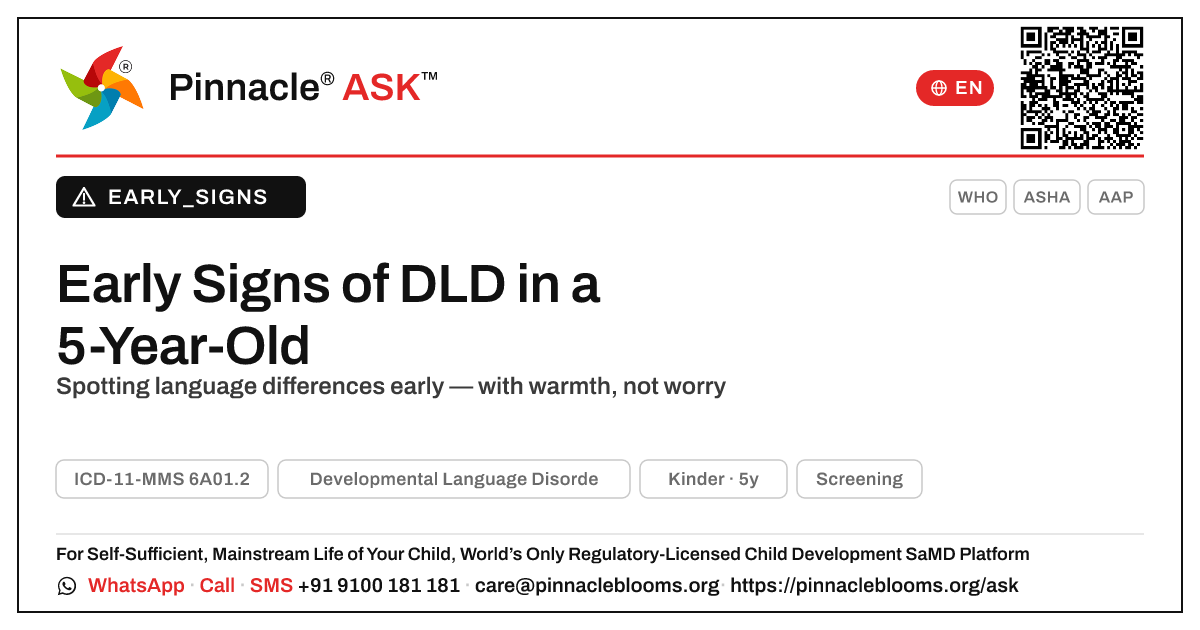
Early Signs of Developmental Language Disorder at 5 Years
Early signs of Developmental Language Disorder in a 5-year-old include short or jumbled sentences, word-finding struggles, muddled grammar, difficulty following multi-step instructions, and trouble telling a story. DLD is a language difference, not low intelligence. Only a clinician can confirm it.
In this answer 5 sections
When your five-year-old understands so much but the words just won't come together, it's natural to wonder why — knowing the early signs helps you support her sooner.
In short
Early signs of Developmental Language Disorder (DLD) in a 5-year-old include short or jumbled sentences, frequent word-finding struggles, muddled grammar (wrong tenses or word order), difficulty following multi-step instructions, and trouble telling a simple story. DLD is a difference in how language develops — not a reflection of intelligence, effort or parenting. Only a qualified clinician can tell DLD apart from a passing delay, so a developmental check is the right next step.
Early signs to watch for
Talking (expressive language)
- Sentences that stay short, simple or jumbled compared with peers
- Frequent pauses, "um", or using vague words ("thing", "that one") because the right word won't come
- Mixing up grammar — wrong tenses, plurals or word order ("him goed there")
- Struggling to retell a simple event or story in order
Understanding (receptive language)
- Difficulty following two- or three-step instructions
- Often answering off-topic, or needing things repeated
- Trouble understanding longer sentences, questions or "who/why/when"
Around social and learning life
- Frustration, withdrawing, or avoiding conversation and group play
- Difficulty learning new words, rhymes or early letter-sound links
- A clear gap between what she clearly knows and what she can express
DLD is not about being shy or slow — it is a genuine difficulty with the language system, and it can occur even when hearing, intelligence and effort are all just fine.
When to seek a check
By five years, most children speak in clear, mostly-grammatical sentences, follow multi-step directions and share simple stories. Seek a developmental and speech-language check when these patterns persist across home and school, when others outside the family struggle to understand her, or when language difficulty is affecting friendships, confidence or early school readiness. A hearing test is usually part of the picture too. Your steady worry is itself a good reason to ask.
The Pinnacle way
At Pinnacle Blooms Network, language support blends playful, evidence-based speech therapy with family coaching, so progress carries into everyday talk at home. A clinical AbilityScore® and any diagnosis are formed only at a Pinnacle Blooms Network centre under qualified clinician care — never from an online list. With 2.5 billion+ data points and 25 million+ therapy sessions behind our approach, across 70+ centres and 700+ therapists, we focus on the next word, sentence and story your child can build.
Trusted sources
Aligned with WHO ICD-11 (6A01.2, developmental language disorder), American Speech-Language-Hearing Association (ASHA) guidance on language disorders, and AAP / HealthyChildren.org guidance on speech and language milestones.
Next step — if her sentences and understanding worry you, book a gentle speech-language and developmental screen with the Pinnacle team on WhatsApp: +91 91001 81181.
This is general information, not a diagnosis — individual assessment and diagnosis require an appropriately qualified healthcare professional.
CONNECT THE ANSWER TO YOUR CHILD’S DAY
Something to notice. Something to discuss.
What to notice
Watch for language difficulty that persists across home and school, where people outside the family struggle to understand her, or where talking affects friendships, confidence or school readiness. A hearing check is usually part of the assessment too.
In everyday life
Talk alongside play: narrate what you're both doing in short, clear sentences, then pause and give her time to respond — gentle repetition and unhurried turns build language far better than correcting or quizzing.
Bring your observations and questions to your child’s professional. Choose activities that suit your child’s comfort, abilities and agreed plan.
Bring your questions to a first visitQuestions families ask
Is DLD the same as being a 'late talker'?
Not quite. Many late talkers catch up, but DLD is a persistent difficulty with understanding or using language that continues beyond the toddler years and affects everyday life. A clinician can tell the difference through a structured assessment.
Does DLD mean my child has low intelligence?
No. DLD occurs even when a child's thinking, hearing and effort are all typical — it is a specific difficulty with the language system, not a measure of intelligence or how hard she tries.
Can DLD be helped at age five?
Yes. Five is a good age to begin support. Playful, evidence-based speech-language therapy with family coaching helps build vocabulary, grammar, understanding and confidence step by step.
FOLLOW THE SOURCE
References behind this answer.
- Organisation website · further readingWHO ICD-11: Developmental language disorder
- Organisation website · further readingASHA: Language disorders in children
- Organisation website · further readingAAP HealthyChildren.org: Speech & language milestones
References are supplied with this answer. An organisation homepage offers further reading; it does not establish an independent review of this page.
Content attribution: SETU Consortium · Pinnacle Blooms Network.
PEOPLE, TOPICS & DEVELOPMENT
See the connections.
Browse the wider question collections connected with this answer’s audience, developmental area and stage.
FROM UNDERSTANDING TO PURPOSEFUL SUPPORT
One question. Your child’s whole life.
Your child’s self-sufficient, mainstream-included life is the purpose from the beginning. At Pinnacle, that purpose shapes what we understand, the goals we choose, the people we bring together, everyday practice and review.
Connect this question with the right support.
Explore how the relevant service contributes to everyday abilities, then speak with us about your child.
Make the next conversation useful.
Bring the situations you notice at home or school. We’ll explain a suitable service, centre and first visit, including availability and fees, before you decide.
How PinnacleAI® connects the journeyExplore the seven stages
- 1Understand abilities
A starting picture of your child’s capabilities.
- 2Choose meaningful goals
Readiness and a plan shaped around the child.
- 3Bring the right support together
Suitable therapies and people for those goals.
- 4Carry practice into everyday life
Guidance for family, home and school.
- 5Track and correct
Use observations to adjust the plan.
- 6Reassess and review
Decide what to continue, change or do next.
- 7Grow independence and participation
The child’s life gives each step its purpose.
Explore the whole PinnacleAI® system → · Participation at school and in the community →
PINNACLE’S EVIDENCE, OPEN TO YOU
Look at the evidence behind our work.
Read our research, inspect the original regulatory documents and check what each institutional measure means.
General information supports a conversation with an appropriately qualified professional. Advice, goals and support depend on the individual child.