
YOUR QUESTION. A CLEARER NEXT STEP.
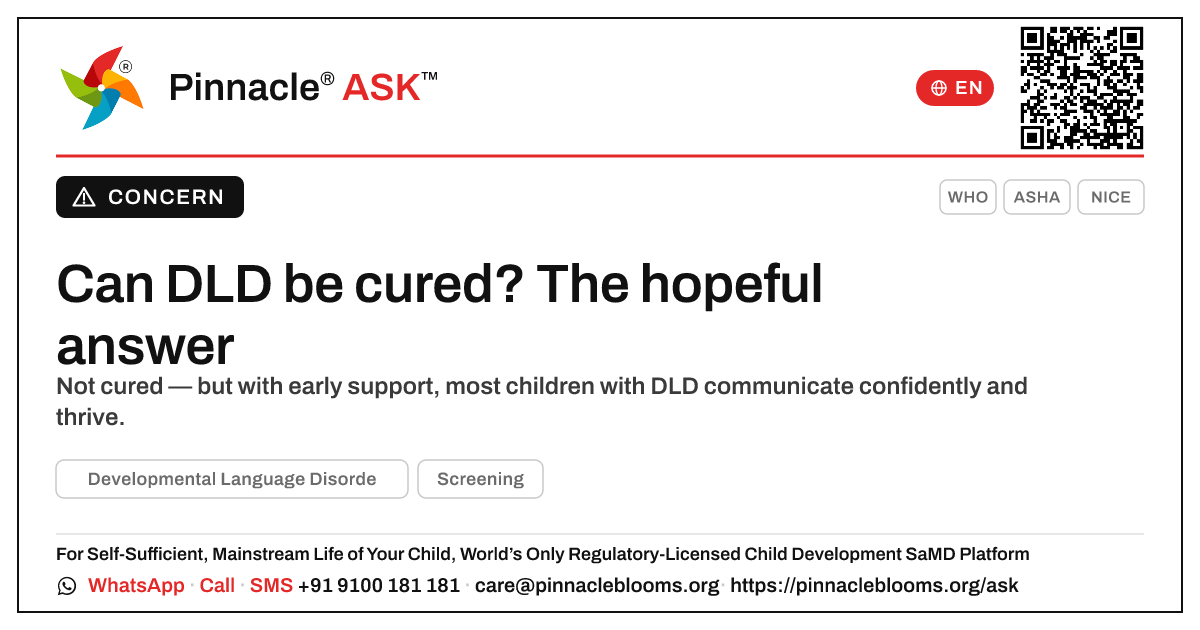
Can Developmental Language Disorder be cured?
DLD isn't an illness that is cured — it's a lifelong difference in how language is learned. But with the right speech and language support, most children communicate confidently and thrive in mainstream school. Started early, the gains are greatest. Only a clinician can confirm DLD and shape the plan.
In this answer 5 sections
"Cured" is the word every parent reaches for — but with language, the truer, more hopeful word is thriving, and that is very much within reach.
In short
Developmental Language Disorder (DLD) is a lifelong difference in how language is learned and used — it isn't an illness that is "cured" and gone. But here is the reassuring truth: with the right speech and language support, most children with DLD make remarkable progress, communicate confidently, learn well, and flourish in mainstream school. The goal isn't a cure — it's a child who is understood, included and thriving.
What "getting better" really looks like
DLD is best thought of like left-handedness or short sight — a way the brain is wired, not a disease that comes and goes. So rather than asking will it disappear?, the kinder and more useful question is how well can my child communicate and thrive? — and the answer there is: often very well indeed.
- Therapy builds real skills — vocabulary, sentence structure, understanding instructions, telling a story, and the back-and-forth of conversation.
- Strategies become second nature — children learn ways to express themselves, and families learn ways to support them.
- Confidence grows — as language steadies, school, friendships and self-belief follow.
Started early, when the brain is most adaptable, the gains are greatest. Some children's needs become so light over time that day-to-day life looks effortless — but the foundation is support and practice, not a single fix.
When to seek help
Don't wait for difficulties to "sort themselves out" if your child's language has stayed behind past age four to five, is hard for people outside the family to understand, or causes real frustration. Earlier support means stronger results — and there is no downside to checking.
The Pinnacle way
A clinical AbilityScore® and any diagnosis are formed only at a Pinnacle Blooms Network centre, under the care of a qualified clinician — never from an online form. Our speech-language pathologists measure your child against their own baseline, rule out other causes such as hearing loss first, and build a plan aimed squarely at one thing: your child communicating and thriving in the mainstream.
Trusted sources
WHO ICD-11 classifies DLD within developmental speech and language disorders; the CATALISE international expert consensus defined DLD so it would be recognised, not missed; and the American Speech-Language-Hearing Association (ASHA) describes evidence-based language support.
Next step — Swap the worry about "cure" for a clear plan. Book a language assessment with a Pinnacle speech-language pathologist today.
This is general information, not a diagnosis — individual assessment and diagnosis require an appropriately qualified healthcare professional.
CONNECT THE ANSWER TO YOUR CHILD’S DAY
Something to notice. Something to discuss.
What to notice
Seek assessment sooner if your child's language stays behind past age 4–5, isn't understood by familiar adults, loses words once used, or shows real frustration and withdrawal when trying to communicate.
In everyday life
Narrate your day and leave gaps for your child to fill: "We're putting on your… ?" Pause, wait, and warmly celebrate any attempt — a sound, word or gesture. Ten minutes of this back-and-forth daily is gentle, powerful language practice.
Bring your observations and questions to your child’s professional. Choose activities that suit your child’s comfort, abilities and agreed plan.
Bring your questions to a first visitQuestions families ask
Will my child grow out of DLD?
DLD is a lifelong difference in how language is learned, so it doesn't simply vanish like a passing late-talking phase. But with the right support, many children make such strong progress that day-to-day communication becomes easy and confident — they thrive in mainstream settings.
If it can't be cured, is therapy still worth it?
Absolutely. Speech and language therapy builds real, lasting skills — vocabulary, sentence structure, understanding and conversation — and the earlier it begins, the greater the gains. Therapy is the single most powerful thing you can do to help your child thrive.
Can my child still do well at school with DLD?
Yes. Many children with DLD are bright and socially warm. With timely language support and the right strategies, they learn well, read, make friends and grow in confidence at school.
FOLLOW THE SOURCE
References behind this answer.
- Organisation website · further readingWHO ICD-11 — developmental speech and language disorders
- Organisation website · further readingASHA — language disorders in children
- Organisation website · further readingNICE — speech, language and communication needs
References are supplied with this answer. An organisation homepage offers further reading; it does not establish an independent review of this page.
Content attribution: SETU Consortium · Pinnacle Blooms Network.
PEOPLE, TOPICS & DEVELOPMENT
See the connections.
Browse the wider question collections connected with this answer’s audience, developmental area and stage.
FROM UNDERSTANDING TO PURPOSEFUL SUPPORT
One question. Your child’s whole life.
Your child’s self-sufficient, mainstream-included life is the purpose from the beginning. At Pinnacle, that purpose shapes what we understand, the goals we choose, the people we bring together, everyday practice and review.
Connect this question with the right support.
Explore how the relevant service contributes to everyday abilities, then speak with us about your child.
Make the next conversation useful.
Bring the situations you notice at home or school. We’ll explain a suitable service, centre and first visit, including availability and fees, before you decide.
How PinnacleAI® connects the journeyExplore the seven stages
- 1Understand abilities
A starting picture of your child’s capabilities.
- 2Choose meaningful goals
Readiness and a plan shaped around the child.
- 3Bring the right support together
Suitable therapies and people for those goals.
- 4Carry practice into everyday life
Guidance for family, home and school.
- 5Track and correct
Use observations to adjust the plan.
- 6Reassess and review
Decide what to continue, change or do next.
- 7Grow independence and participation
The child’s life gives each step its purpose.
Explore the whole PinnacleAI® system → · Participation at school and in the community →
PINNACLE’S EVIDENCE, OPEN TO YOU
Look at the evidence behind our work.
Read our research, inspect the original regulatory documents and check what each institutional measure means.
General information supports a conversation with an appropriately qualified professional. Advice, goals and support depend on the individual child.