
YOUR QUESTION. A CLEARER NEXT STEP.
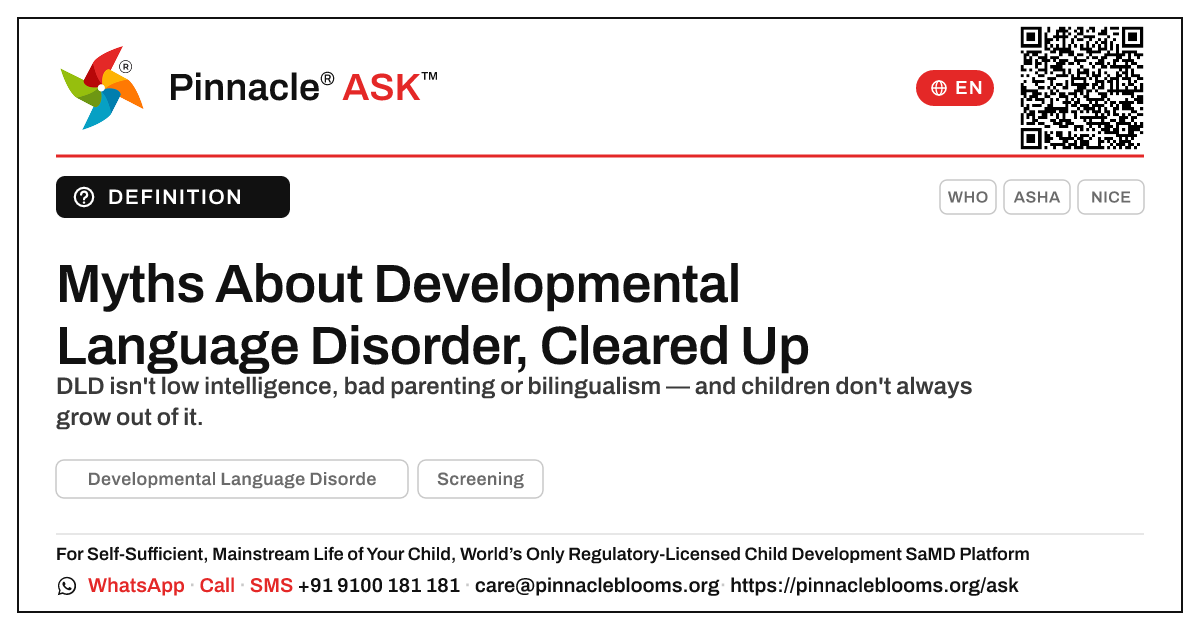
Common Myths About Developmental Language Disorder
Common DLD myths include "he'll grow out of it", "it means low intelligence", "bilingualism or parenting caused it", and "nothing can be done". In truth DLD affects about 1 in 14 children, is unrelated to intelligence or upbringing, and responds well to targeted speech and language therapy. Developmental measurement supports care planning; diagnosis requires an appropriately qualified healthcare professional., under clinician care.
In this answer 5 sections
If you've just heard the term Developmental Language Disorder, you've probably already met a few myths about it — let's clear them away.
In short
Developmental Language Disorder (DLD) is a lifelong difference in learning and using language that is not caused by low intelligence, poor parenting, laziness, or simply "being a late talker". It affects roughly 1 in 14 children and exists with no obvious medical reason — children with DLD are bright, capable and able to thrive with the right support. The biggest myth of all is that a child will "just grow out of it"; many do not without help, which is why early support matters.
Myths, and what's actually true
Myth: "He'll grow out of it." Some late talkers do catch up, but for many children language difficulties persist into school and beyond. Monitoring and support are far safer than waiting.
Myth: "It means my child isn't clever." Untrue. DLD occurs in children right across the ability range; language difficulty does not equal low intelligence.
Myth: "It was caused by something we did — too much screen time, two languages, not reading enough." No. Growing up bilingual does not cause DLD, and good parenting does not prevent it. DLD has no single known cause.
Myth: "Bilingualism confuses children with DLD, so we should drop our home language." Children with DLD can and should keep their home languages — dropping one does not fix the difficulty and may cost a child their family connection.
Myth: "It's the same as a speech sound problem or stammer." DLD is about understanding and using language — words, grammar, meaning, conversation — not only how speech sounds are pronounced.
Myth: "There's nothing that can be done." Targeted speech and language therapy genuinely helps children understand, express and communicate with greater confidence.
When to seek a check
If your child finds it hard to follow instructions, struggles to find words, leaves sentences muddled or short, or seems to understand less than peers — and this persists across home, nursery and play — a friendly developmental check is worthwhile. Concern that lasts is reason enough to ask.
The Pinnacle way
AbilityScore® is part of Pinnacle’s developmental assessment. Diagnosis, where needed, requires an appropriately qualified healthcare professional — never from an online form. We start by understanding your child's language strengths and challenges, build a clear baseline through a clinician-administered assessment, and move forward with focused speech therapy that fits your family — including your home languages.
Trusted sources
World Health Organization ICD-11 framework for developmental language difficulties; the American Speech-Language-Hearing Association (ASHA) on spoken-language disorders; NICE guidance on children's speech, language and communication needs.
Next step — Curious where your child's language stands today? Book a friendly screen with a Pinnacle clinician.
This is general information, not a diagnosis — individual assessment and diagnosis require an appropriately qualified healthcare professional.
CONNECT THE ANSWER TO YOUR CHILD’S DAY
Something to notice. Something to discuss.
What to notice
Difficulty following instructions, trouble finding the right words, short or muddled sentences, or understanding less than peers — persisting across home, nursery and play.
In everyday life
Keep speaking your home language with your child. Bilingualism does not cause or worsen DLD, and your family language is part of who your child is.
Bring your observations and questions to your child’s professional. Choose activities that suit your child’s comfort, abilities and agreed plan.
Bring your questions to a first visitQuestions families ask
Will my child just grow out of Developmental Language Disorder?
Some late talkers do catch up, but for many children with DLD the difficulty persists into school and adulthood without support. That's why a developmental check and, where needed, speech and language therapy are far safer than simply waiting.
Does being bilingual cause DLD?
No. Growing up with two or more languages does not cause DLD and does not make it worse. Children with DLD can keep all their home languages — dropping one does not fix the difficulty.
Does DLD mean my child is not intelligent?
No. DLD occurs in children across the whole range of ability. A child can be bright, curious and capable while still finding language harder to learn and use.
Is DLD the same as a speech sound or stammering problem?
Not quite. DLD is about understanding and using language — words, grammar, meaning and conversation — rather than only how speech sounds are pronounced or fluency.
FOLLOW THE SOURCE
References behind this answer.
- Organisation website · further readingWHO ICD-11 framework for developmental language difficulties
- Organisation website · further readingASHA on spoken-language disorders in children
- Organisation website · further readingNICE guidance on children's speech, language and communication needs
References are supplied with this answer. An organisation homepage offers further reading; it does not establish an independent review of this page.
Content attribution: SETU Consortium · Pinnacle Blooms Network.
PEOPLE, TOPICS & DEVELOPMENT
See the connections.
Browse the wider question collections connected with this answer’s audience, developmental area and stage.
FROM UNDERSTANDING TO PURPOSEFUL SUPPORT
One question. Your child’s whole life.
Your child’s self-sufficient, mainstream-included life is the purpose from the beginning. At Pinnacle, that purpose shapes what we understand, the goals we choose, the people we bring together, everyday practice and review.
Connect this question with the right support.
Explore how the relevant service contributes to everyday abilities, then speak with us about your child.
Make the next conversation useful.
Bring the situations you notice at home or school. We’ll explain a suitable service, centre and first visit, including availability and fees, before you decide.
How PinnacleAI® connects the journeyExplore the seven stages
- 1Understand abilities
A starting picture of your child’s capabilities.
- 2Choose meaningful goals
Readiness and a plan shaped around the child.
- 3Bring the right support together
Suitable therapies and people for those goals.
- 4Carry practice into everyday life
Guidance for family, home and school.
- 5Track and correct
Use observations to adjust the plan.
- 6Reassess and review
Decide what to continue, change or do next.
- 7Grow independence and participation
The child’s life gives each step its purpose.
Explore the whole PinnacleAI® system → · Participation at school and in the community →
PINNACLE’S EVIDENCE, OPEN TO YOU
Look at the evidence behind our work.
Read our research, inspect the original regulatory documents and check what each institutional measure means.
General information supports a conversation with an appropriately qualified professional. Advice, goals and support depend on the individual child.