
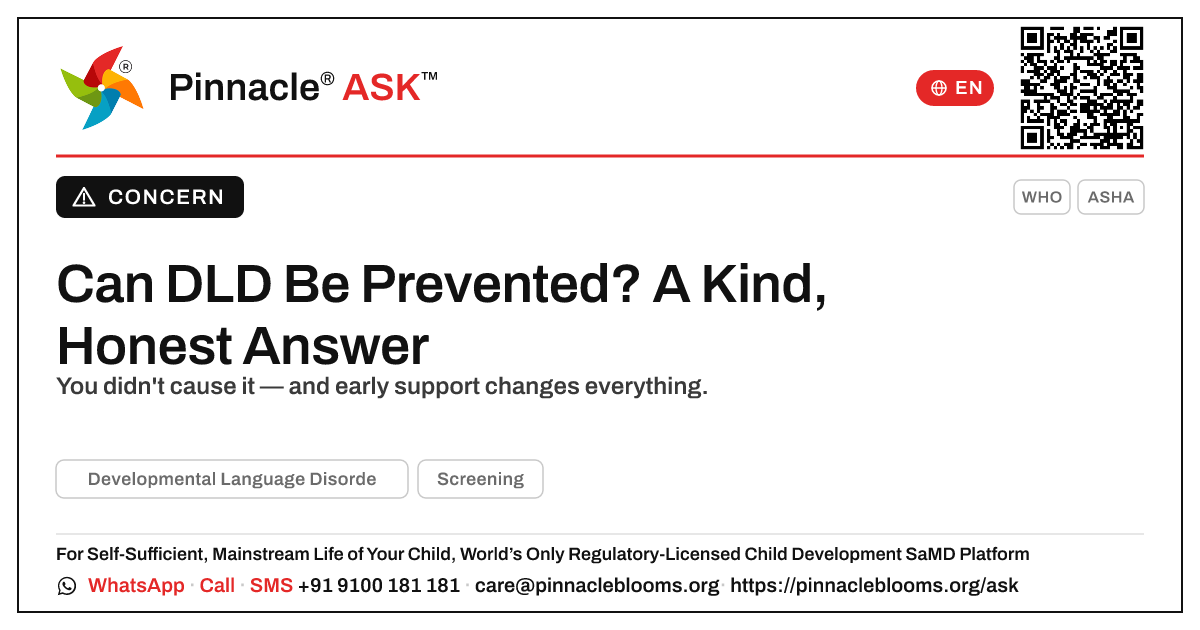
YOUR QUESTION. A CLEARER NEXT STEP.
Can Developmental Language Disorder be prevented?
DLD cannot be prevented — it is a brain-based difference in learning language, not caused by parenting, screen time or anything you did. What you can do is enrich everyday talk and, crucially, identify any difficulty early, because early support transforms outcomes. Only a clinician can confirm DLD.
In this answer 5 sections
If you're wondering whether you could have done something to stop this — pause. That question comes from love, and it deserves a kind, honest answer.
In short
Developmental Language Disorder (DLD) cannot be reliably prevented — it is not caused by anything you did or did not do as a parent. DLD is a difference in how a child's brain learns and uses language, present from early development, and not the result of bad parenting, screen time or too little talking. What you can do is help language flourish through everyday interaction, and — most importantly — identify any difficulty early, because early support changes outcomes profoundly.
Why it isn't about prevention
DLD affects around 7% of children — roughly two in a typical classroom. It runs in families more often than chance, which tells us biology and inheritance play a real part. There is no single cause to remove, no vaccine, no diet and no parenting style that switches it on or off. So the honest, freeing truth is this: you didn't cause it, and no checklist could have prevented it.
That doesn't leave you powerless. A language-rich home — lots of back-and-forth talk, shared reading, naming the world together — supports every child's communication and softens the impact of DLD. And one thing genuinely protects your child's future: early identification. Spotted and supported early, children with DLD make strong gains in language, reading and confidence; left unrecognised, the difficulty can quietly affect learning and self-esteem at school.
When to check
A single late-talking phase is common and often resolves. A pattern that persists is the real flag — for example, by age 4–5 sentences that stay short or jumbled, trouble following directions, or being hard for people outside the family to understand. If that sounds familiar, the kindest next step is an assessment, not more worry.
The Pinnacle way
No diagnosis or clinical AbilityScore® is ever made from an online form — it is formed only at a Pinnacle Blooms Network centre, by a qualified clinician who looks for other causes first and builds a plan around your child's own baseline. Our speech-language pathologists focus on what helps now: your child communicating, connecting and thriving. The goal is never a label — it is your child being understood.
Trusted sources
WHO ICD-11 classifies DLD within developmental speech and language disorders; the American Speech-Language-Hearing Association (ASHA) describes its features and support; international expert consensus (CATALISE) defined DLD so it would stop being missed.
Next step — Trade the "what if" for clarity. Book a language assessment with a Pinnacle speech-language pathologist.
This is general information, not a diagnosis — individual assessment and diagnosis require an appropriately qualified healthcare professional.
CONNECT THE ANSWER TO YOUR CHILD’S DAY
Something to notice. Something to discuss.
What to notice
Seek assessment sooner if your child loses words they once used, is not understood by familiar adults by age 3, or shows real frustration when trying to communicate. These are reasons to check, not to blame yourself.
In everyday life
Build language into ordinary moments: narrate your day and leave gaps for your child to fill — "We're putting on your… ?" Pause, wait, and warmly celebrate any attempt. This rich back-and-forth supports every child, whether or not DLD is present.
Bring your observations and questions to your child’s professional. Choose activities that suit your child’s comfort, abilities and agreed plan.
Bring your questions to a first visitQuestions families ask
Did I cause my child's DLD?
No. DLD is a brain-based difference in how language is learned, present from early development. It is not caused by parenting, screen time, bilingualism or how much you talked to your child. It often runs in families, which points to biology rather than anything you did.
If it can't be prevented, is there anything I can do?
Yes — plenty. A language-rich home with lots of back-and-forth talk and shared reading supports every child's communication. Most powerfully, early identification and support genuinely change outcomes, helping children with DLD make strong gains in language and confidence.
Does talking more to my baby stop DLD developing?
Rich interaction is wonderful for all children and supports language growth, but it does not prevent DLD, which has biological roots. What it can do is help your child make the most of the language they have — and a quiet child is always worth checking with a professional.
How do I know if it's DLD or just a late-talking phase?
One late phase is common and often resolves. A persistent pattern past age four — short or jumbled sentences, trouble following directions, being hard for others to understand — is the real flag. Only a qualified speech-language pathologist can tell the difference through assessment.
FOLLOW THE SOURCE
References behind this answer.
- Organisation website · further readingWHO ICD-11 — developmental speech and language disorders
- Organisation website · further readingASHA — spoken language disorders in children
- Organisation website · further readingWHO — child development and communication
References are supplied with this answer. An organisation homepage offers further reading; it does not establish an independent review of this page.
Content attribution: SETU Consortium · Pinnacle Blooms Network.
PEOPLE, TOPICS & DEVELOPMENT
See the connections.
Browse the wider question collections connected with this answer’s audience, developmental area and stage.
FROM UNDERSTANDING TO PURPOSEFUL SUPPORT
One question. Your child’s whole life.
Your child’s self-sufficient, mainstream-included life is the purpose from the beginning. At Pinnacle, that purpose shapes what we understand, the goals we choose, the people we bring together, everyday practice and review.
Connect this question with the right support.
Explore how the relevant service contributes to everyday abilities, then speak with us about your child.
Make the next conversation useful.
Bring the situations you notice at home or school. We’ll explain a suitable service, centre and first visit, including availability and fees, before you decide.
How PinnacleAI® connects the journeyExplore the seven stages
- 1Understand abilities
A starting picture of your child’s capabilities.
- 2Choose meaningful goals
Readiness and a plan shaped around the child.
- 3Bring the right support together
Suitable therapies and people for those goals.
- 4Carry practice into everyday life
Guidance for family, home and school.
- 5Track and correct
Use observations to adjust the plan.
- 6Reassess and review
Decide what to continue, change or do next.
- 7Grow independence and participation
The child’s life gives each step its purpose.
Explore the whole PinnacleAI® system → · Participation at school and in the community →
PINNACLE’S EVIDENCE, OPEN TO YOU
Look at the evidence behind our work.
Read our research, inspect the original regulatory documents and check what each institutional measure means.
General information supports a conversation with an appropriately qualified professional. Advice, goals and support depend on the individual child.