
YOUR QUESTION. A CLEARER NEXT STEP.
Do vaccines cause autism?
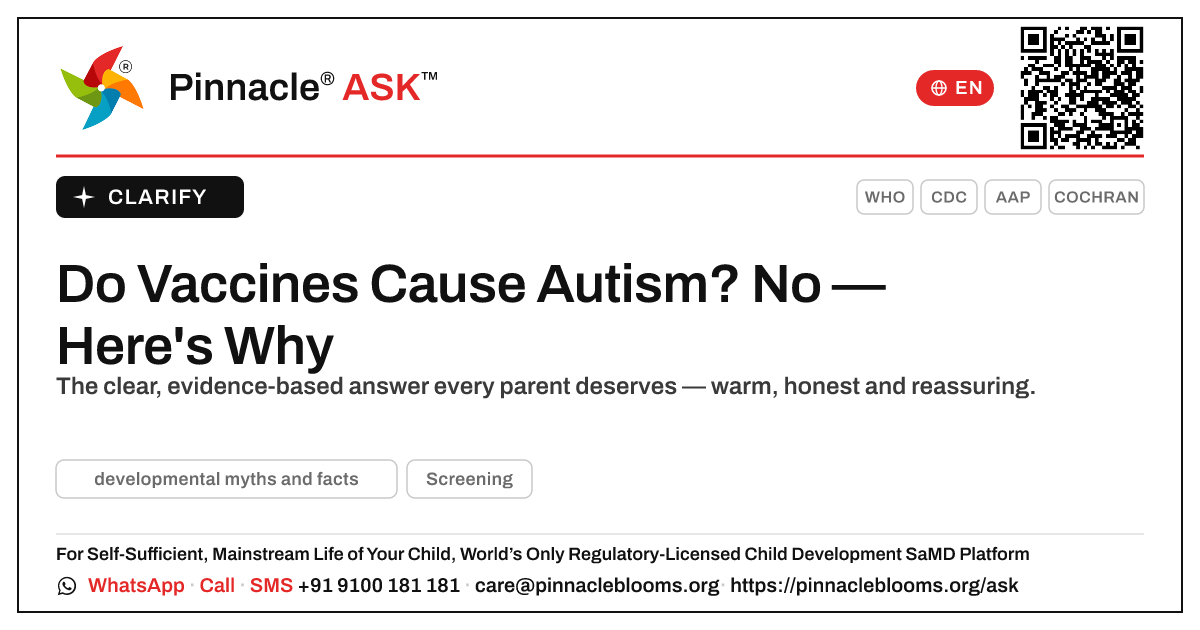
No — vaccines do not cause autism. This is one of the most studied questions in medicine, and large reviews of over a million children show no link, including for the MMR vaccine and thimerosal. The original 1998 claim was retracted as fraudulent. Autism begins before birth, and skipping vaccines only exposes children to preventable illness.
In this answer 5 sections
One worried question shouldn't outlive the evidence that answered it — so let's answer it clearly and kindly.
In short
No. Vaccines do not cause autism. This is one of the most thoroughly studied questions in modern medicine, and study after study involving millions of children has found no link — not from the MMR vaccine, and not from thimerosal or any vaccine ingredient. The original 1998 paper that sparked the fear was found to be flawed and dishonest, was formally retracted, and its author lost his licence to practise.
Why this myth took hold — and why it isn't true
Many parents first notice signs of autism around 12–24 months, which happens to be when several routine vaccines are given. The two events sit close together in time, so it can feel connected. But timing is not cause. Large, careful studies that compared vaccinated and unvaccinated children found autism appears at the same rate in both groups.
What we now understand:
- Autism begins before birth. Brain-development differences linked to autism start during pregnancy — long before any childhood vaccine is given.
- The studies are vast. Reviews pooling more than a million children consistently show no association between vaccines and autism.
- Thimerosal was studied too. Even after this preservative was removed from most childhood vaccines, autism rates did not fall — the opposite of what you'd expect if it were a cause.
Skipping vaccines does not lower autism risk. It does expose your child to serious, preventable illnesses like measles. Vaccinating on schedule is one of the safest, kindest things you can do for your child.
What actually matters for your child
If you've noticed differences in how your child communicates, plays or connects, that observation deserves attention — not because of vaccines, but because early support helps. Watching milestones and acting early is far more powerful than worrying about a disproven link.
The Pinnacle way
A clinical AbilityScore® and any diagnosis are formed only at a Pinnacle Blooms Network centre, under qualified clinician care — never from a screen, a score or an online article. Across 70+ centres, our teams help families separate myth from fact and focus on what genuinely supports a child's growth. If you have any concern about development, start with a developmental check or explore early speech therapy — both are about strengths and support, never blame.
Trusted sources
Aligned with the World Health Organization, the U.S. Centers for Disease Control and Prevention, the American Academy of Pediatrics, and Cochrane systematic reviews — all of which conclude that vaccines do not cause autism and that the original claim has been discredited and retracted.
Next step — if you're unsure about your child's development, book a developmental check with the Pinnacle team on WhatsApp: +91 91001 81181 — for reassurance, clarity, and a plan built on facts.
This is general information, not a diagnosis — individual assessment and diagnosis require an appropriately qualified healthcare professional.
CONNECT THE ANSWER TO YOUR CHILD’S DAY
Something to notice. Something to discuss.
What to notice
Rather than watching for vaccine effects (there are none linked to autism), watch developmental milestones: response to name by 12 months, pointing to share interest, first words by 16 months. Persistent concern about communication or play is the reason to seek a check — not a vaccine.
In everyday life
Keep your child's vaccines on schedule and keep a simple milestone diary. If something about how your child connects or communicates worries you, note it and mention it at the next check — early observation helps far more than online worry.
Bring your observations and questions to your child’s professional. Choose activities that suit your child’s comfort, abilities and agreed plan.
Bring your questions to a first visitQuestions families ask
Does the MMR vaccine cause autism?
No. The MMR vaccine has been studied in many large groups of children and shows no link to autism. The 1998 paper that first suggested this was found to be flawed and dishonest, was retracted, and its author lost his medical licence.
What about the ingredients in vaccines, like thimerosal?
Thimerosal, a preservative, was studied carefully and removed from most childhood vaccines years ago. Autism rates did not fall afterward — the opposite of what you'd see if it were a cause. No vaccine ingredient has been shown to cause autism.
Why do some parents notice autism signs after vaccination?
Several routine vaccines are given at 12–24 months, around the same age many signs of autism become noticeable. The two events sit close in time, so they can feel connected, but timing is not cause. Autism's roots begin before birth.
Is it safer to delay or skip vaccines?
No. Skipping or delaying vaccines does not reduce autism risk — it only leaves your child exposed to serious, preventable illnesses like measles. Vaccinating on schedule is one of the safest choices for your child.
FOLLOW THE SOURCE
References behind this answer.
- Source referenceWHO — Autism spectrum disorders Q&A
- Source referenceCDC — Vaccines do not cause autism
- Organisation website · further readingAAP — HealthyChildren on vaccine safety
- Organisation website · further readingCochrane — Systematic reviews on MMR safety
References are supplied with this answer. An organisation homepage offers further reading; it does not establish an independent review of this page.
Content attribution: SETU Consortium · Pinnacle Blooms Network.
PEOPLE, TOPICS & DEVELOPMENT
See the connections.
Browse the wider question collections connected with this answer’s audience, developmental area and stage.
FROM UNDERSTANDING TO PURPOSEFUL SUPPORT
One question. Your child’s whole life.
Your child’s self-sufficient, mainstream-included life is the purpose from the beginning. At Pinnacle, that purpose shapes what we understand, the goals we choose, the people we bring together, everyday practice and review.
Connect this question with the right support.
Explore how the relevant service contributes to everyday abilities, then speak with us about your child.
Make the next conversation useful.
Bring the situations you notice at home or school. We’ll explain a suitable service, centre and first visit, including availability and fees, before you decide.
How PinnacleAI® connects the journeyExplore the seven stages
- 1Understand abilities
A starting picture of your child’s capabilities.
- 2Choose meaningful goals
Readiness and a plan shaped around the child.
- 3Bring the right support together
Suitable therapies and people for those goals.
- 4Carry practice into everyday life
Guidance for family, home and school.
- 5Track and correct
Use observations to adjust the plan.
- 6Reassess and review
Decide what to continue, change or do next.
- 7Grow independence and participation
The child’s life gives each step its purpose.
Explore the whole PinnacleAI® system → · Participation at school and in the community →
PINNACLE’S EVIDENCE, OPEN TO YOU
Look at the evidence behind our work.
Read our research, inspect the original regulatory documents and check what each institutional measure means.
General information supports a conversation with an appropriately qualified professional. Advice, goals and support depend on the individual child.