
YOUR QUESTION. A CLEARER NEXT STEP.
Is there a link between vaccines and autism?
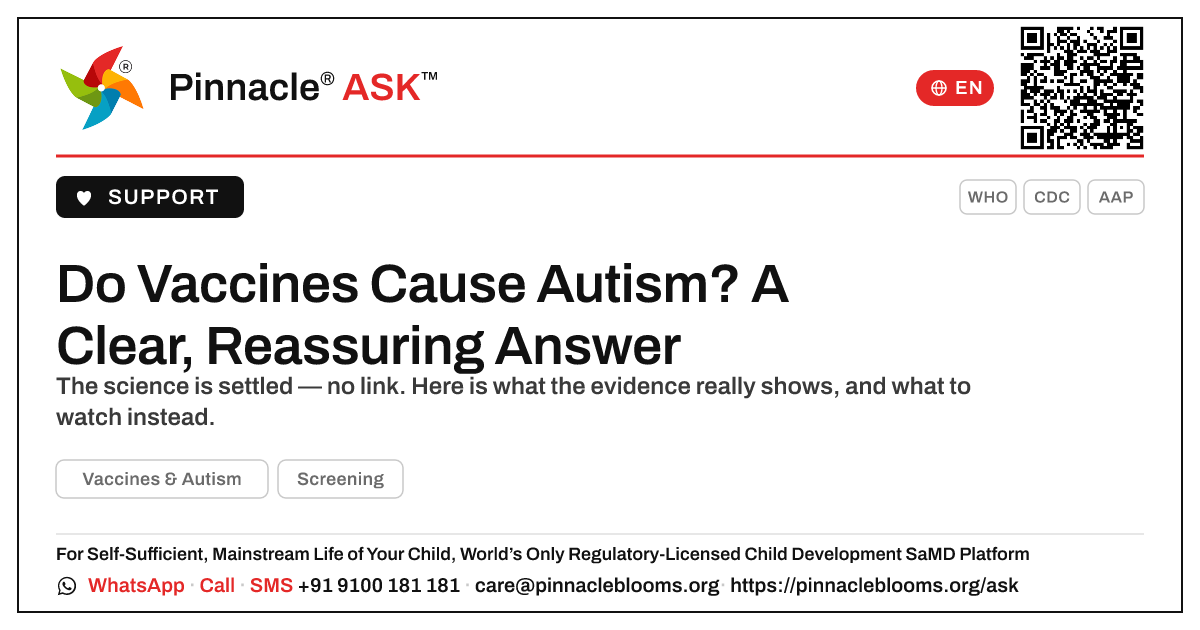
Vaccines do not cause autism. The original 1998 paper claiming a link was flawed, retracted and discredited, and large studies following millions of children have since found no connection. Autism's early signs often appear around toddler age, which overlaps with the vaccine schedule by coincidence, not cause. AbilityScore® is part of Pinnacle’s developmental assessment. Diagnosis, where needed, requires an appropriately qualified healthcare professional.
In this answer 5 sections
If you've heard worries linking vaccines to autism, take a breath — the science here is large, clear and reassuring.
In short
No — vaccines do not cause autism. This is one of the most thoroughly studied questions in modern medicine, and study after study involving millions of children has found no link between vaccines (including the MMR vaccine) and autism. The original 1998 paper that sparked the fear was found to be flawed and dishonest, was formally retracted, and its author lost his medical licence. Vaccinating your child on schedule protects them — and is not a risk factor for autism.
Why the worry began — and why it's settled
- The retracted study. A 1998 paper claimed a link between the MMR vaccine and autism. It was based on just 12 children, contained serious ethical and scientific problems, was retracted by the journal, and its lead author was struck off the medical register.
- What the evidence actually shows. Since then, very large studies across many countries — together following millions of children, including those at higher genetic likelihood of autism — have consistently found no increased risk from vaccines.
- Thimerosal and ingredients. Worries about the preservative thimerosal have also been studied carefully and not borne out; it was removed from most childhood vaccines years ago, yet autism identification continued to rise — because awareness and diagnosis improved, not vaccines.
- Why autism appears around vaccine age. Autism's early signs often become noticeable in the toddler years, which happens to overlap with the routine vaccine schedule. This timing is coincidence, not cause — the two are simply unrelated events happening in the same season of life.
What this means for your child
Autism is a difference in how the brain develops, with strong roots in genetics and brain development that begin well before birth. If you have noticed differences in your child's communication, play or social interaction, the helpful next step is a general developmental check — not a worry about vaccines. Early understanding opens the door to the right support, and a child's strengths are always the starting point.
The Pinnacle way
AbilityScore® is part of Pinnacle’s developmental assessment. Diagnosis, where needed, requires an appropriately qualified healthcare professional — never from an app, online quiz or a single worry. If you'd like clarity on your child's development, our team offers a warm, structured developmental understanding and, where helpful, support such as speech therapy. You can also explore how we support families across 70+ centres.
Trusted sources
World Health Organization guidance on vaccine safety; US CDC resources confirming no link between vaccines and autism; American Academy of Pediatrics family guidance via HealthyChildren.org.
Next step — If you have any questions about your child's development, book a developmental assessment with a Pinnacle clinician — and keep your child's vaccines on schedule.
This is general information, not a diagnosis — individual assessment and diagnosis require an appropriately qualified healthcare professional.
CONNECT THE ANSWER TO YOUR CHILD’S DAY
Something to notice. Something to discuss.
What to notice
Not vaccine timing — instead watch your child's communication, eye contact, response to their name, play and social interaction. If these seem different from peers, ask for a general developmental check.
In everyday life
Keep your child's vaccines on schedule, and if you ever feel anxious about something you've read online, bring it to a trusted clinician rather than carrying the worry alone.
Bring your observations and questions to your child’s professional. Choose activities that suit your child’s comfort, abilities and agreed plan.
Bring your questions to a first visitQuestions families ask
Does the MMR vaccine cause autism?
No. The MMR vaccine has been studied in very large groups of children across many countries, and none of this research has found a link to autism. The single 1998 paper that claimed one was retracted and discredited.
Why do some children seem to change around the time of their vaccines?
The early signs of autism often become noticeable in the toddler years, which is also when routine vaccines are given. This is a coincidence of timing — the two are unrelated. Autism's roots are in brain development that begins well before birth.
Should I delay or skip my child's vaccines just in case?
No. Delaying or skipping vaccines does not reduce any risk of autism (there is none) and leaves your child exposed to serious preventable illnesses. Keeping to the schedule is the safest choice.
If it isn't vaccines, what causes autism?
Autism is a difference in brain development with strong genetic influences that begin before birth. It is not caused by anything a parent did, and not by vaccines.
FOLLOW THE SOURCE
References behind this answer.
- Source referenceWHO — Autism: questions and answers
- Source referenceCDC — Vaccines and autism: no link
- Source referenceAAP HealthyChildren — Vaccine studies and the evidence
References are supplied with this answer. An organisation homepage offers further reading; it does not establish an independent review of this page.
Content attribution: SETU Consortium · Pinnacle Blooms Network.
PEOPLE, TOPICS & DEVELOPMENT
See the connections.
Browse the wider question collections connected with this answer’s audience, developmental area and stage.
FROM UNDERSTANDING TO PURPOSEFUL SUPPORT
One question. Your child’s whole life.
Your child’s self-sufficient, mainstream-included life is the purpose from the beginning. At Pinnacle, that purpose shapes what we understand, the goals we choose, the people we bring together, everyday practice and review.
Connect this question with the right support.
Explore how the relevant service contributes to everyday abilities, then speak with us about your child.
Make the next conversation useful.
Bring the situations you notice at home or school. We’ll explain a suitable service, centre and first visit, including availability and fees, before you decide.
How PinnacleAI® connects the journeyExplore the seven stages
- 1Understand abilities
A starting picture of your child’s capabilities.
- 2Choose meaningful goals
Readiness and a plan shaped around the child.
- 3Bring the right support together
Suitable therapies and people for those goals.
- 4Carry practice into everyday life
Guidance for family, home and school.
- 5Track and correct
Use observations to adjust the plan.
- 6Reassess and review
Decide what to continue, change or do next.
- 7Grow independence and participation
The child’s life gives each step its purpose.
Explore the whole PinnacleAI® system → · Participation at school and in the community →
PINNACLE’S EVIDENCE, OPEN TO YOU
Look at the evidence behind our work.
Read our research, inspect the original regulatory documents and check what each institutional measure means.
General information supports a conversation with an appropriately qualified professional. Advice, goals and support depend on the individual child.