
YOUR QUESTION. A CLEARER NEXT STEP.
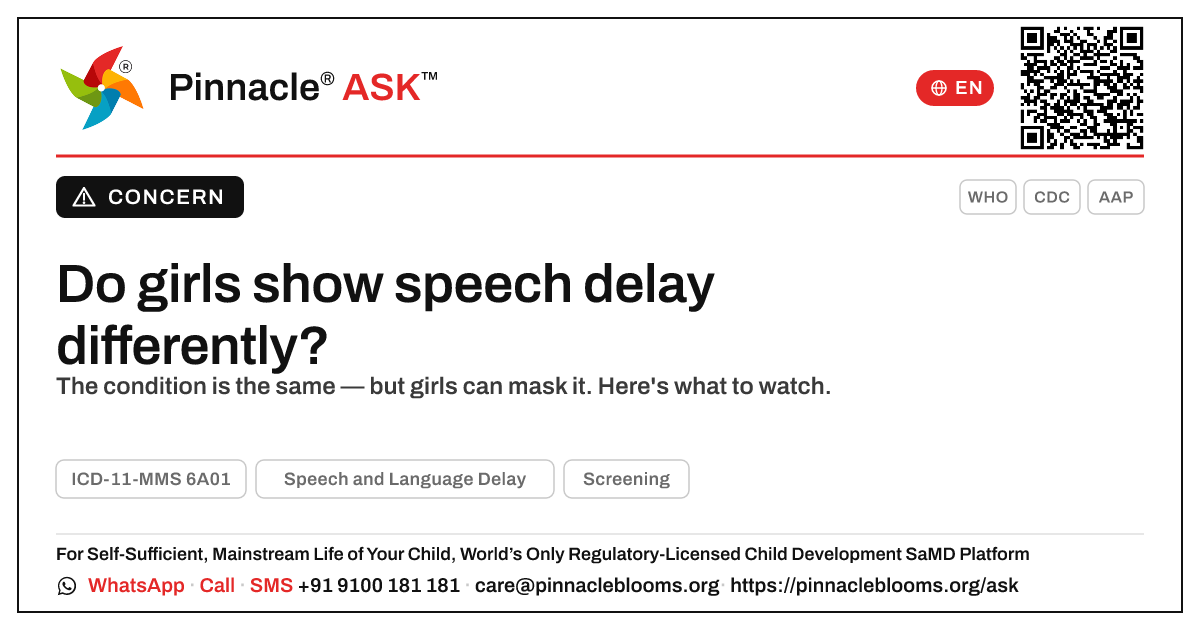
Do girls show speech and language delay differently?
There is no separate 'girls' version' of speech and language delay — the condition (ICD-11 6A01) is the same. But girls can mask a delay with strong social skills, so it is easier to miss. The pattern, not the gender, is what matters, and only a clinician can confirm.
In this answer 4 sections
If your daughter is bright, chatty in her own way, and yet you sense something is off — your instinct deserves a fair hearing, not a dismissal.
In short
There is no separate "girls' version" of speech and language delay — the underlying difficulty (ICD-11 6A01) is the same. But research and clinical experience suggest delays in girls can be easier to miss, because girls often compensate with strong social engagement, eye contact, gesture and imitation. The pattern, not the gender, is what matters: a delay that persists is worth checking, whether in a girl or a boy.
What can look different in girls
Girls more often mask or "bridge" a language gap using social skills — copying peers, using gesture and expression, staying close to a familiar adult who interprets for them. This can mean:
- Fewer words, but warm interaction — so the gap is overlooked because she seems sociable.
- Good single words, weaker sentences — vocabulary may look fine while joining words, following longer instructions, or telling a story lags.
- Quiet rather than frustrated — some girls withdraw or go along quietly instead of protesting, so the difficulty stays under the radar.
The milestones to watch are the same for every child: few words by age 2, not joining two words by age 3, sentences that stay short or jumbled or being hard for outsiders to understand by 4–5. One late phase is common; a persistent pattern is the real flag — regardless of sex.
The Pinnacle way
Whether your child is a girl or a boy, only a qualified speech-language pathologist can tell whether this is a passing phase or a true delay — that is exactly what an assessment is for. Developmental measurement supports care planning; diagnosis requires an appropriately qualified healthcare professional., under qualified clinician care, never from an online form. The clinician measures your child against her own AbilityScore® baseline and gives you clarity and a plan — not a label.
Trusted sources
WHO ICD-11 (6A01, developmental speech or language disorders); CDC Learn the Signs, Act Early milestones; American Academy of Pediatrics (HealthyChildren.org); Indian Academy of Pediatrics; RBSK developmental screening.
Next step — Trust your instinct and check. Book a language assessment with a Pinnacle speech-language pathologist.
This is general information, not a diagnosis — individual assessment and diagnosis require an appropriately qualified healthcare professional.
CONNECT THE ANSWER TO YOUR CHILD’S DAY
Something to notice. Something to discuss.
What to notice
Watch if a sociable, engaged girl still has very few words by age 2, isn't joining two words by 3, or isn't understood by people outside the family by 4 — warmth can mask a real language gap.
In everyday life
Narrate your day and leave gaps for her to fill: "We're putting on your… ?" Pause, wait, and warmly celebrate any attempt — a sound, word or gesture. Ten minutes of this back-and-forth daily is gentle, powerful language practice.
Bring your observations and questions to your child’s professional. Choose activities that suit your child’s comfort, abilities and agreed plan.
Bring your questions to a first visitQuestions families ask
Is speech delay really different in girls than boys?
The underlying condition (ICD-11 6A01) is the same. What can differ is that girls more often compensate with social skills — gesture, eye contact, staying close to a familiar adult — which can make a real delay easier to overlook.
My daughter is very sociable but barely talks. Should I worry?
Sociability is wonderful, but it can mask a language gap. If she has very few words by 2, isn't joining two words by 3, or isn't understood by outsiders by 4, it's worth a gentle assessment — being warm and being on track are two different things.
Are boys diagnosed with speech delay more often than girls?
Studies often report more boys identified, but part of that gap may be because girls mask difficulty and are missed rather than truly being affected less. The kindest approach is to check any persistent concern, regardless of sex.
FOLLOW THE SOURCE
References behind this answer.
- Source referenceWHO ICD-11 · Developmental speech or language disorders
- Source referenceCDC — Learn the Signs. Act Early.
- Organisation website · further readingAmerican Academy of Pediatrics — HealthyChildren.org
References are supplied with this answer. An organisation homepage offers further reading; it does not establish an independent review of this page.
Content attribution: SETU Consortium · Pinnacle Blooms Network.
PEOPLE, TOPICS & DEVELOPMENT
See the connections.
Browse the wider question collections connected with this answer’s audience, developmental area and stage.
FROM UNDERSTANDING TO PURPOSEFUL SUPPORT
One question. Your child’s whole life.
Your child’s self-sufficient, mainstream-included life is the purpose from the beginning. At Pinnacle, that purpose shapes what we understand, the goals we choose, the people we bring together, everyday practice and review.
Connect this question with the right support.
Explore how the relevant service contributes to everyday abilities, then speak with us about your child.
Make the next conversation useful.
Bring the situations you notice at home or school. We’ll explain a suitable service, centre and first visit, including availability and fees, before you decide.
How PinnacleAI® connects the journeyExplore the seven stages
- 1Understand abilities
A starting picture of your child’s capabilities.
- 2Choose meaningful goals
Readiness and a plan shaped around the child.
- 3Bring the right support together
Suitable therapies and people for those goals.
- 4Carry practice into everyday life
Guidance for family, home and school.
- 5Track and correct
Use observations to adjust the plan.
- 6Reassess and review
Decide what to continue, change or do next.
- 7Grow independence and participation
The child’s life gives each step its purpose.
Explore the whole PinnacleAI® system → · Participation at school and in the community →
PINNACLE’S EVIDENCE, OPEN TO YOU
Look at the evidence behind our work.
Read our research, inspect the original regulatory documents and check what each institutional measure means.
General information supports a conversation with an appropriately qualified professional. Advice, goals and support depend on the individual child.