
YOUR QUESTION. A CLEARER NEXT STEP.
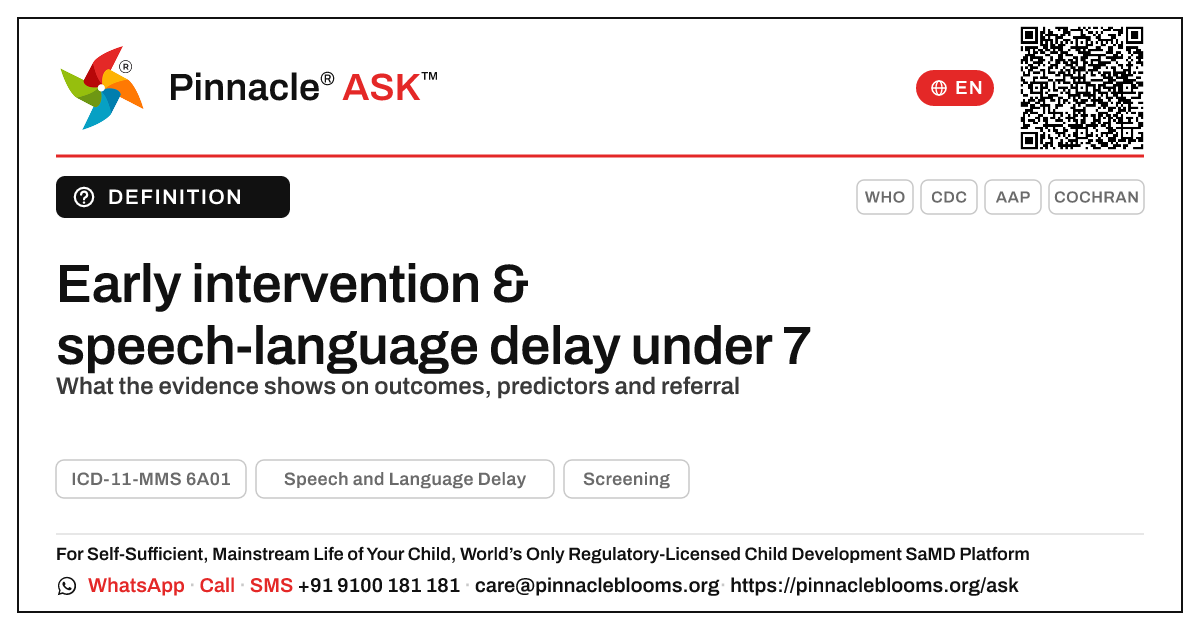
Early intervention outcomes for speech and language delay under 7
Research consistently shows that early, structured intervention for speech and language delay in children under seven improves expressive and receptive language, with the strongest, most durable gains when therapy begins in the preschool years and actively coaches caregivers. The contemporary stance is active surveillance plus timely targeted intervention rather than passive waiting.
In this answer 5 sections
The question every early-years researcher and clinician returns to: how much does intervening before seven actually change the trajectory?
In short
Current evidence is consistent and encouraging: early, structured intervention for speech and language delay in children under seven improves expressive and receptive language outcomes, with effect sizes strongest when intervention begins in the preschool years and incorporates the parent or primary caregiver. The under-seven window matters because language networks remain highly plastic, and earlier support reduces the secondary risks — literacy difficulty, social-emotional strain and behavioural sequelae — that can accumulate when delay persists untreated. Crucially, a proportion of late-talking toddlers do resolve spontaneously, so the contemporary stance is active surveillance plus timely, targeted intervention rather than indiscriminate treatment or passive 'wait-and-see'.
What the research shows
Magnitude and durability. Systematic reviews of speech-language therapy for children with primary developmental language difficulties report meaningful gains in expressive vocabulary and syntax, with more modest and variable effects for receptive language. Effects are most robust where intervention is intensive, individualised, and sustained rather than brief or one-off.
Parent-mediated intervention. A strong and replicated finding is that coaching caregivers to use responsive, language-rich interaction strategies yields gains comparable to clinician-delivered therapy for many younger children — and generalises better to everyday contexts. This shifts the dose from the therapy room into thousands of daily interactions.
Heterogeneity matters. Outcomes differ by phenotype: isolated expressive delay, mixed receptive-expressive difficulty, and delay secondary to hearing loss, global developmental delay or autism each follow distinct trajectories. Predictors of poorer spontaneous resolution include receptive involvement, family history, limited gesture and weak comprehension — these children warrant earlier, more intensive support rather than watchful waiting.
When to refer
Refer for formal assessment with persistent parental concern, no babble or gesture by 12 months, no single words by 16 months, no two-word combinations by 24 months, any regression of acquired language at any age, or comprehension lagging noticeably behind peers. Hearing should be checked first in every case. Under ICD-11, developmental speech or language disorders are coded under 6A01.
The Pinnacle way
A clinical AbilityScore® and any diagnosis are formed only at a Pinnacle Blooms Network centre, under qualified clinician care — never from an online form or an app. Our approach to speech and language delay pairs clinician-led speech therapy with structured caregiver coaching, so that evidence on parent-mediated gains is operationalised in each family's daily life. Across 70+ centres, 25 million+ therapy sessions and 12 validated studies, that model is built to measure change the same way every time.
Trusted sources
WHO ICD-11 (6A01, developmental speech or language disorders); CDC developmental milestones and 'Learn the Signs. Act Early.'; American Academy of Pediatrics guidance via HealthyChildren.org; Cochrane reviews of speech and language therapy for children. Findings are paraphrased and reflect the consensus that earlier, caregiver-inclusive intervention improves outcomes.
Next step — Reviewing a child or designing a pathway? Partner with a Pinnacle clinician to establish a measured baseline.
This is general information, not a diagnosis — individual assessment and diagnosis require an appropriately qualified healthcare professional.
CONNECT THE ANSWER TO YOUR CHILD’S DAY
Something to notice. Something to discuss.
What to notice
Receptive (comprehension) involvement, limited gesture, weak word combinations and family history predict poorer spontaneous resolution and warrant earlier, more intensive support.
In everyday life
Responsive, language-rich caregiver interaction repeated across daily routines can match clinic-delivered gains for many young children and generalises better to real life.
Bring your observations and questions to your child’s professional. Choose activities that suit your child’s comfort, abilities and agreed plan.
Bring your questions to a first visitQuestions families ask
Does early intervention work better than waiting?
For children with receptive involvement, limited gesture or family history, earlier targeted intervention is associated with better outcomes than passive waiting. Some isolated late talkers resolve spontaneously, so the evidence-based stance is active surveillance combined with timely, individualised intervention rather than indiscriminate treatment or delay.
How effective is parent-mediated therapy?
Replicated evidence shows that coaching caregivers to use responsive, language-rich strategies produces gains comparable to clinician-delivered therapy for many younger children, and often generalises better to everyday contexts because the language dose moves into daily interaction.
Why is the under-7 window emphasised?
Language networks remain highly plastic in early childhood, and earlier support reduces secondary risks such as literacy difficulty and social-emotional strain that can accumulate when delay persists untreated.
FOLLOW THE SOURCE
References behind this answer.
- Source referenceWHO ICD-11 — Developmental speech or language disorders
- Source referenceCDC — Learn the Signs. Act Early.
- Organisation website · further readingAmerican Academy of Pediatrics — HealthyChildren.org
- Organisation website · further readingCochrane — systematic reviews of speech and language therapy
References are supplied with this answer. An organisation homepage offers further reading; it does not establish an independent review of this page.
Content attribution: SETU Consortium · Pinnacle Blooms Network.
PEOPLE, TOPICS & DEVELOPMENT
See the connections.
Browse the wider question collections connected with this answer’s audience, developmental area and stage.
FROM UNDERSTANDING TO PURPOSEFUL SUPPORT
One question. Your child’s whole life.
Your child’s self-sufficient, mainstream-included life is the purpose from the beginning. At Pinnacle, that purpose shapes what we understand, the goals we choose, the people we bring together, everyday practice and review.
Connect this question with the right support.
Explore how the relevant service contributes to everyday abilities, then speak with us about your child.
Make the next conversation useful.
Bring the situations you notice at home or school. We’ll explain a suitable service, centre and first visit, including availability and fees, before you decide.
How PinnacleAI® connects the journeyExplore the seven stages
- 1Understand abilities
A starting picture of your child’s capabilities.
- 2Choose meaningful goals
Readiness and a plan shaped around the child.
- 3Bring the right support together
Suitable therapies and people for those goals.
- 4Carry practice into everyday life
Guidance for family, home and school.
- 5Track and correct
Use observations to adjust the plan.
- 6Reassess and review
Decide what to continue, change or do next.
- 7Grow independence and participation
The child’s life gives each step its purpose.
Explore the whole PinnacleAI® system → · Participation at school and in the community →
PINNACLE’S EVIDENCE, OPEN TO YOU
Look at the evidence behind our work.
Read our research, inspect the original regulatory documents and check what each institutional measure means.
General information supports a conversation with an appropriately qualified professional. Advice, goals and support depend on the individual child.