
YOUR QUESTION. A CLEARER NEXT STEP.
ICD-11 Classification of Speech and Language Delay (6A01)
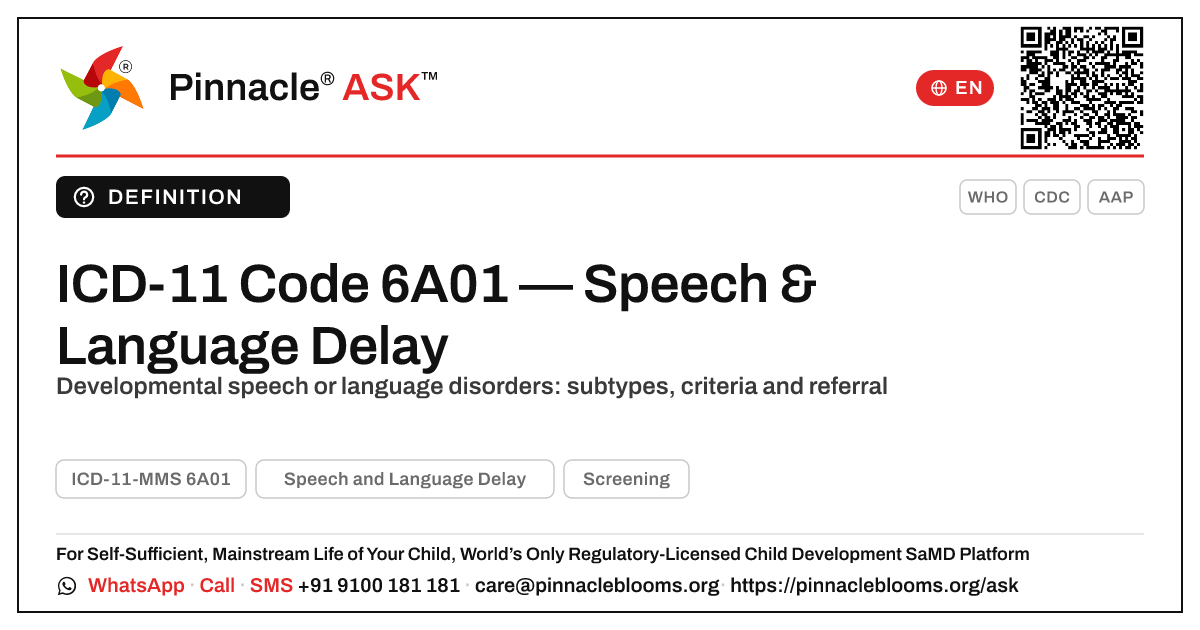
In ICD-11-MMS, speech and language delay is classified under code 6A01 — Developmental speech or language disorders, within neurodevelopmental disorders. It encompasses speech sound disorder (6A01.0), speech fluency disorder (6A01.1) and developmental language disorder (6A01.2), distinguishing a true developmental disorder from transient variation.
In this answer 5 sections
Behind a parent's worry about "late talking" sits a precise clinical question — where does speech and language delay actually sit in ICD-11?
In short
In ICD-11-MMS, what is colloquially called speech and language delay is classified under 6A01 — Developmental speech or language disorders, within the broader grouping of neurodevelopmental disorders (6A0). The code captures persistent difficulties in acquiring, producing or understanding speech and language that begin in the developmental period and are not better accounted for by hearing loss, another sensory deficit, intellectual developmental disorder or a global delay. ICD-11 deliberately distinguishes a true developmental disorder from transient or expected variation — so "delay" is a presenting concern, while 6A01 is the diagnostic classification.
The classification, in detail
The 6A01 block resolves into clinically meaningful subtypes, which is the practical value of ICD-11 over a single "delay" label:
- 6A01.0 Developmental speech sound disorder — difficulty with articulation/phonology beyond age expectation.
- 6A01.1 Developmental speech fluency disorder — disruption of normal fluency and timing (stuttering).
- 6A01.2 Developmental language disorder, with subtypes specifying impairment of receptive and expressive language, mainly expressive, mainly pragmatic, or other specified profiles.
Diagnosis requires that the difficulty falls substantially below the expected level for age, emerges in the developmental period, and produces functional limitation — and that hearing impairment and other neurological or intellectual conditions have been considered. ICD-11 sits alongside the WHO ICF functioning framework, so the code names the condition while functional profiling describes its day-to-day impact.
When to refer
Refer for structured speech-language assessment rather than "watchful waiting" when there is no babble or gesture by 12 months, no single words by 16 months, no two-word phrases by 24 months, any loss of previously acquired words, or persistent parental concern. Always rule out hearing loss first via audiology.
The Pinnacle way
AbilityScore® is part of Pinnacle’s developmental assessment. Diagnosis, where needed, requires an appropriately qualified healthcare professional — never from a code, a checklist or an app. Coding informs the clinical picture; it does not replace assessment. Explore how we support speech and language development, how the AbilityScore® is established, and begin a developmental review.
Trusted sources
WHO ICD-11 for Mortality and Morbidity Statistics, code 6A01 (developmental speech or language disorders); CDC developmental milestone guidance; Indian Academy of Pediatrics; American Academy of Pediatrics (HealthyChildren.org); RBSK developmental screening framework.
Next step — Refer or review a child with persistent speech-language concerns at a Pinnacle Blooms Network centre for structured, clinician-led assessment.
This is general information, not a diagnosis — individual assessment and diagnosis require an appropriately qualified healthcare professional.
CONNECT THE ANSWER TO YOUR CHILD’S DAY
Something to notice. Something to discuss.
What to notice
Persistent difficulty below age expectation in speech production, fluency or language comprehension/expression, beginning in the developmental period and not explained by hearing loss or global delay.
In everyday life
Before attributing late talking to a disorder, confirm hearing has been formally tested — undetected otitis media or sensorineural loss is the most common reversible mimic.
Bring your observations and questions to your child’s professional. Choose activities that suit your child’s comfort, abilities and agreed plan.
Bring your questions to a first visitQuestions families ask
What is the exact ICD-11 code for speech and language delay?
It is classified under 6A01 — Developmental speech or language disorders — in the ICD-11-MMS, within the neurodevelopmental disorders grouping (6A0).
Does ICD-11 use the term 'delay' or 'disorder'?
ICD-11 codes the condition as a developmental speech or language disorder (6A01). 'Delay' is a presenting concern; the formal classification requires functional impairment beginning in the developmental period and exclusion of other causes such as hearing loss.
What are the subtypes under 6A01?
Developmental speech sound disorder (6A01.0), developmental speech fluency disorder (6A01.1) and developmental language disorder (6A01.2), the latter with receptive-expressive, mainly expressive and pragmatic profiles.
Should every late-talking child be coded under 6A01?
No. Diagnosis requires performance substantially below age expectation with functional limitation, after considering hearing loss, intellectual developmental disorder and global delay. Hearing should be formally assessed first.
FOLLOW THE SOURCE
References behind this answer.
- Source referenceWHO ICD-11 MMS — Developmental speech or language disorders
- Source referenceCDC — Learn the Signs. Act Early. milestones
- Organisation website · further readingAmerican Academy of Pediatrics — HealthyChildren.org
References are supplied with this answer. An organisation homepage offers further reading; it does not establish an independent review of this page.
Content attribution: SETU Consortium · Pinnacle Blooms Network.
PEOPLE, TOPICS & DEVELOPMENT
See the connections.
Browse the wider question collections connected with this answer’s audience, developmental area and stage.
FROM UNDERSTANDING TO PURPOSEFUL SUPPORT
One question. Your child’s whole life.
Your child’s self-sufficient, mainstream-included life is the purpose from the beginning. At Pinnacle, that purpose shapes what we understand, the goals we choose, the people we bring together, everyday practice and review.
Connect this question with the right support.
Explore how the relevant service contributes to everyday abilities, then speak with us about your child.
Make the next conversation useful.
Bring the situations you notice at home or school. We’ll explain a suitable service, centre and first visit, including availability and fees, before you decide.
How PinnacleAI® connects the journeyExplore the seven stages
- 1Understand abilities
A starting picture of your child’s capabilities.
- 2Choose meaningful goals
Readiness and a plan shaped around the child.
- 3Bring the right support together
Suitable therapies and people for those goals.
- 4Carry practice into everyday life
Guidance for family, home and school.
- 5Track and correct
Use observations to adjust the plan.
- 6Reassess and review
Decide what to continue, change or do next.
- 7Grow independence and participation
The child’s life gives each step its purpose.
Explore the whole PinnacleAI® system → · Participation at school and in the community →
PINNACLE’S EVIDENCE, OPEN TO YOU
Look at the evidence behind our work.
Read our research, inspect the original regulatory documents and check what each institutional measure means.
General information supports a conversation with an appropriately qualified professional. Advice, goals and support depend on the individual child.