
YOUR QUESTION. A CLEARER NEXT STEP.
Do girls show social communication difficulties differently?
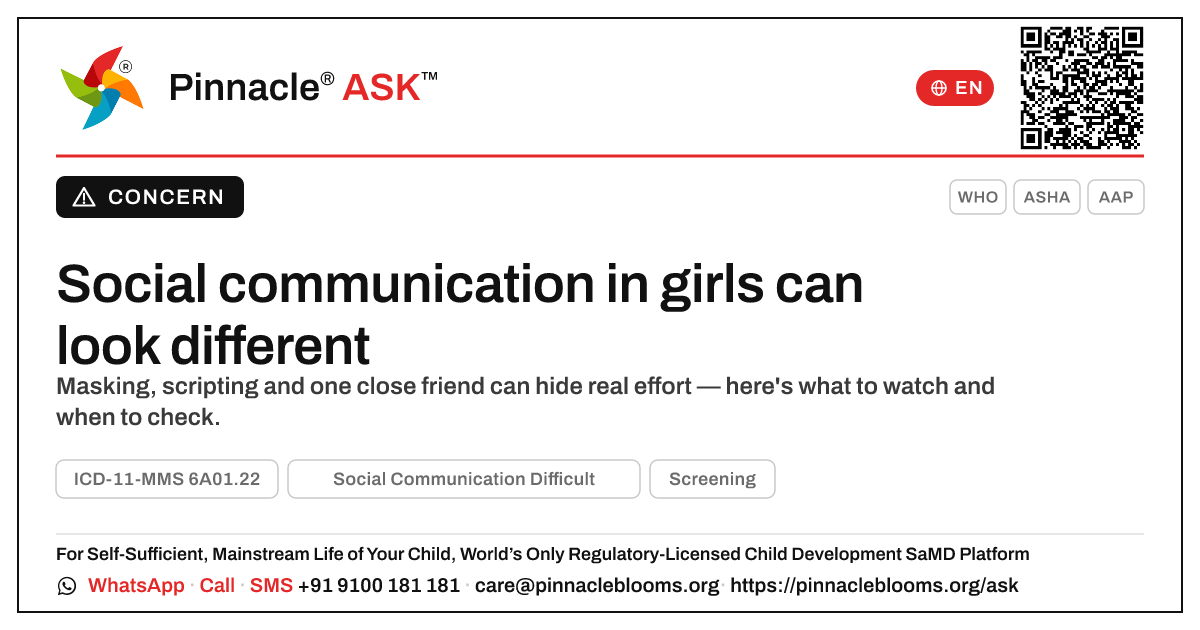
Social communication difficulties can present differently in girls — often masked by copying, scripting and one close friendship, with strain showing as anxiety or exhaustion rather than obvious signs. This means they are frequently recognised later. Differences in presentation don't change what helps, and only a clinician can confirm what you're seeing.
In this answer 5 sections
If your daughter seems to manage socially in glimpses — then struggles in ways you can't quite name — your instinct to look closer is worth honouring.
In short
Yes — social communication difficulties can look different in girls, and that is one reason they are so often missed or recognised later. Many girls watch, copy and rehearse social behaviour, which can mask underlying difficulty so that it shows up as exhaustion, anxiety or a sudden struggle when social demands rise (often around the school years). Differences in presentation are real, but they do not change what helps — and only a qualified clinician can tell whether what you're seeing is social communication difficulty or simply your daughter's own pace.
What this can look like in girls
Social communication difficulty (ICD-11 6A01.22) means persistent trouble with the everyday, back-and-forth use of language and social cues — reading tone, taking turns, adjusting to context. In many girls this can appear as:
- Masking or camouflaging — copying phrases, expressions or a friend's behaviour to "fit in", which hides effort underneath.
- One close friend rather than a group — managing one-to-one but tiring quickly in busy social settings.
- Conversations that follow a learned script — fine on familiar ground, harder when chat is open-ended or fast-moving.
- Difficulty that surfaces under load — coping at school, then meltdowns, withdrawal or anxiety at home once the effort is spent.
- Subtler signs — being slightly behind on the unspoken rules of friendship, missing jokes or hints, or finding group play overwhelming.
These are patterns to gently observe, not a checklist for self-diagnosis. The effort it takes to mask is itself worth noticing.
When to seek a check
If the difficulty is persistent across settings, if your daughter seems drained or distressed by social demands, or if friendships feel consistently hard to sustain — a developmental check brings clarity. Earlier understanding means support shaped to her, before the masking turns into anxiety.
The Pinnacle way
Developmental measurement supports care planning; diagnosis requires an appropriately qualified healthcare professional., under qualified clinician care — never from an online description or form. Our clinicians look closely at how your daughter communicates in her own world, against her own AbilityScore® baseline, and where helpful build a plan through speech and language therapy that strengthens genuine connection — not just a better mask.
Trusted sources
WHO ICD-11 (6A01.22, social communication difficulties); American Speech-Language-Hearing Association (ASHA) on social communication; AAP/HealthyChildren guidance on developmental monitoring.
Next step — The kindest response to a quiet worry is a clear look. Book a developmental check with a Pinnacle clinician.
This is general information, not a diagnosis — individual assessment and diagnosis require an appropriately qualified healthcare professional.
CONNECT THE ANSWER TO YOUR CHILD’S DAY
Something to notice. Something to discuss.
What to notice
Watch for a gap between how she copes in public and how drained or distressed she is afterwards, friendships that are hard to sustain over time, and social difficulty that grows as demands rise at school. Persistent strain across settings is the flag — not one tricky day.
In everyday life
Give her low-pressure, one-to-one social time where she doesn't have to perform — drawing, cooking or a shared task side by side. Narrate the small social moments gently ("I think she wanted a turn — shall we ask?") so the unspoken rules become spoken, without putting her on the spot.
Bring your observations and questions to your child’s professional. Choose activities that suit your child’s comfort, abilities and agreed plan.
Bring your questions to a first visitQuestions families ask
Why are social communication difficulties often missed in girls?
Many girls camouflage — they watch, copy and rehearse social behaviour, which can mask the underlying effort. The difficulty may only surface as anxiety, tiredness or withdrawal once social demands rise, so it is frequently recognised later than in boys.
Does a girl having one good friend mean she's fine socially?
Not necessarily. Managing one close, predictable friendship while struggling in larger or open-ended groups is a common pattern. It's the overall picture across settings — and how much effort it costs her — that matters, which is what a clinical assessment looks at.
Should I be worried if my daughter copes at school but melts down at home?
It's worth a gentle look. Coping all day and then unravelling at home can mean she is masking effort throughout the day. A developmental check can clarify whether this is social communication difficulty or another cause — only a clinician can confirm.
FOLLOW THE SOURCE
References behind this answer.
- Organisation website · further readingWHO ICD-11 — social communication difficulties
- Organisation website · further readingASHA — social communication
- Organisation website · further readingAAP HealthyChildren — developmental monitoring
References are supplied with this answer. An organisation homepage offers further reading; it does not establish an independent review of this page.
Content attribution: SETU Consortium · Pinnacle Blooms Network.
PEOPLE, TOPICS & DEVELOPMENT
See the connections.
Browse the wider question collections connected with this answer’s audience, developmental area and stage.
FROM UNDERSTANDING TO PURPOSEFUL SUPPORT
One question. Your child’s whole life.
Your child’s self-sufficient, mainstream-included life is the purpose from the beginning. At Pinnacle, that purpose shapes what we understand, the goals we choose, the people we bring together, everyday practice and review.
Connect this question with the right support.
Explore how the relevant service contributes to everyday abilities, then speak with us about your child.
Make the next conversation useful.
Bring the situations you notice at home or school. We’ll explain a suitable service, centre and first visit, including availability and fees, before you decide.
How PinnacleAI® connects the journeyExplore the seven stages
- 1Understand abilities
A starting picture of your child’s capabilities.
- 2Choose meaningful goals
Readiness and a plan shaped around the child.
- 3Bring the right support together
Suitable therapies and people for those goals.
- 4Carry practice into everyday life
Guidance for family, home and school.
- 5Track and correct
Use observations to adjust the plan.
- 6Reassess and review
Decide what to continue, change or do next.
- 7Grow independence and participation
The child’s life gives each step its purpose.
Explore the whole PinnacleAI® system → · Participation at school and in the community →
PINNACLE’S EVIDENCE, OPEN TO YOU
Look at the evidence behind our work.
Read our research, inspect the original regulatory documents and check what each institutional measure means.
General information supports a conversation with an appropriately qualified professional. Advice, goals and support depend on the individual child.