
YOUR QUESTION. A CLEARER NEXT STEP.
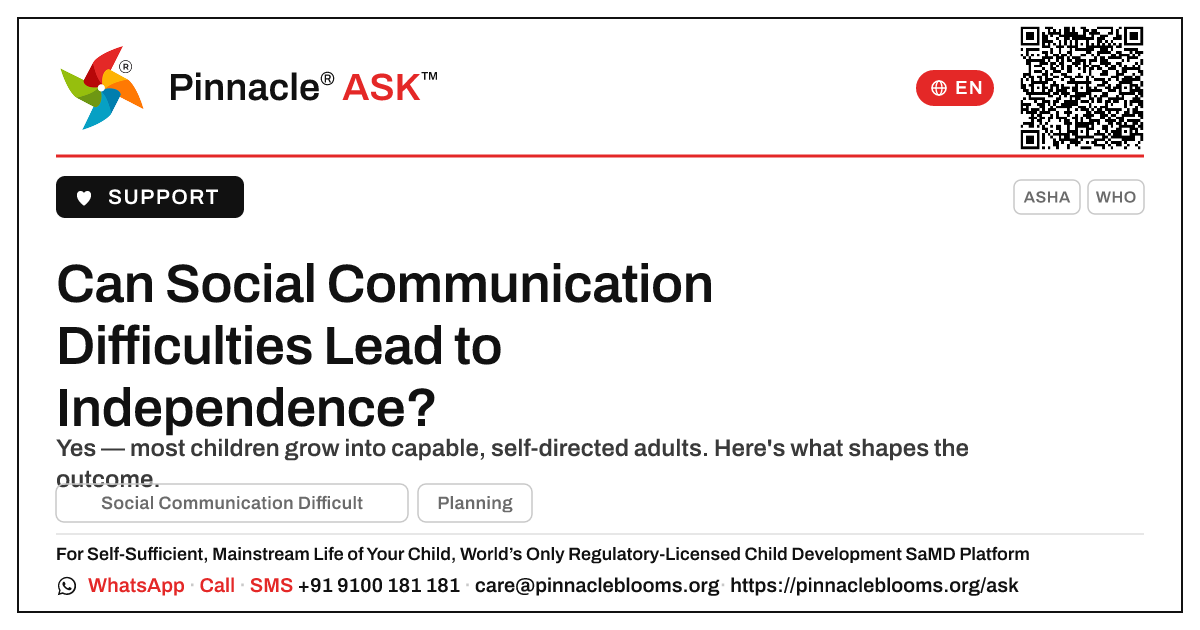
Can a Child With Social Communication Difficulties Live Independently?
Yes — most children with Social Communication Difficulties grow into independent adults who work, build friendships and run their own homes. Social communication is a learnable skill, and early, real-life practice in a strengths-first environment shapes the outcome most. Independence is built step by step, starting now.
In this answer 4 sections
When your child finds the back-and-forth of conversation hard, it's natural to look ahead and wonder about the grown-up they'll become. Here's an honest, hopeful answer.
In short
Yes — most children with Social Communication Difficulties grow into capable, independent adults who hold jobs, build friendships and run their own homes. Social communication is a learnable skill, not a fixed ceiling, and the earlier a child is supported, the more naturally these skills fold into everyday life. Independence is built step by step — and it starts long before adulthood.
What shapes the outcome
Social communication difficulty means trouble with the practical, social use of language — reading tone, taking turns in conversation, knowing what to say to whom, following the unspoken rules of social settings. It is not about intelligence, warmth or capability, and it does not limit how far a child can go.
What genuinely shifts the long-term picture:
- Early, targeted support — practising conversation, perspective-taking and social problem-solving while the brain is most adaptable.
- Real-life practice — skills rehearsed in play, at the dinner table, with siblings and peers, not only in a therapy room.
- A strengths-first environment — schools and families that build on what your child is good at, rather than spotlighting what's hard.
- Self-understanding as they grow — teens who learn their own social style cope and self-advocate brilliantly.
Many adults simply develop their own toolkit — scripts, routines, honest friendships — and thrive on their own terms.
The Pinnacle way
Developmental measurement supports care planning; diagnosis requires an appropriately qualified healthcare professional., under the care of a qualified clinician — never from an online form or a single conversation. Our speech-language therapists map your child's social communication against their own AbilityScore baseline, so progress is measured child-to-self, and we build a plan that turns small wins into lifelong independence. Across 70+ centres and 25 million+ therapy sessions, the goal is always the same: your child communicating with confidence, and living a full, self-directed life.
Trusted sources
World Health Organization classification of developmental communication difficulties; American Speech-Language-Hearing Association (ASHA) guidance on social communication and adult outcomes; Pinnacle Blooms Network clinical studies.
Next step — Independence grows from the support given today. Book a social communication assessment with a Pinnacle speech-language therapist.
This is general information, not a diagnosis — individual assessment and diagnosis require an appropriately qualified healthcare professional.
CONNECT THE ANSWER TO YOUR CHILD’S DAY
Something to notice. Something to discuss.
What to notice
Watch how your child copes in new social settings and with peers, not just at home. Growing self-awareness, the ability to ask for help, and small everyday wins — joining a game, holding a short chat — are strong signs of building independence.
In everyday life
Turn daily routines into gentle social practice: take turns in a simple game, narrate feelings ("You look excited!"), and pause to let your child respond. Ten minutes of warm back-and-forth a day builds the very skills independence rests on.
Bring your observations and questions to your child’s professional. Choose activities that suit your child’s comfort, abilities and agreed plan.
Bring your questions to a first visitQuestions families ask
Will my child outgrow social communication difficulties?
Many children make strong gains, especially with early support, and develop their own confident social toolkit. Rather than waiting to 'outgrow' it, targeted practice in real-life settings helps these skills develop naturally over time.
Does social communication difficulty affect intelligence?
No. Social communication difficulty is about the practical, social use of language — reading tone, taking turns, social rules. It is unrelated to intelligence, warmth or how capable your child is in other areas.
When should I have my child assessed?
The sooner the better — early support is when the brain is most adaptable. A qualified speech-language therapist can map your child's strengths and needs and build a plan; no diagnosis is ever made from an online form.
FOLLOW THE SOURCE
References behind this answer.
- Source referenceASHA — Social Communication Disorder
- Source referenceWHO — Disability and developmental support
References are supplied with this answer. An organisation homepage offers further reading; it does not establish an independent review of this page.
Content attribution: SETU Consortium · Pinnacle Blooms Network.
PEOPLE, TOPICS & DEVELOPMENT
See the connections.
Browse the wider question collections connected with this answer’s audience, developmental area and stage.
FROM UNDERSTANDING TO PURPOSEFUL SUPPORT
One question. Your child’s whole life.
Your child’s self-sufficient, mainstream-included life is the purpose from the beginning. At Pinnacle, that purpose shapes what we understand, the goals we choose, the people we bring together, everyday practice and review.
Connect this question with the right support.
Explore how the relevant service contributes to everyday abilities, then speak with us about your child.
Make the next conversation useful.
Bring the situations you notice at home or school. We’ll explain a suitable service, centre and first visit, including availability and fees, before you decide.
How PinnacleAI® connects the journeyExplore the seven stages
- 1Understand abilities
A starting picture of your child’s capabilities.
- 2Choose meaningful goals
Readiness and a plan shaped around the child.
- 3Bring the right support together
Suitable therapies and people for those goals.
- 4Carry practice into everyday life
Guidance for family, home and school.
- 5Track and correct
Use observations to adjust the plan.
- 6Reassess and review
Decide what to continue, change or do next.
- 7Grow independence and participation
The child’s life gives each step its purpose.
Explore the whole PinnacleAI® system → · Participation at school and in the community →
PINNACLE’S EVIDENCE, OPEN TO YOU
Look at the evidence behind our work.
Read our research, inspect the original regulatory documents and check what each institutional measure means.
General information supports a conversation with an appropriately qualified professional. Advice, goals and support depend on the individual child.