
YOUR QUESTION. A CLEARER NEXT STEP.
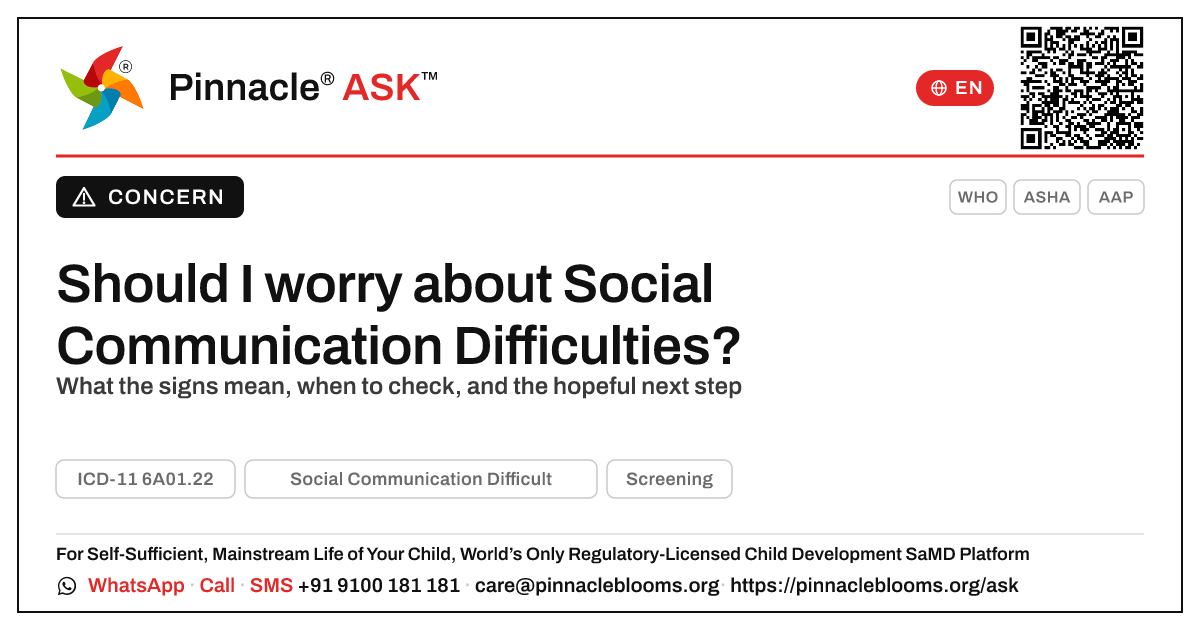
Should I be worried about Social Communication Difficulties?
Worry is reasonable, but worry is not a diagnosis. Persistent difficulty with the social use of language — turn-taking, reading cues, adjusting to listeners — beyond about age 4–5, can signal Social Communication Difficulties, and early assessment is the hopeful next step. Only a clinician can confirm it.
In this answer 5 sections
If your child finds the give-and-take of conversation harder than other children do, your worry is real — and reasonable. Here's what it may mean, and what to do with it.
In short
Social Communication Difficulties describe persistent trouble with the social use of language — taking turns in conversation, reading tone or body language, adjusting how you speak to different people, or understanding hints, humour and stories — that isn't better explained by another condition. Single awkward moments are part of normal childhood. A pattern that persists and gets in the way of friendships and learning is the real flag. Worry is a good reason to check — it is not, by itself, a diagnosis.
Signs worth gentle attention
- Difficulty taking turns in back-and-forth conversation, or talking at people rather than with them
- Trouble adjusting language to the listener or the setting (same way with a teacher as with a baby)
- Missing hints, sarcasm, jokes or unspoken social rules
- Hard to start, follow or repair a conversation, or to tell a simple story in order
- Finds making and keeping friends harder than peers
These skills mature gradually, so brief lags can be normal. A persisting cluster, beyond about age 4–5, is what merits a closer look.
The science, briefly
The WHO classifies this within developmental disorders of speech or language (ICD-11 6A01.22). The social side of communication is sometimes overlooked because vocabulary and grammar can look fine — yet it is central to friendships, classroom learning and confidence. Identified early, these skills respond well to warm, structured support.
The Pinnacle way
Only a qualified speech-language pathologist can tell whether this is a difficulty needing support or a passing phase. Developmental measurement supports care planning; diagnosis requires an appropriately qualified healthcare professional., under qualified clinician care — never from an online form. Your child is measured against their own baseline, and you leave with clarity and a plan, not a label.
Trusted sources
WHO ICD-11 (6A01.22); American Speech-Language-Hearing Association (ASHA) guidance on social communication; AAP developmental guidance.
Next step — The kindest thing you can do with worry is check. Book a communication assessment with a Pinnacle speech-language pathologist.
This is general information, not a diagnosis — individual assessment and diagnosis require an appropriately qualified healthcare professional.
CONNECT THE ANSWER TO YOUR CHILD’S DAY
Something to notice. Something to discuss.
What to notice
Seek assessment sooner if your child is increasingly left out or frustrated in group play, cannot follow simple conversations with familiar adults by age 4–5, or withdraws from social settings they once enjoyed.
In everyday life
Build back-and-forth play: roll a ball, take turns naming things, or tell a story together one line each. Pause warmly and wait for your child's turn — these tiny conversational loops are powerful practice in social communication.
Bring your observations and questions to your child’s professional. Choose activities that suit your child’s comfort, abilities and agreed plan.
Bring your questions to a first visitQuestions families ask
Is Social Communication Difficulty the same as autism?
No. The two can overlap, but Social Communication Difficulties focus specifically on the social use of language, without the restricted, repetitive behaviours seen in autism. A clinician looks at the whole picture to tell them apart — which is exactly what an assessment is for.
At what age should I start to be concerned?
Social skills develop gradually, so brief lags are normal. A persisting pattern of difficulty with conversation, reading social cues or making friends beyond roughly age 4–5 is worth a professional check.
Can these skills improve with support?
Yes. Identified early, social communication skills respond well to warm, structured speech-language therapy. The aim is always your child communicating and thriving among peers.
FOLLOW THE SOURCE
References behind this answer.
- Organisation website · further readingWHO ICD-11: developmental speech or language disorders
- Organisation website · further readingASHA: social communication disorder
- Organisation website · further readingAAP HealthyChildren: communication milestones
References are supplied with this answer. An organisation homepage offers further reading; it does not establish an independent review of this page.
Content attribution: SETU Consortium · Pinnacle Blooms Network.
PEOPLE, TOPICS & DEVELOPMENT
See the connections.
Browse the wider question collections connected with this answer’s audience, developmental area and stage.
FROM UNDERSTANDING TO PURPOSEFUL SUPPORT
One question. Your child’s whole life.
Your child’s self-sufficient, mainstream-included life is the purpose from the beginning. At Pinnacle, that purpose shapes what we understand, the goals we choose, the people we bring together, everyday practice and review.
Connect this question with the right support.
Explore how the relevant service contributes to everyday abilities, then speak with us about your child.
Make the next conversation useful.
Bring the situations you notice at home or school. We’ll explain a suitable service, centre and first visit, including availability and fees, before you decide.
How PinnacleAI® connects the journeyExplore the seven stages
- 1Understand abilities
A starting picture of your child’s capabilities.
- 2Choose meaningful goals
Readiness and a plan shaped around the child.
- 3Bring the right support together
Suitable therapies and people for those goals.
- 4Carry practice into everyday life
Guidance for family, home and school.
- 5Track and correct
Use observations to adjust the plan.
- 6Reassess and review
Decide what to continue, change or do next.
- 7Grow independence and participation
The child’s life gives each step its purpose.
Explore the whole PinnacleAI® system → · Participation at school and in the community →
PINNACLE’S EVIDENCE, OPEN TO YOU
Look at the evidence behind our work.
Read our research, inspect the original regulatory documents and check what each institutional measure means.
General information supports a conversation with an appropriately qualified professional. Advice, goals and support depend on the individual child.