
YOUR QUESTION. A CLEARER NEXT STEP.
Standardised tools for assessing Social Communication Difficulties in early childhood
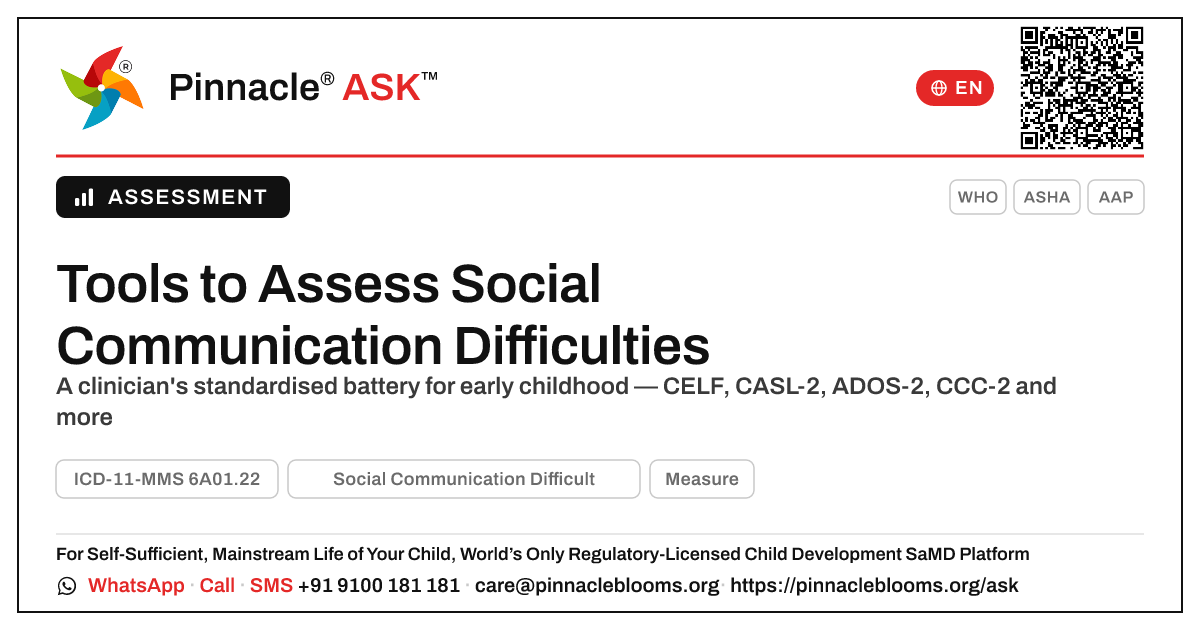
No single test diagnoses Social Communication Difficulties (ICD-11 6A01.22). Clinicians use a battery — a standardised language/pragmatics measure (CELF, CASL-2), structured observation (ADOS-2 to differentiate ASD), caregiver report (CCC-2, SCQ, SRS-2, CDI), plus developmental history and audiology clearance — interpreted together by age and verbal level.
In this answer 4 sections
A child with social communication difficulties is often first flagged not by a single test, but by a clinician triangulating across structured tools.
In short
No single instrument diagnoses Social Communication Difficulties (ICD-11 6A01.22). Best practice uses a battery: a standardised language and pragmatics measure, a structured observation of social interaction, a caregiver questionnaire, and a developmental history — interpreted together against a child's age and culture. The aim is to characterise pragmatic-social communication relative to structural language, and to rule out ASD, hearing loss and global delay.
The standardised toolkit
Direct assessment & observation
- CELF Preschool-2 / CELF-5 — core and pragmatic-profile subtests for receptive/expressive language.
- CASL-2 — pragmatic judgement and inference where verbal level allows.
- ADOS-2 (Toddler/Module 1) — structured social-communication observation, chiefly to differentiate from ASD.
Caregiver / teacher report
- Children's Communication Checklist (CCC-2) — flags pragmatic difficulty against structural language.
- SCQ and SRS-2 — social-communication screening across settings.
- MacArthur-Bates CDI for the youngest children.
Foundations
- A multidisciplinary developmental history, plus a documented audiology clearance — untreated hearing loss must be excluded before attributing pragmatic difficulty.
Tool selection follows age, verbal level and presenting concern; scores inform a profile, not a label.
The Pinnacle way
A clinical AbilityScore® — and any diagnosis — is formed only at a Pinnacle Blooms Network centre, under qualified clinician care, never from a form or app. Our team integrates these standardised measures into one structured profile to guide therapy planning. See Social Communication Difficulties, our speech therapy pathway, and how the AbilityScore is calculated.
Trusted sources
WHO ICD-11 framing of developmental speech and language disorders; ASHA practice guidance on social-communication assessment; AAP developmental surveillance recommendations.
Next step — Partner with a Pinnacle centre to build a standardised assessment battery for your young clients.
This is general information, not a diagnosis — individual assessment and diagnosis require an appropriately qualified healthcare professional.
CONNECT THE ANSWER TO YOUR CHILD’S DAY
Something to notice. Something to discuss.
What to notice
Pragmatic difficulty that exceeds what structural language scores predict; persistent trouble with turn-taking, topic maintenance, inference and adjusting language to listener — across home, preschool and clinic settings.
In everyday life
Always confirm a recent audiology clearance before attributing pragmatic difficulty; untreated hearing loss mimics social-communication delay and must be excluded first.
Bring your observations and questions to your child’s professional. Choose activities that suit your child’s comfort, abilities and agreed plan.
Bring your questions to a first visitQuestions families ask
Does one test diagnose Social Communication Difficulties?
No. Assessment relies on a battery — direct language/pragmatics measures, structured observation, caregiver report and developmental history — interpreted together. A clinical diagnosis is formed only by a qualified clinician at a Pinnacle Blooms Network centre.
How is this distinguished from autism spectrum disorder?
Social communication difficulty involves pragmatic-social impairment without the restricted, repetitive behaviours and interests required for ASD. Tools such as ADOS-2 and SRS-2 help characterise this, but differentiation is a clinical judgement, not a single score.
Why is audiology clearance essential first?
Untreated hearing loss can closely mimic social-communication delay. Documented audiology clearance is needed before attributing difficulty to pragmatic-language factors.
FOLLOW THE SOURCE
References behind this answer.
- Source referenceWHO ICD-11: developmental speech and language disorders
- Organisation website · further readingASHA: social-communication assessment guidance
- Organisation website · further readingAAP: developmental surveillance and screening
References are supplied with this answer. An organisation homepage offers further reading; it does not establish an independent review of this page.
Content attribution: SETU Consortium · Pinnacle Blooms Network.
PEOPLE, TOPICS & DEVELOPMENT
See the connections.
Browse the wider question collections connected with this answer’s audience, developmental area and stage.
FROM UNDERSTANDING TO PURPOSEFUL SUPPORT
One question. Your child’s whole life.
Your child’s self-sufficient, mainstream-included life is the purpose from the beginning. At Pinnacle, that purpose shapes what we understand, the goals we choose, the people we bring together, everyday practice and review.
Connect this question with the right support.
Explore how the relevant service contributes to everyday abilities, then speak with us about your child.
Make the next conversation useful.
Bring the situations you notice at home or school. We’ll explain a suitable service, centre and first visit, including availability and fees, before you decide.
How PinnacleAI® connects the journeyExplore the seven stages
- 1Understand abilities
A starting picture of your child’s capabilities.
- 2Choose meaningful goals
Readiness and a plan shaped around the child.
- 3Bring the right support together
Suitable therapies and people for those goals.
- 4Carry practice into everyday life
Guidance for family, home and school.
- 5Track and correct
Use observations to adjust the plan.
- 6Reassess and review
Decide what to continue, change or do next.
- 7Grow independence and participation
The child’s life gives each step its purpose.
Explore the whole PinnacleAI® system → · Participation at school and in the community →
PINNACLE’S EVIDENCE, OPEN TO YOU
Look at the evidence behind our work.
Read our research, inspect the original regulatory documents and check what each institutional measure means.
General information supports a conversation with an appropriately qualified professional. Advice, goals and support depend on the individual child.