
YOUR QUESTION. A CLEARER NEXT STEP.
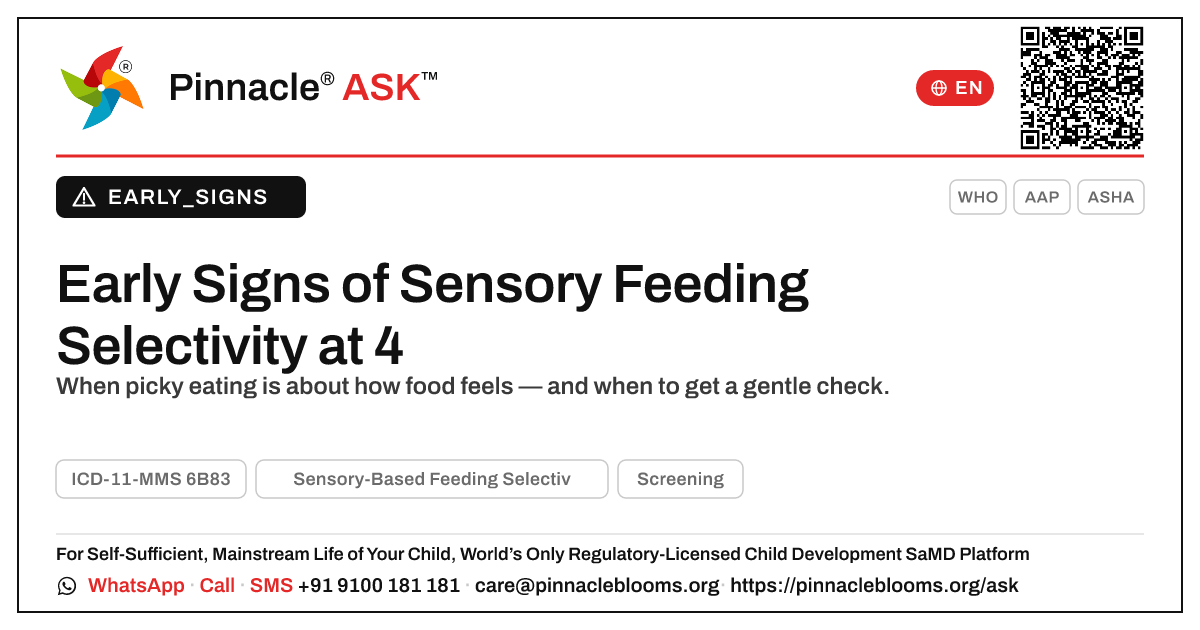
Early Signs of Sensory-Based Feeding Selectivity in a 4-Year-Old Boy
Sensory-based feeding selectivity in a 4-year-old shows as a strong, persistent narrowing of accepted foods by texture, smell or appearance — gagging or recoiling at new foods, distress when foods touch, refusing whole textures — well beyond ordinary fussiness. It is common and often improvable; a developmental check, not a wait, is the right next step.
In this answer 5 sections
Mealtimes can feel like a daily battle when your little one turns away from so many foods — and you are not imagining it, nor are you to blame.
In short
Sensory-based feeding selectivity in a 4-year-old shows as a strong, persistent narrowing of accepted foods — often by texture, smell, colour or brand — that goes well beyond ordinary toddler fussiness and can leave him eating only a handful of items. The clue is sensory: he reacts to how a food feels or looks, not just whether he likes it. This is common, often improvable, and worth a gentle developmental check rather than a wait.
Early signs to watch
How he reacts to food
- Accepts only a small, fixed range of foods (often beige or crunchy) and the list seems to shrink, not grow
- Refuses whole textures — purées, mixed dishes, anything "wet" or "lumpy"
- Gags, retches or visibly recoils at the sight, smell or touch of new foods
- Needs a specific brand, packet, plate or presentation, and is upset by any change
Around the table
- New foods touching "safe" foods on the plate causes real distress
- Will skip a meal entirely rather than try an unfamiliar item
- May explore food with fingers cautiously, or avoid touching it at all
- Strong reactions are not stubbornness — they reflect genuine sensory discomfort
Why it matters When selectivity is this narrow, watch for low energy, constipation, or a very limited variety across food groups. These are signals to seek support, not reasons to panic.
When to seek a check
Most 4-year-olds go through fussy phases that ease with patience. Consider a developmental check when the pattern is intense, persistent across months and settings, narrowing his diet, or causing mealtime distress for him and the family. A check looks at feeding, sensory processing, oral-motor skills and growth together — and pairs naturally with occupational therapy where sensory strategies help.
The Pinnacle way
At Pinnacle Blooms Network, feeding selectivity is understood through a child's sensory world, building on the foods he already trusts. A clinical AbilityScore® and any diagnosis are formed only at a Pinnacle Blooms Network centre under qualified clinician care — never from an online list. Across 70+ centres, our therapists support families with practical, play-led mealtime strategies. It is a structured, clinician-administered assessment, not a diagnostic label you can self-apply.
Trusted sources
Aligned with WHO ICD-11 (6B83 Avoidant-restrictive food intake disorder), the American Academy of Pediatrics and HealthyChildren.org guidance on picky eating, and ASHA resources on paediatric feeding.
Next step — message our clinical team on WhatsApp at +91 91001 81181 to arrange a gentle feeding and developmental check for your son.
This is general information, not a diagnosis — individual assessment and diagnosis require an appropriately qualified healthcare professional.
CONNECT THE ANSWER TO YOUR CHILD’S DAY
Something to notice. Something to discuss.
What to notice
Seek a same-month check if his food list is shrinking, he gags or recoils at new foods, skips meals over textures, or shows low energy, constipation or poor weight gain — these signal it's more than a fussy phase.
In everyday life
Keep new foods on a separate side plate so they never touch his safe foods, and invite him to just look at or touch them with no pressure to eat — exposure without demand lowers sensory alarm.
Bring your observations and questions to your child’s professional. Choose activities that suit your child’s comfort, abilities and agreed plan.
Bring your questions to a first visitQuestions families ask
Is this just normal fussy eating?
Many 4-year-olds are fussy and grow out of it. Sensory-based selectivity is different — it is intense and persistent, driven by how foods feel, smell or look, and his diet tends to narrow rather than widen. When that pattern lasts months and causes real mealtime distress, a gentle check is wise.
Could forcing him to eat make it worse?
Pressure usually increases the sensory alarm and can deepen refusal. Calm, no-pressure exposure — letting him see, touch or smell foods without having to eat them — tends to work far better, ideally guided by a therapist.
Will my son grow out of it on his own?
Some children ease naturally, but when selectivity is severe or affects energy, growth or variety, early support helps. A developmental and feeding check can tell you whether watchful waiting or active help is the right path.
FOLLOW THE SOURCE
References behind this answer.
- Source referenceWHO ICD-11: Avoidant-restrictive food intake disorder
- Organisation website · further readingAAP HealthyChildren.org: picky eating guidance
- Organisation website · further readingASHA: paediatric feeding and swallowing
References are supplied with this answer. An organisation homepage offers further reading; it does not establish an independent review of this page.
Content attribution: SETU Consortium · Pinnacle Blooms Network.
PEOPLE, TOPICS & DEVELOPMENT
See the connections.
Browse the wider question collections connected with this answer’s audience, developmental area and stage.
FROM UNDERSTANDING TO PURPOSEFUL SUPPORT
One question. Your child’s whole life.
Your child’s self-sufficient, mainstream-included life is the purpose from the beginning. At Pinnacle, that purpose shapes what we understand, the goals we choose, the people we bring together, everyday practice and review.
Connect this question with the right support.
Explore how the relevant service contributes to everyday abilities, then speak with us about your child.
Make the next conversation useful.
Bring the situations you notice at home or school. We’ll explain a suitable service, centre and first visit, including availability and fees, before you decide.
How PinnacleAI® connects the journeyExplore the seven stages
- 1Understand abilities
A starting picture of your child’s capabilities.
- 2Choose meaningful goals
Readiness and a plan shaped around the child.
- 3Bring the right support together
Suitable therapies and people for those goals.
- 4Carry practice into everyday life
Guidance for family, home and school.
- 5Track and correct
Use observations to adjust the plan.
- 6Reassess and review
Decide what to continue, change or do next.
- 7Grow independence and participation
The child’s life gives each step its purpose.
Explore the whole PinnacleAI® system → · Participation at school and in the community →
PINNACLE’S EVIDENCE, OPEN TO YOU
Look at the evidence behind our work.
Read our research, inspect the original regulatory documents and check what each institutional measure means.
General information supports a conversation with an appropriately qualified professional. Advice, goals and support depend on the individual child.