
YOUR QUESTION. A CLEARER NEXT STEP.
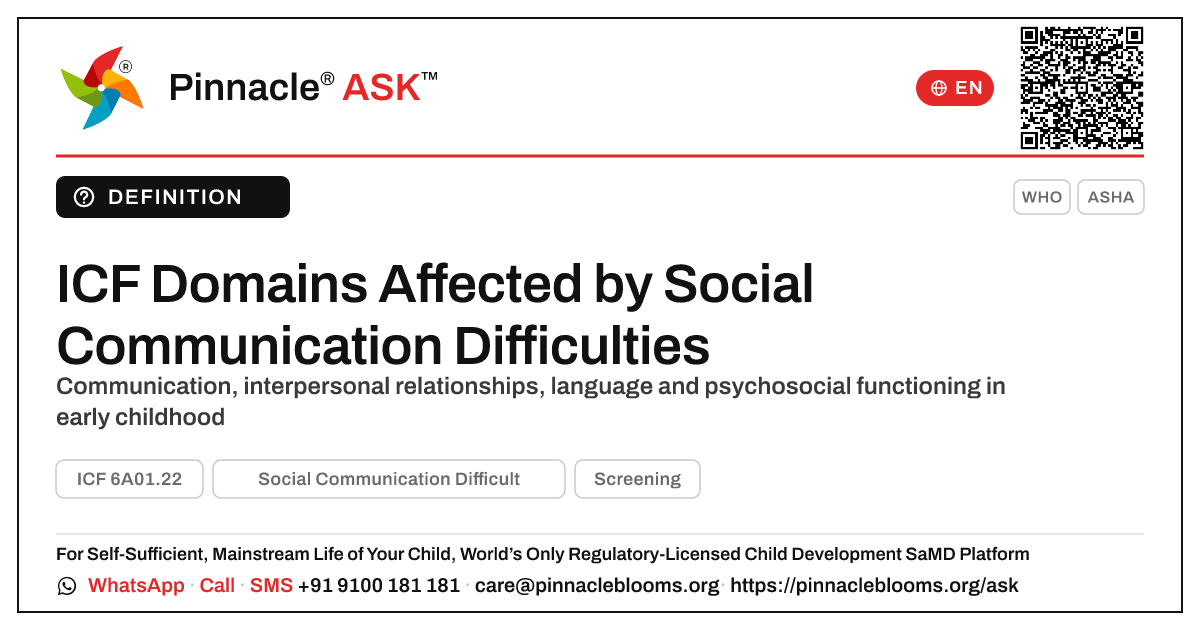
ICF Functioning Domains in Social Communication Difficulties
Social Communication Difficulties affect functioning mainly within the ICF Activities and Participation component — Chapter d3 Communication and d7 Interpersonal interactions — with flow-on effects to d8 major life areas (play, early learning) and d2 general tasks. On the Body Functions side, b167 language and b122 global psychosocial functions are key contributors, modulated by environmental and personal factors.
In this answer 4 sections
A young child's social-communication difficulty is never confined to one box — it ripples across how they connect, learn and take part in everyday life.
In short
Social Communication Difficulties affect functioning predominantly within the ICF Activities and Participation domain — most directly Chapter d3 Communication and Chapter d7 Interpersonal interactions and relationships — with meaningful flow-on effects to d8 Major life areas (early learning, play) and d2 General tasks and demands. On the Body Functions side, b167 Mental functions of language and the b122 Global psychosocial functions are the principal contributors. Environmental (e3 support and relationships, e4 attitudes) and personal factors then modulate how much these impairments translate into real-world participation restriction.
The ICF domains in detail
Using the WHO ICF biopsychosocial frame, map the difficulty across components rather than as a single deficit:
Body Functions (b)
- b167 Mental functions of language — reception and expression, including pragmatic and discourse functions.
- b122 Global psychosocial functions — the foundation for reciprocal social engagement.
- b1252 / b140 Attention and behavioural regulation functions that support joint attention.
Activities & Participation (d)
- d3 Communication — d310 receiving spoken messages, d330 speaking, d335 producing nonverbal messages (gesture, eye gaze), d350 conversation.
- d7 Interpersonal interactions and relationships — d710 basic interpersonal interactions, d720 complex interactions, d7504 informal relationships with peers.
- d8 Major life areas — d815/d880 engagement in play and early pre-school participation.
- d2 General tasks — d250 managing one's own behaviour within social demands.
Contextual factors
- Environmental (e310, e355, e410) — family, professional and attitudinal supports that can be barrier or facilitator.
- Personal factors — temperament, co-occurring profiles.
This multi-domain mapping is what distinguishes the ICF from a purely deficit-based ICD-11 description (6A01.22), and it is precisely the framing that drives functional, participation-led goal-setting in early childhood.
The Pinnacle way
A clinical AbilityScore® and any diagnosis are formed only at a Pinnacle Blooms Network centre, under qualified clinician care — never from an online tool. Across 70+ centres in 4 states, our clinicians profile functioning across exactly these ICF domains so that goals target participation, not just impairment. Pragmatic and expressive gains are then built through structured speech therapy.
Trusted sources
WHO International Classification of Functioning, Disability and Health (ICF), including the ICF-CY child and youth derivation; WHO ICD-11 for the linked diagnostic concept; ASHA practice guidance on social-communication and pragmatic functioning.
Next step — Partner with a Pinnacle clinician to translate this ICF profile into a measurable, participation-focused plan. Begin a structured developmental assessment.
This is general information, not a diagnosis — individual assessment and diagnosis require an appropriately qualified healthcare professional.
CONNECT THE ANSWER TO YOUR CHILD’S DAY
Something to notice. Something to discuss.
What to notice
Persistent reduced reciprocity, limited gesture and eye gaze, and weak pragmatic conversation skills that restrict play and peer participation across settings rather than in one context alone.
In everyday life
When documenting, code participation restriction (d-codes) alongside impairment (b-codes) — it makes goals functional and progress measurable across home, preschool and therapy settings.
Bring your observations and questions to your child’s professional. Choose activities that suit your child’s comfort, abilities and agreed plan.
Bring your questions to a first visitQuestions families ask
Which single ICF chapter is most affected in Social Communication Difficulties?
Chapter d3 (Communication) within the Activities and Participation component is the most directly affected, particularly d350 conversation and d335 producing nonverbal messages, closely followed by d7 interpersonal interactions and relationships.
How does the ICF mapping differ from the ICD-11 code 6A01.22?
ICD-11 6A01.22 names the diagnostic concept; the ICF describes how that condition affects functioning across body functions, activities, participation and contextual factors. The two are complementary, not interchangeable.
Why include environmental factors in the ICF profile?
Environmental factors (e3 supports, e4 attitudes) determine whether an underlying impairment becomes a real-world participation restriction. Strong family and preschool facilitators can substantially reduce functional disability.
FOLLOW THE SOURCE
References behind this answer.
- Organisation website · further readingWHO ICD-11
- Source referenceASHA — Social Communication and Pragmatics
References are supplied with this answer. An organisation homepage offers further reading; it does not establish an independent review of this page.
Content attribution: SETU Consortium · Pinnacle Blooms Network.
PEOPLE, TOPICS & DEVELOPMENT
See the connections.
Browse the wider question collections connected with this answer’s audience, developmental area and stage.
FROM UNDERSTANDING TO PURPOSEFUL SUPPORT
One question. Your child’s whole life.
Your child’s self-sufficient, mainstream-included life is the purpose from the beginning. At Pinnacle, that purpose shapes what we understand, the goals we choose, the people we bring together, everyday practice and review.
Connect this question with the right support.
Explore how the relevant service contributes to everyday abilities, then speak with us about your child.
Make the next conversation useful.
Bring the situations you notice at home or school. We’ll explain a suitable service, centre and first visit, including availability and fees, before you decide.
How PinnacleAI® connects the journeyExplore the seven stages
- 1Understand abilities
A starting picture of your child’s capabilities.
- 2Choose meaningful goals
Readiness and a plan shaped around the child.
- 3Bring the right support together
Suitable therapies and people for those goals.
- 4Carry practice into everyday life
Guidance for family, home and school.
- 5Track and correct
Use observations to adjust the plan.
- 6Reassess and review
Decide what to continue, change or do next.
- 7Grow independence and participation
The child’s life gives each step its purpose.
Explore the whole PinnacleAI® system → · Participation at school and in the community →
PINNACLE’S EVIDENCE, OPEN TO YOU
Look at the evidence behind our work.
Read our research, inspect the original regulatory documents and check what each institutional measure means.
General information supports a conversation with an appropriately qualified professional. Advice, goals and support depend on the individual child.