
YOUR QUESTION. A CLEARER NEXT STEP.
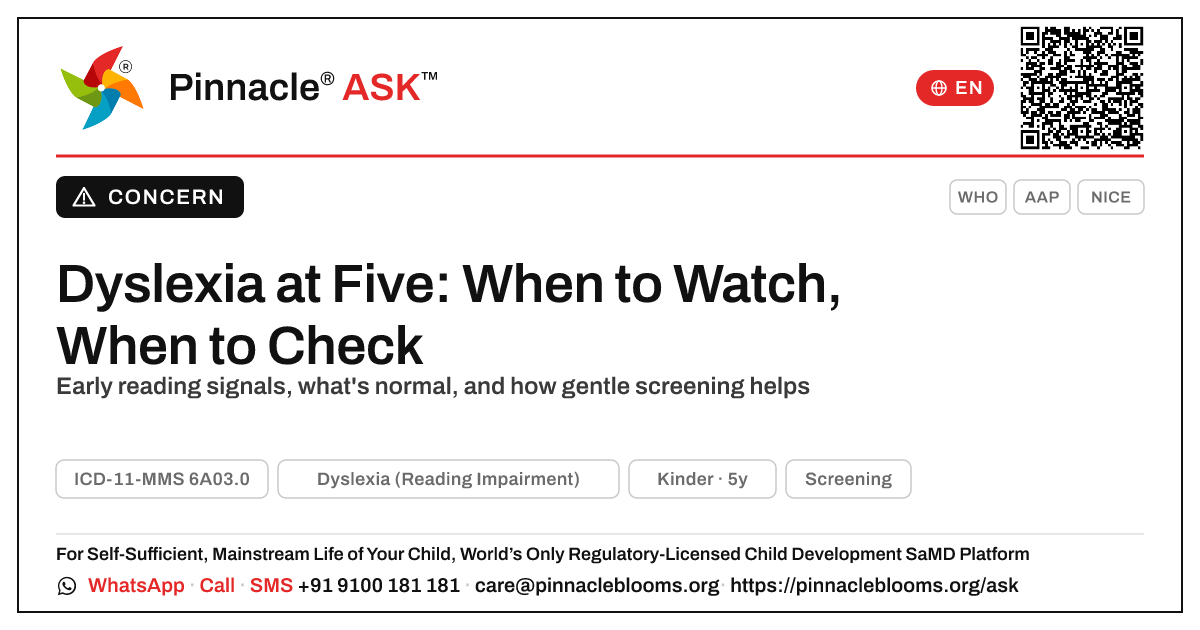
When to worry about dyslexia at five years
At five, a formal dyslexia diagnosis is usually too early — children are only beginning to learn letters and sounds. This is the age to watch the building blocks of reading: rhyme, sound play, letter recognition and family history. If several lag, or there is dyslexia in the family, a structured screen is wise — not a label, but a path to early, playful support that works best when started young.
In this answer 5 sections
At five, reading is just beginning — so noticing how your child plays with sounds and letters now is a gift, not a cause for alarm.
In short
At five, a formal dyslexia diagnosis is usually too early — most children are only starting to learn letters and sounds, and there is wide, healthy variation in pace. Rather than "worry", this is the age to watch the early building blocks of reading: rhyme, sound play, letter recognition and family history. If several of these lag, or there's dyslexia in the family, a structured screen is wise — not because something is wrong, but because early, playful support is remarkably effective.
What to watch at five years
Dyslexia is recognised more confidently once formal reading instruction is underway (often around 6–8 years). At five, these are gentle pre-reading signals worth a clinician's eye — never a diagnosis on their own:
- Sound awareness — struggles to hear or make rhymes, or to break simple words into beats/sounds (cat → c-a-t).
- Letters & names — slow to learn or recall letter names and the sounds they make, even with lots of exposure.
- Word retrieval — frequent "tip-of-the-tongue" pauses, or muddling similar-sounding words.
- Family history — a parent or sibling with reading or spelling difficulty (one of the strongest indicators).
- Spoken language — late talking, or persistent mix-ups in pronouncing longer words.
What is not a worry at five: reversing letters like b/d, writing some letters backwards, or needing repetition. These are completely typical at this age and usually resolve with practice.
When to seek a check
Arrange a developmental check if you notice several of the signals above together, if there is a strong family history of dyslexia, or if your child seems to be falling behind peers in playing with sounds and letters despite plenty of warm exposure. Early screening guides support — it does not label your child.
The Pinnacle way
A clinical AbilityScore® and any diagnosis are formed only at a Pinnacle Blooms Network centre, under qualified clinician care — never from an online list. Our clinicians build a strengths-based picture of your child's language and pre-reading skills, and shape playful, evidence-led support around them. You can read more about dyslexia and how our speech therapy team strengthens the sound-and-language foundations that reading is built on.
Trusted sources
ICD-11 describes developmental learning disorder with impairment in reading; the American Academy of Pediatrics (healthychildren.org) and ASHA outline early literacy and language milestones; NICE guidance frames assessment around emerging reading difficulty rather than fixed age cut-offs.
Next step — Trust what you've noticed. Book a developmental check with a Pinnacle clinician so your child's early reading foundations are reviewed with clarity and care.
This is general information, not a diagnosis — individual assessment and diagnosis require an appropriately qualified healthcare professional.
CONNECT THE ANSWER TO YOUR CHILD’S DAY
Something to notice. Something to discuss.
What to notice
Watch how your five-year-old plays with sounds: trouble hearing or making rhymes, slow to learn letter names and sounds despite exposure, frequent word-finding pauses, late or unclear speech, and a family history of reading difficulty. Letter reversals (b/d) and backward writing are normal at this age. Seek a check if several signals appear together or there is strong family history.
In everyday life
Make sound-play part of daily fun — sing rhyming songs, clap out syllables in names, and play "I spy something starting with sss". These build the exact pre-reading skills clinicians look for, and a few minutes a day reveals how comfortably your child hears and plays with sounds.
Bring your observations and questions to your child’s professional. Choose activities that suit your child’s comfort, abilities and agreed plan.
Bring your questions to a first visitQuestions families ask
Can dyslexia be diagnosed at age five?
Usually not formally — at five most children are only beginning to learn letters and sounds, so there's wide normal variation. Five is the age to watch the early building blocks (rhyme, sound play, letter recognition) and screen if several lag. A confident diagnosis typically follows once formal reading instruction is underway, often around 6–8 years.
Is it normal for my 5-year-old to reverse letters like b and d?
Yes — reversing b/d and writing some letters backwards is completely typical at five and usually resolves with practice. On its own it is not a sign of dyslexia. More telling early signals are difficulty with rhyme, breaking words into sounds, and learning letter names despite plenty of exposure.
Does dyslexia run in families?
Family history is one of the strongest early indicators. If a parent or sibling has reading or spelling difficulty, it's wise to watch your child's sound and letter skills closely and consider an early screen — not as a worry, but to enable early, playful support.
FOLLOW THE SOURCE
References behind this answer.
- Organisation website · further readingAAP — early literacy and language milestones
- Organisation website · further readingNICE — assessment of reading difficulty
References are supplied with this answer. An organisation homepage offers further reading; it does not establish an independent review of this page.
Content attribution: SETU Consortium · Pinnacle Blooms Network.
PEOPLE, TOPICS & DEVELOPMENT
See the connections.
Browse the wider question collections connected with this answer’s audience, developmental area and stage.
FROM UNDERSTANDING TO PURPOSEFUL SUPPORT
One question. Your child’s whole life.
Your child’s self-sufficient, mainstream-included life is the purpose from the beginning. At Pinnacle, that purpose shapes what we understand, the goals we choose, the people we bring together, everyday practice and review.
Connect this question with the right support.
Start with your child’s strengths, your observations and what you want everyday life to become.
Make the next conversation useful.
Bring the situations you notice at home or school. We’ll explain a suitable service, centre and first visit, including availability and fees, before you decide.
How PinnacleAI® connects the journeyExplore the seven stages
- 1Understand abilities
A starting picture of your child’s capabilities.
- 2Choose meaningful goals
Readiness and a plan shaped around the child.
- 3Bring the right support together
Suitable therapies and people for those goals.
- 4Carry practice into everyday life
Guidance for family, home and school.
- 5Track and correct
Use observations to adjust the plan.
- 6Reassess and review
Decide what to continue, change or do next.
- 7Grow independence and participation
The child’s life gives each step its purpose.
Explore the whole PinnacleAI® system → · Participation at school and in the community →
PINNACLE’S EVIDENCE, OPEN TO YOU
Look at the evidence behind our work.
Read our research, inspect the original regulatory documents and check what each institutional measure means.
General information supports a conversation with an appropriately qualified professional. Advice, goals and support depend on the individual child.