
YOUR QUESTION. A CLEARER NEXT STEP.
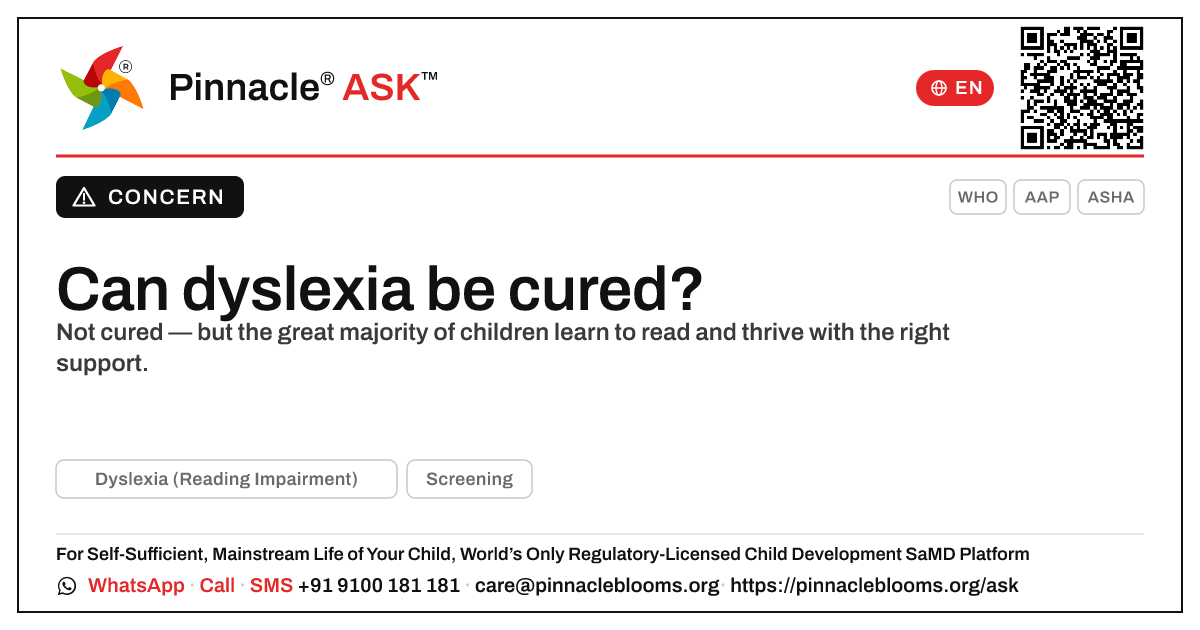
Can dyslexia be cured?
Dyslexia isn't an illness to be cured — it's a lifelong difference in how the brain processes reading. But with early, structured literacy teaching and the right accommodations, the vast majority of children learn to read, spell and thrive. Only a clinician can confirm dyslexia.
In this answer 4 sections
If your child sees letters dance on the page, you may be longing for a "cure" — but the real, hopeful answer is even better than that.
In short
Dyslexia is not an illness to be cured — it is a different way the brain processes written language, and it stays with a person for life. But "not curable" does not mean "not changeable". With the right structured teaching, the great majority of children with dyslexia learn to read, spell and thrive — many go on to flourish at school, university and in careers. The goal is not to erase dyslexia; it is to build skilful, confident readers.
What actually helps
The science here is reassuringly clear. Reading is a learned skill, and the dyslexic brain learns it through a different, more explicit route:
- Structured literacy — systematic, step-by-step teaching of how sounds map to letters (phonics), built up cumulatively. This is the most evidence-backed approach worldwide.
- Early start matters — the younger the support begins, the easier reading comes and the more a child's confidence stays intact.
- Accommodations — extra time, audiobooks and assistive technology let a bright child show what they truly know while their reading strengthens.
- Protecting confidence — many dyslexic children are creative, verbal and quick thinkers. Naming the difficulty early prevents the quiet belief that they are "not clever".
Think of it like glasses for reading: the difficulty doesn't vanish, but with the right tools and teaching the child reads, learns and shines.
The Pinnacle way
Whether your child has dyslexia — or simply needs more time — is something only a qualified clinician can determine; a clinical AbilityScore® baseline and any diagnosis are formed only at a Pinnacle Blooms Network centre under qualified clinician care, never from an online form. Our special education and literacy support teams build a plan around your child's own reading profile, drawing on structured, evidence-led methods. The aim is always the same: a child who reads, learns and believes in their own mind.
Trusted sources
WHO ICD-11 on developmental learning disorders; the American Academy of Pediatrics and HealthyChildren.org on reading difficulties; ASHA on literacy and language; Pinnacle Blooms Network clinical studies.
Next step — Curiosity is kinder than waiting. Book a reading and learning assessment with a Pinnacle specialist and get clarity, not labels.
This is general information, not a diagnosis — individual assessment and diagnosis require an appropriately qualified healthcare professional.
CONNECT THE ANSWER TO YOUR CHILD’S DAY
Something to notice. Something to discuss.
What to notice
Seek assessment sooner if your child avoids reading, tires quickly when reading aloud, reverses or muddles letters past age 7, struggles to learn letter sounds, or says they feel 'stupid' — protecting confidence is as urgent as building skill.
In everyday life
Read aloud together daily and let your child follow with a finger — no pressure to perform. Audiobooks alongside the printed book build vocabulary and love of stories while reading skills grow. Celebrate effort, not just accuracy.
Bring your observations and questions to your child’s professional. Choose activities that suit your child’s comfort, abilities and agreed plan.
Bring your questions to a first visitQuestions families ask
Will my child grow out of dyslexia?
Dyslexia is lifelong — children don't grow out of it. But with structured literacy teaching and the right support, most learn to read fluently and do very well at school and beyond. The difficulty becomes manageable, not limiting.
Is dyslexia a sign of low intelligence?
Not at all. Dyslexia is unrelated to intelligence — many dyslexic children are bright, creative and verbally strong. The difficulty is specific to processing written language, which is why early, targeted teaching is so effective.
When should reading support begin?
The earlier the better. Even before a formal diagnosis, structured, explicit teaching of letter sounds helps, and starting young protects a child's confidence. A clinician can advise after assessing your child's reading profile.
FOLLOW THE SOURCE
References behind this answer.
- Organisation website · further readingWHO ICD-11 — developmental learning disorders
- Organisation website · further readingAAP HealthyChildren.org — learning disabilities
- Organisation website · further readingASHA — written language and literacy
References are supplied with this answer. An organisation homepage offers further reading; it does not establish an independent review of this page.
Content attribution: SETU Consortium · Pinnacle Blooms Network.
PEOPLE, TOPICS & DEVELOPMENT
See the connections.
Browse the wider question collections connected with this answer’s audience, developmental area and stage.
FROM UNDERSTANDING TO PURPOSEFUL SUPPORT
One question. Your child’s whole life.
Your child’s self-sufficient, mainstream-included life is the purpose from the beginning. At Pinnacle, that purpose shapes what we understand, the goals we choose, the people we bring together, everyday practice and review.
Connect this question with the right support.
Start with your child’s strengths, your observations and what you want everyday life to become.
Make the next conversation useful.
Bring the situations you notice at home or school. We’ll explain a suitable service, centre and first visit, including availability and fees, before you decide.
How PinnacleAI® connects the journeyExplore the seven stages
- 1Understand abilities
A starting picture of your child’s capabilities.
- 2Choose meaningful goals
Readiness and a plan shaped around the child.
- 3Bring the right support together
Suitable therapies and people for those goals.
- 4Carry practice into everyday life
Guidance for family, home and school.
- 5Track and correct
Use observations to adjust the plan.
- 6Reassess and review
Decide what to continue, change or do next.
- 7Grow independence and participation
The child’s life gives each step its purpose.
Explore the whole PinnacleAI® system → · Participation at school and in the community →
PINNACLE’S EVIDENCE, OPEN TO YOU
Look at the evidence behind our work.
Read our research, inspect the original regulatory documents and check what each institutional measure means.
General information supports a conversation with an appropriately qualified professional. Advice, goals and support depend on the individual child.