
YOUR QUESTION. A CLEARER NEXT STEP.
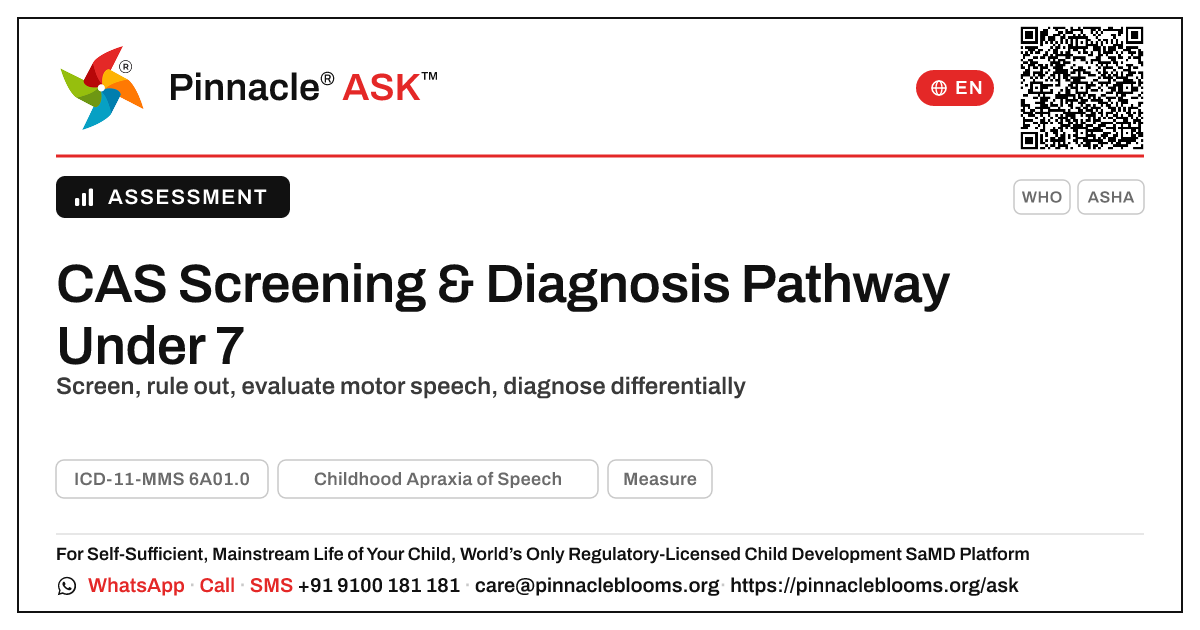
Screening and diagnostic pathway for Childhood Apraxia of Speech under 7
CAS has no single diagnostic test; a paediatric SLP makes the diagnosis after a differential motor-speech evaluation. The pathway is screen, rule out hearing and structural causes, comprehensive motor-speech assessment, and differential diagnosis. Under ~3 years a provisional designation enables early therapy with serial re-evaluation.
In this answer 4 sections
A child who knows exactly what they want to say but cannot reliably make the mouth do it — that is the puzzle CAS presents, and the pathway is built to solve it precisely.
In short
There is no single test for Childhood Apraxia of Speech (CAS, ICD-11 6A01.0); diagnosis is a clinical judgement made by a paediatric speech-language pathologist after differential motor-speech assessment. The pathway runs screen → hearing and oral-mechanism check → comprehensive motor-speech evaluation → differential diagnosis, and a provisional label is appropriate under ~3 years pending confirmation as speech emerges. Refer early — do not wait — because CAS responds to intensive, principled motor-based therapy.
The diagnostic pathway
1. Screen and rule out. Confirm hearing (audiology) and complete an oral-mechanism exam to exclude structural or dysarthric causes. Establish that receptive language and non-verbal cognition outstrip expressive speech — the hallmark dissociation.
2. Comprehensive motor-speech evaluation. Assess across varying utterance length and complexity, including diadochokinetic and multisyllabic tasks. ASHA recognises three consensus features: inconsistent errors on repeated productions, lengthened and disrupted coarticulatory transitions, and inappropriate prosody (notably lexical/phrasal stress).
3. Differential diagnosis. Distinguish from phonological disorder, dysarthria and severe expressive delay. In children under 3 with limited speech output, a working/provisional CAS designation enables therapy while the profile clarifies with repeated sampling.
4. Re-evaluation. Serial assessment tracks change and refines the diagnosis as the speech system matures.
The Pinnacle way
A clinical AbilityScore® and any diagnosis are formed only at a Pinnacle Blooms Network centre, under qualified clinician care — never from an app or checklist. Our speech therapy pathway pairs this structured, clinician-administered profile with motor-speech-specific intervention; see the full Childhood Apraxia of Speech overview for families.
Trusted sources
ASHA technical/position statements on CAS (asha.org); WHO ICD-11 6A01.0 (icd.who.int).
Next step — Refer a child with suspected CAS for a paediatric motor-speech evaluation — partner with a Pinnacle centre.
This is general information, not a diagnosis — individual assessment and diagnosis require an appropriately qualified healthcare professional.
CONNECT THE ANSWER TO YOUR CHILD’S DAY
Something to notice. Something to discuss.
What to notice
Inconsistent errors on repeated productions of the same word, disrupted coarticulatory transitions between sounds, and inappropriate prosody — alongside receptive language and cognition that clearly outstrip speech output.
In everyday life
When sampling speech, vary utterance length and complexity and ask for repeated productions of the same target — consistency across repetitions is what differentiates CAS from phonological disorder.
Bring your observations and questions to your child’s professional. Choose activities that suit your child’s comfort, abilities and agreed plan.
Bring your questions to a first visitQuestions families ask
Is there a single test that confirms Childhood Apraxia of Speech?
No. CAS is a clinical diagnosis made by a paediatric speech-language pathologist after a differential motor-speech evaluation, not from one standardised test. ASHA describes three consensus features — inconsistent errors, disrupted coarticulatory transitions, and inappropriate prosody — assessed across tasks of varying complexity.
Can CAS be diagnosed in a child under 3?
A provisional or working diagnosis is appropriate when speech output is limited, allowing therapy to begin while the profile is confirmed through repeated speech sampling and serial re-evaluation as the child's speech matures.
What must be ruled out before diagnosing CAS?
Hearing loss (via audiology), structural or oral-mechanism abnormalities, dysarthria, and phonological disorder. A key marker is receptive language and non-verbal cognition that clearly exceed expressive speech ability.
FOLLOW THE SOURCE
References behind this answer.
- Organisation website · further readingWHO ICD-11 6A01.0 Developmental speech sound disorder
- Organisation website · further readingASHA — Childhood Apraxia of Speech
References are supplied with this answer. An organisation homepage offers further reading; it does not establish an independent review of this page.
Content attribution: SETU Consortium · Pinnacle Blooms Network.
PEOPLE, TOPICS & DEVELOPMENT
See the connections.
Browse the wider question collections connected with this answer’s audience, developmental area and stage.
FROM UNDERSTANDING TO PURPOSEFUL SUPPORT
One question. Your child’s whole life.
Your child’s self-sufficient, mainstream-included life is the purpose from the beginning. At Pinnacle, that purpose shapes what we understand, the goals we choose, the people we bring together, everyday practice and review.
Connect this question with the right support.
Explore how the relevant service contributes to everyday abilities, then speak with us about your child.
Make the next conversation useful.
Bring the situations you notice at home or school. We’ll explain a suitable service, centre and first visit, including availability and fees, before you decide.
How PinnacleAI® connects the journeyExplore the seven stages
- 1Understand abilities
A starting picture of your child’s capabilities.
- 2Choose meaningful goals
Readiness and a plan shaped around the child.
- 3Bring the right support together
Suitable therapies and people for those goals.
- 4Carry practice into everyday life
Guidance for family, home and school.
- 5Track and correct
Use observations to adjust the plan.
- 6Reassess and review
Decide what to continue, change or do next.
- 7Grow independence and participation
The child’s life gives each step its purpose.
Explore the whole PinnacleAI® system → · Participation at school and in the community →
PINNACLE’S EVIDENCE, OPEN TO YOU
Look at the evidence behind our work.
Read our research, inspect the original regulatory documents and check what each institutional measure means.
General information supports a conversation with an appropriately qualified professional. Advice, goals and support depend on the individual child.