
YOUR QUESTION. A CLEARER NEXT STEP.
Can a Child with Specific Learning Disability Attend Mainstream School?
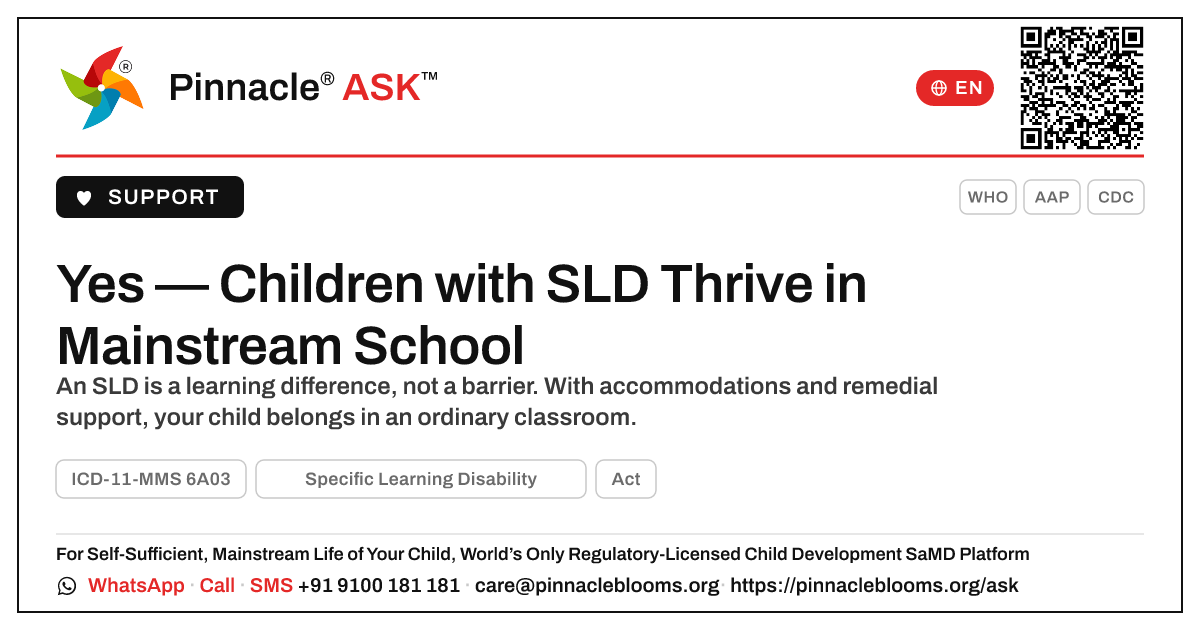
Yes — most children with a Specific Learning Disability attend and thrive in mainstream school. An SLD affects a specific skill, not intelligence. With reasonable accommodations such as extra time, a scribe or assistive tools, plus structured remedial teaching, children learn alongside their peers and progress to higher education.
In this answer 4 sections
The question every parent asks on diagnosis: will my child still belong in an ordinary classroom? The answer is a confident yes — with the right support.
In short
Yes — the vast majority of children with a Specific Learning Disability attend, thrive in, and complete mainstream school. A specific learning disability affects a particular skill such as reading, writing or maths; it is not a measure of intelligence, and it does not mean your child needs a separate school. With reasonable accommodations and targeted teaching, most children learn alongside their peers and go on to higher education and careers.
How mainstream school works for your child
Under India's inclusive-education framework, schools provide reasonable accommodations — extra time in exams, a reader or scribe, use of a calculator or laptop, spelling leniency, and assessment alternatives. These are well-established and your child is entitled to them. Alongside, structured remedial teaching builds the specific skill that is hard.
The evidence is clear: a learning disability is a difference in how the brain processes certain information, not a barrier to learning itself. Early, explicit, systematic instruction — especially for reading — produces strong gains. Your child stays in their community, with their friends, learning the same curriculum through routes that suit how their brain works.
The Pinnacle way
Developmental measurement supports care planning; diagnosis requires an appropriately qualified healthcare professional., under qualified clinician care — never from an app or online form. From there we build a school-ready support plan with you and your child's teachers. Explore Specific Learning Disability support, our special-education programmes, and how the AbilityScore works.
Trusted sources
WHO ICD-11 (developmental learning disorder); Indian Academy of Pediatrics; American Academy of Pediatrics guidance on learning differences and school support.
Next step — Ask a Pinnacle clinician to build your child's school-support plan — begin here.
This is general information, not a diagnosis — individual assessment and diagnosis require an appropriately qualified healthcare professional.
CONNECT THE ANSWER TO YOUR CHILD’S DAY
Something to notice. Something to discuss.
What to notice
Watch how your child copes with the school day, not just exam marks — frustration, avoidance of reading or homework, or tiredness can signal that accommodations need adjusting. Stay in close touch with teachers so support is reviewed each term.
In everyday life
Tell your child's class teacher early and specifically — name the accommodations your child is entitled to (extra time, a reader, leniency on spelling). A short, warm note works better than waiting for problems to surface.
Bring your observations and questions to your child’s professional. Choose activities that suit your child’s comfort, abilities and agreed plan.
Bring your questions to a first visitQuestions families ask
Does a Specific Learning Disability mean my child is less intelligent?
No. An SLD affects a specific skill such as reading, writing or maths, while overall intelligence is typically average or above. It describes how the brain processes certain information, not your child's ability to think or succeed.
What accommodations can a mainstream school provide?
Common, well-established accommodations include extra time in exams, a reader or scribe, use of a calculator or laptop, leniency on spelling, and alternative assessment formats — alongside structured remedial teaching for the specific skill.
Will my child need to move to a special school?
Usually not. Most children with SLD stay in mainstream school with their peers. Inclusive education and accommodations are designed precisely so children can learn the same curriculum in their own community.
FOLLOW THE SOURCE
References behind this answer.
- Source referenceWHO ICD-11 · Developmental learning disorder
- Organisation website · further readingAmerican Academy of Pediatrics · HealthyChildren.org
- Source referenceCDC · Learn the Signs. Act Early.
References are supplied with this answer. An organisation homepage offers further reading; it does not establish an independent review of this page.
Content attribution: SETU Consortium · Pinnacle Blooms Network.
PEOPLE, TOPICS & DEVELOPMENT
See the connections.
Browse the wider question collections connected with this answer’s audience, developmental area and stage.
FROM UNDERSTANDING TO PURPOSEFUL SUPPORT
One question. Your child’s whole life.
Your child’s self-sufficient, mainstream-included life is the purpose from the beginning. At Pinnacle, that purpose shapes what we understand, the goals we choose, the people we bring together, everyday practice and review.
Connect this question with the right support.
Explore how the relevant service contributes to everyday abilities, then speak with us about your child.
Make the next conversation useful.
Bring the situations you notice at home or school. We’ll explain a suitable service, centre and first visit, including availability and fees, before you decide.
How PinnacleAI® connects the journeyExplore the seven stages
- 1Understand abilities
A starting picture of your child’s capabilities.
- 2Choose meaningful goals
Readiness and a plan shaped around the child.
- 3Bring the right support together
Suitable therapies and people for those goals.
- 4Carry practice into everyday life
Guidance for family, home and school.
- 5Track and correct
Use observations to adjust the plan.
- 6Reassess and review
Decide what to continue, change or do next.
- 7Grow independence and participation
The child’s life gives each step its purpose.
Explore the whole PinnacleAI® system → · Participation at school and in the community →
PINNACLE’S EVIDENCE, OPEN TO YOU
Look at the evidence behind our work.
Read our research, inspect the original regulatory documents and check what each institutional measure means.
General information supports a conversation with an appropriately qualified professional. Advice, goals and support depend on the individual child.