
YOUR QUESTION. A CLEARER NEXT STEP.
Prevalence and public-health burden of Specific Learning Disability in India
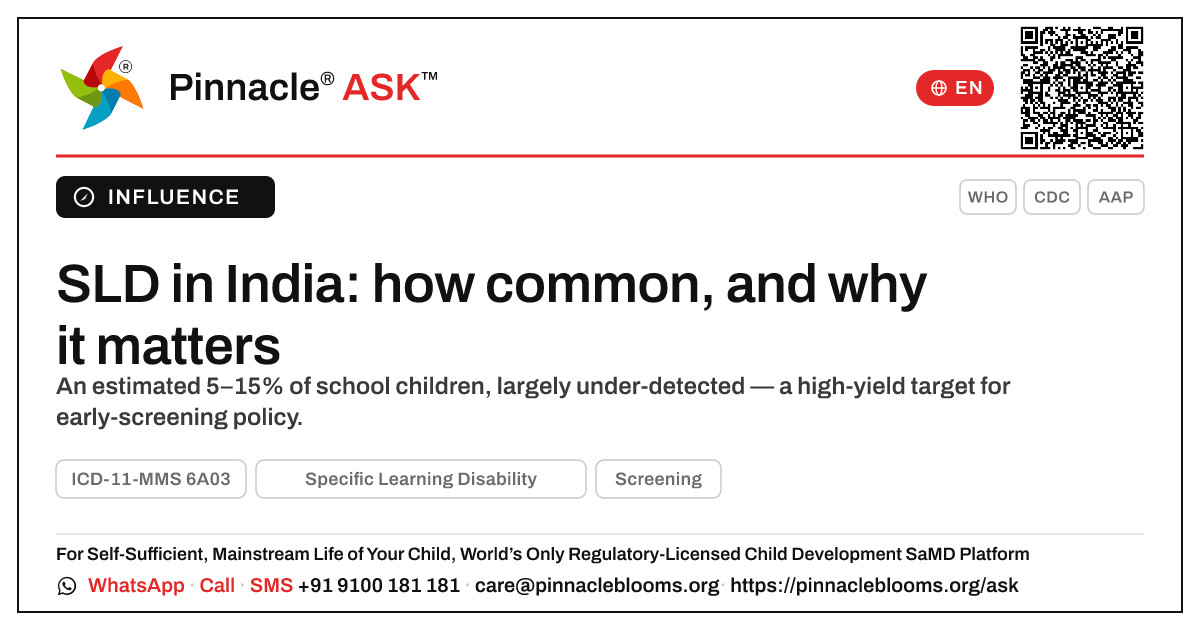
Specific Learning Disability (ICD-11 6A03) affects an estimated 5–15% of school-age children in India, but is reliably identified only from ages 6–8 and is heavily under-detected. The public-health burden — dropout, lowered employability, secondary anxiety — is large and largely preventable through early screening and structured remediation.
In this answer 5 sections
When a child struggles to read, write or reckon despite able effort, it is rarely laziness — and at population scale, it becomes a public-health question that policy must answer.
In short
Specific Learning Disability (SLD) — covering difficulties in reading, written expression and arithmetic — is among the most common neurodevelopmental conditions of childhood, yet it is reliably identified only from around ages 6–8, once formal schooling exposes the gap between effort and attainment. Indian community and school-based studies place prevalence in the broad range of roughly 5–15% of school-age children, with international estimates clustering similarly; the wide band reflects differing tools, languages and case definitions rather than true volatility. The public-health burden is large and largely under-counted in India, because most affected children are never formally screened. Early identification, accommodations and structured remediation change life trajectories — making SLD a high-yield target for policy investment.
The science and the burden
Under ICD-11, the relevant category is 6A03 — Developmental learning disorder, defined by significant, persistent difficulty acquiring academic skills that is not explained by intellectual disability, sensory impairment, inadequate schooling or another disorder. Because the diagnosis requires sustained underachievement against age and instruction, it is not meaningful in pre-schoolers; what is appropriate before age 6 is watchful monitoring of pre-literacy and pre-numeracy precursors — phonological awareness, vocabulary, attention and fine-motor skills.
The burden in India is best understood as three gaps:
- Detection gap — large numbers of children present as "weak students" and are never screened, so prevalence is systematically under-recorded.
- Service gap — identification often happens late, near board examinations, when remediation windows have narrowed.
- Equity gap — multilingual schooling and uneven access to assessment mean rural and first-generation learners are disproportionately missed.
The consequences — grade repetition, school dropout, lowered employability and secondary anxiety — are exactly the downstream costs that early-screening policy is designed to prevent.
When assessment becomes meaningful
Formal SLD assessment is appropriate from roughly age 6–8 onward, when a child shows persistent reading, spelling or arithmetic difficulty despite adequate teaching and effort. Before that, a general developmental check is the right route for any parent or teacher concern. Persistent underachievement that resists ordinary classroom support warrants structured evaluation.
The Pinnacle way
AbilityScore® is part of Pinnacle’s developmental assessment. Diagnosis, where needed, requires an appropriately qualified healthcare professional — never from an online form, screener or school checklist. As infrastructure serving 4.95 lakh+ families through 70+ centres across 4 states, Pinnacle partners with schools and government programmes to move identification earlier and make remediation routine. Learn more about Specific Learning Disability, explore structured learning-disability support, and understand our clinician-administered AbilityScore®.
Trusted sources
WHO ICD-11 (6A03, Developmental learning disorder); CDC developmental milestones and early-identification guidance; Indian Academy of Pediatrics; American Academy of Pediatrics (HealthyChildren.org). Figures are paraphrased ranges from community and school-based literature, not single fixed national counts.
Next step — If your department or school network wants earlier, scalable SLD identification, partner with Pinnacle to build a screening pathway.
This is general information, not a diagnosis — individual assessment and diagnosis require an appropriately qualified healthcare professional.
CONNECT THE ANSWER TO YOUR CHILD’S DAY
Something to notice. Something to discuss.
What to notice
From age 6–8, watch for persistent difficulty in reading, spelling or arithmetic that resists ordinary classroom support despite adequate effort and teaching; before age 6, monitor pre-literacy precursors rather than seeking a label.
In everyday life
Reading aloud daily and playing rhyming and counting games in a child's home language strengthens the phonological and number sense that later school learning builds on.
Bring your observations and questions to your child’s professional. Choose activities that suit your child’s comfort, abilities and agreed plan.
Bring your questions to a first visitQuestions families ask
Can Specific Learning Disability be diagnosed in pre-school children?
No. SLD (ICD-11 6A03) requires persistent academic underachievement against age and instruction, so it is reliably identified only from around ages 6–8 once formal schooling begins. Before that, monitor pre-literacy and pre-numeracy precursors and use a general developmental check for any concern.
Why do prevalence estimates for SLD in India vary so widely?
The 5–15% range reflects differing assessment tools, languages of instruction and case definitions across studies, plus large under-detection — not true variation in how common the condition is. Most affected children are never formally screened.
Why is SLD considered a public-health priority rather than only an educational issue?
Unidentified SLD drives grade repetition, school dropout, lowered employability and secondary anxiety at population scale. Early screening, classroom accommodations and structured remediation are cost-effective interventions that prevent these downstream costs.
FOLLOW THE SOURCE
References behind this answer.
- Source referenceWHO ICD-11 — Developmental learning disorder
- Source referenceCDC — Learn the Signs. Act Early.
- Organisation website · further readingAmerican Academy of Pediatrics — HealthyChildren.org
References are supplied with this answer. An organisation homepage offers further reading; it does not establish an independent review of this page.
Content attribution: SETU Consortium · Pinnacle Blooms Network.
PEOPLE, TOPICS & DEVELOPMENT
See the connections.
Browse the wider question collections connected with this answer’s audience, developmental area and stage.
FROM UNDERSTANDING TO PURPOSEFUL SUPPORT
One question. Your child’s whole life.
Your child’s self-sufficient, mainstream-included life is the purpose from the beginning. At Pinnacle, that purpose shapes what we understand, the goals we choose, the people we bring together, everyday practice and review.
Connect this question with the right support.
Explore how the relevant service contributes to everyday abilities, then speak with us about your child.
Make the next conversation useful.
Bring the situations you notice at home or school. We’ll explain a suitable service, centre and first visit, including availability and fees, before you decide.
How PinnacleAI® connects the journeyExplore the seven stages
- 1Understand abilities
A starting picture of your child’s capabilities.
- 2Choose meaningful goals
Readiness and a plan shaped around the child.
- 3Bring the right support together
Suitable therapies and people for those goals.
- 4Carry practice into everyday life
Guidance for family, home and school.
- 5Track and correct
Use observations to adjust the plan.
- 6Reassess and review
Decide what to continue, change or do next.
- 7Grow independence and participation
The child’s life gives each step its purpose.
Explore the whole PinnacleAI® system → · Participation at school and in the community →
PINNACLE’S EVIDENCE, OPEN TO YOU
Look at the evidence behind our work.
Read our research, inspect the original regulatory documents and check what each institutional measure means.
General information supports a conversation with an appropriately qualified professional. Advice, goals and support depend on the individual child.