
YOUR QUESTION. A CLEARER NEXT STEP.
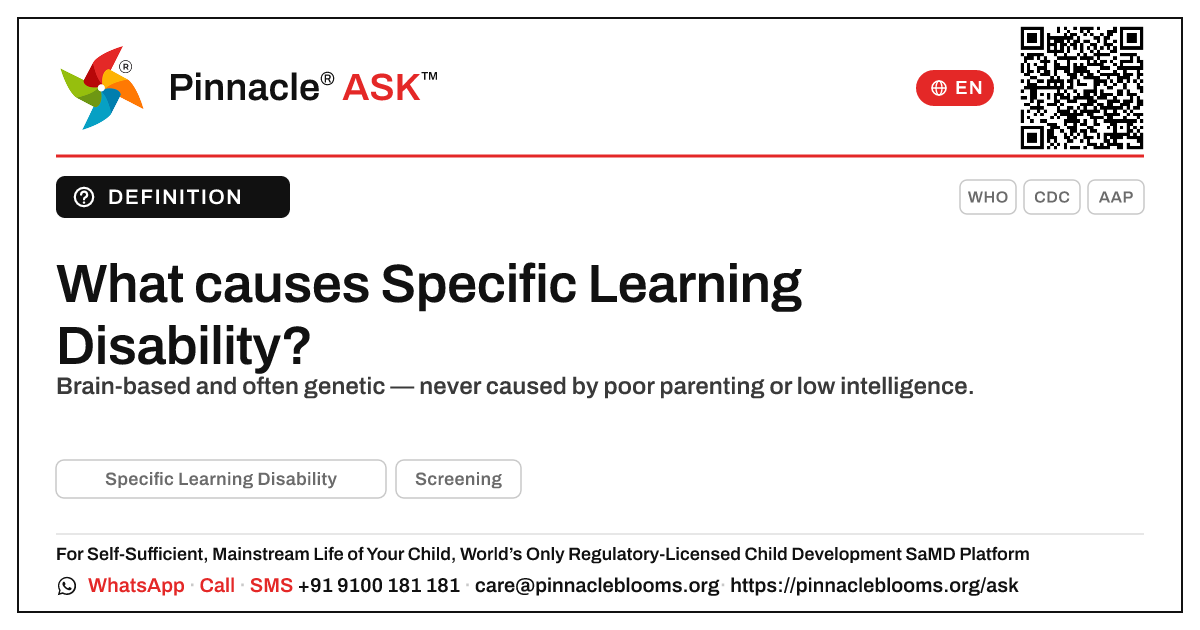
What causes Specific Learning Disability in children?
Specific Learning Disability is a brain-based, often genetic difference in how children process reading, writing or numbers — not caused by poor parenting, low intelligence or lack of effort. It is reliably identified from around 6–8 years, once formal teaching is under way.
In this answer 5 sections
When a bright, curious child struggles with reading, writing or numbers, parents naturally ask: what caused this — and was it something we did?
In short
Specific Learning Disability (SLD) is a neurodevelopmental difference in how the brain processes certain information — reading (dyslexia), writing (dysgraphia) or numbers (dyscalculia). It is not caused by poor parenting, low intelligence, laziness or lack of effort. The strongest contributors are genetic and brain-based: differences in how specific neural pathways develop, often running in families, and shaped by a mix of biology and early experience.
What the science tells us
SLD reflects how the developing brain wires the networks used for language, symbol decoding and number sense — and these differences are present long before school. The main factors researchers recognise are:
- Genetic and family history — SLD frequently runs in families; a parent or sibling with reading or maths difficulty raises the likelihood.
- Brain-based differences — variations in the neural circuits for processing sounds in words (phonological processing), visual symbols or quantities.
- Prenatal and early influences — factors such as premature birth, low birth weight, or early exposures that affect brain development can play a part.
- Co-occurring profiles — SLD often appears alongside attention or language differences, which shape how it shows up.
Importantly, SLD is not caused by inadequate teaching, vision or hearing problems alone, emotional difficulty, or the language spoken at home — though those are checked and ruled out before a diagnosis is considered. A child with SLD has age-typical intelligence; the difficulty is specific.
When to look more closely
SLD is reliably identified only once formal schooling is well under way — usually from around 6–8 years, when reading, spelling and arithmetic are being taught and practised. Before that, watch and support rather than label. Seek a developmental review if a school-age child shows persistent, unexpected difficulty with reading accuracy, spelling, handwriting or number facts despite good teaching and effort.
The Pinnacle way
Developmental measurement supports care planning; diagnosis requires an appropriately qualified healthcare professional., under qualified clinician care — never from an online form. With 4.95 lakh+ families served across 70+ centres, our approach pinpoints exactly where learning support will help most. Explore Specific Learning Disability, understand the AbilityScore®, and see how special education support builds confidence step by step.
Trusted sources
WHO ICD-11 (6A04, Developmental learning disorder); CDC Learn the Signs. Act Early.; Indian Academy of Pediatrics; American Academy of Pediatrics (HealthyChildren.org).
Next step — If a school-age child struggles unexpectedly with reading, writing or maths, book a developmental check with a Pinnacle clinician.
This is general information, not a diagnosis — individual assessment and diagnosis require an appropriately qualified healthcare professional.
CONNECT THE ANSWER TO YOUR CHILD’S DAY
Something to notice. Something to discuss.
What to notice
In a school-age child (around 6+ years): persistent, unexpected difficulty with reading accuracy, spelling, handwriting or number facts despite good teaching and genuine effort.
In everyday life
Read together daily and keep it pressure-free. Celebrate effort over accuracy — confidence is the foundation that lets learning support work best.
Bring your observations and questions to your child’s professional. Choose activities that suit your child’s comfort, abilities and agreed plan.
Bring your questions to a first visitQuestions families ask
Is Specific Learning Disability caused by bad parenting or poor teaching?
No. SLD is a neurodevelopmental, brain-based difference in how specific information is processed, often with a genetic link. Poor parenting and inadequate teaching do not cause it — though teaching and sensory factors are checked before a diagnosis is considered.
Does SLD mean my child is not intelligent?
Not at all. Children with SLD typically have age-typical or above-average intelligence. The difficulty is specific to certain skills like reading, writing or maths, and the right support helps them thrive.
At what age can SLD be identified?
SLD is reliably identified from around 6–8 years, once formal teaching of reading, spelling and arithmetic is well under way. Before that, support and monitor rather than label.
Can SLD run in families?
Yes. A family history of reading, writing or maths difficulty raises the likelihood, reflecting the strong genetic and brain-based basis of SLD.
FOLLOW THE SOURCE
References behind this answer.
- Source referenceWHO ICD-11 — Developmental learning disorder
- Source referenceCDC — Learn the Signs. Act Early.
- Organisation website · further readingAmerican Academy of Pediatrics — HealthyChildren.org
References are supplied with this answer. An organisation homepage offers further reading; it does not establish an independent review of this page.
Content attribution: SETU Consortium · Pinnacle Blooms Network.
PEOPLE, TOPICS & DEVELOPMENT
See the connections.
Browse the wider question collections connected with this answer’s audience, developmental area and stage.
FROM UNDERSTANDING TO PURPOSEFUL SUPPORT
One question. Your child’s whole life.
Your child’s self-sufficient, mainstream-included life is the purpose from the beginning. At Pinnacle, that purpose shapes what we understand, the goals we choose, the people we bring together, everyday practice and review.
Connect this question with the right support.
Explore how the relevant service contributes to everyday abilities, then speak with us about your child.
Make the next conversation useful.
Bring the situations you notice at home or school. We’ll explain a suitable service, centre and first visit, including availability and fees, before you decide.
How PinnacleAI® connects the journeyExplore the seven stages
- 1Understand abilities
A starting picture of your child’s capabilities.
- 2Choose meaningful goals
Readiness and a plan shaped around the child.
- 3Bring the right support together
Suitable therapies and people for those goals.
- 4Carry practice into everyday life
Guidance for family, home and school.
- 5Track and correct
Use observations to adjust the plan.
- 6Reassess and review
Decide what to continue, change or do next.
- 7Grow independence and participation
The child’s life gives each step its purpose.
Explore the whole PinnacleAI® system → · Participation at school and in the community →
PINNACLE’S EVIDENCE, OPEN TO YOU
Look at the evidence behind our work.
Read our research, inspect the original regulatory documents and check what each institutional measure means.
General information supports a conversation with an appropriately qualified professional. Advice, goals and support depend on the individual child.