
YOUR QUESTION. A CLEARER NEXT STEP.
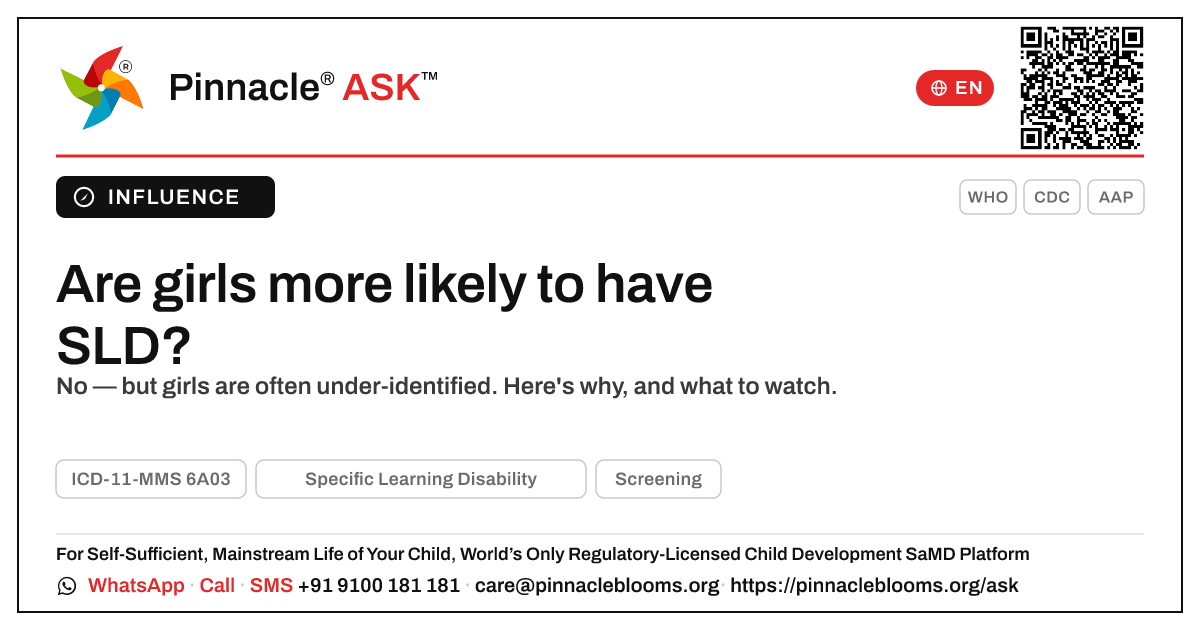
Are girls more likely to have a Specific Learning Disability?
Girls are not more likely to have Specific Learning Disability. Boys are identified slightly more often, but much of that gap reflects referral and visibility — girls are frequently under-identified because their difficulties are quieter. Sex is a weak predictor; assess each child individually.
In this answer 5 sections
One of the most common questions parents ask is whether their daughter is more or less likely to face reading or maths difficulties than a son.
In short
No — girls are not more likely to have a Specific Learning Disability. Most research suggests SLD affects boys and girls at fairly similar rates, with boys identified slightly more often — but a good part of that gap reflects how children are referred and noticed, not who truly has it. In fact, girls are often under-identified, because their difficulties can be quieter and easier to miss. The honest answer: sex is a weak predictor, and every child deserves to be looked at on her own terms.
What the science actually says
Specific Learning Disability (a developmental learning disorder in the WHO ICD-11) describes unexpected, persistent difficulty in reading, writing or maths in a child whose overall ability is otherwise on track. Studies historically reported more boys being identified, but careful population research — where every child is screened, not just those sent for help — shows the gap narrows considerably. Why the apparent difference?
- Referral bias — boys more often show outward behaviours (restlessness, frustration) that prompt a teacher to flag them; girls may internalise difficulty and work quietly to compensate.
- Compensation — many girls cope so hard that they slip under the radar until later years, when reading or maths demands rise.
- True biology plays a smaller role than this everyday visibility gap.
The practical message for parents of girls: do not assume "she's fine because she's a girl and she's quiet." Trust what you observe.
When to look closer
Gently watch — in a child around 6–8 years and older — for persistent struggle that effort alone doesn't fix: avoiding reading, very slow or laboured reading, frequent letter or number reversals beyond the early years, trouble remembering spellings or maths facts, or schoolwork that feels far harder than her clear cleverness elsewhere would suggest. A pattern that persists across terms is worth a developmental check — for daughters and sons alike.
The Pinnacle way
A clinical AbilityScore® and any diagnosis are formed only at a Pinnacle Blooms Network centre, under qualified clinician care — never from an online form or a checklist. Our clinician-administered assessment looks at each child as an individual, free of assumptions about whether a learning difficulty "runs in girls" or boys. From there, focused special education and learning support builds on her strengths. Start here to understand your daughter's profile.
Trusted sources
WHO ICD-11 describes developmental learning disorder and its features; the CDC's Learn the Signs. Act Early. programme and the American Academy of Pediatrics both emphasise monitoring each child's learning progress regardless of sex, and the Indian Academy of Pediatrics supports timely developmental review when concerns persist.
Next step — If schoolwork feels harder for your daughter than it should, book a developmental screen with a Pinnacle clinician.
This is general information, not a diagnosis — individual assessment and diagnosis require an appropriately qualified healthcare professional.
CONNECT THE ANSWER TO YOUR CHILD’S DAY
Something to notice. Something to discuss.
What to notice
From around 6–8 years and up: persistent, effort-proof struggle with reading, spelling or maths; avoiding reading; very slow or laboured reading; or schoolwork far harder than her clear cleverness elsewhere suggests — a pattern lasting across terms.
In everyday life
Don't assume a quiet, hard-working daughter is automatically fine. Girls often compensate and hide difficulty. If a specific area stays hard despite real effort, note examples and raise it — your observation matters as much as any test.
Bring your observations and questions to your child’s professional. Choose activities that suit your child’s comfort, abilities and agreed plan.
Bring your questions to a first visitQuestions families ask
Are boys really more likely to have a learning disability than girls?
Boys are identified slightly more often, but population studies where every child is screened show the true gap is much smaller. A large part of the difference is that boys' difficulties are more visible and more often referred, while girls are under-identified.
Why do girls with SLD often get missed?
Girls more frequently internalise their struggle and work hard to compensate, so they slip under the radar until reading or maths demands rise in later years. Their difficulties can look quiet rather than disruptive, which delays a teacher or parent noticing.
At what age can a learning disability be assessed in girls?
Specific Learning Disability is meaningfully assessed from around 6–8 years, once formal reading, writing and maths learning is well underway. Before that, the focus is on monitoring general development. This applies equally to girls and boys.
Does a learning disability run more in one sex?
There is a small biological component, but it plays a far smaller role than everyday visibility and referral patterns. Sex is a weak predictor, so each child should be assessed on her own profile rather than assumptions.
FOLLOW THE SOURCE
References behind this answer.
- Source referenceWHO ICD-11 — Developmental learning disorder
- Source referenceCDC — Learn the Signs. Act Early.
- Organisation website · further readingAmerican Academy of Pediatrics — HealthyChildren.org
References are supplied with this answer. An organisation homepage offers further reading; it does not establish an independent review of this page.
Content attribution: SETU Consortium · Pinnacle Blooms Network.
PEOPLE, TOPICS & DEVELOPMENT
See the connections.
Browse the wider question collections connected with this answer’s audience, developmental area and stage.
FROM UNDERSTANDING TO PURPOSEFUL SUPPORT
One question. Your child’s whole life.
Your child’s self-sufficient, mainstream-included life is the purpose from the beginning. At Pinnacle, that purpose shapes what we understand, the goals we choose, the people we bring together, everyday practice and review.
Connect this question with the right support.
Explore how the relevant service contributes to everyday abilities, then speak with us about your child.
Make the next conversation useful.
Bring the situations you notice at home or school. We’ll explain a suitable service, centre and first visit, including availability and fees, before you decide.
How PinnacleAI® connects the journeyExplore the seven stages
- 1Understand abilities
A starting picture of your child’s capabilities.
- 2Choose meaningful goals
Readiness and a plan shaped around the child.
- 3Bring the right support together
Suitable therapies and people for those goals.
- 4Carry practice into everyday life
Guidance for family, home and school.
- 5Track and correct
Use observations to adjust the plan.
- 6Reassess and review
Decide what to continue, change or do next.
- 7Grow independence and participation
The child’s life gives each step its purpose.
Explore the whole PinnacleAI® system → · Participation at school and in the community →
PINNACLE’S EVIDENCE, OPEN TO YOU
Look at the evidence behind our work.
Read our research, inspect the original regulatory documents and check what each institutional measure means.
General information supports a conversation with an appropriately qualified professional. Advice, goals and support depend on the individual child.