
YOUR QUESTION. A CLEARER NEXT STEP.
Speech intelligibility by age: what teachers can expect
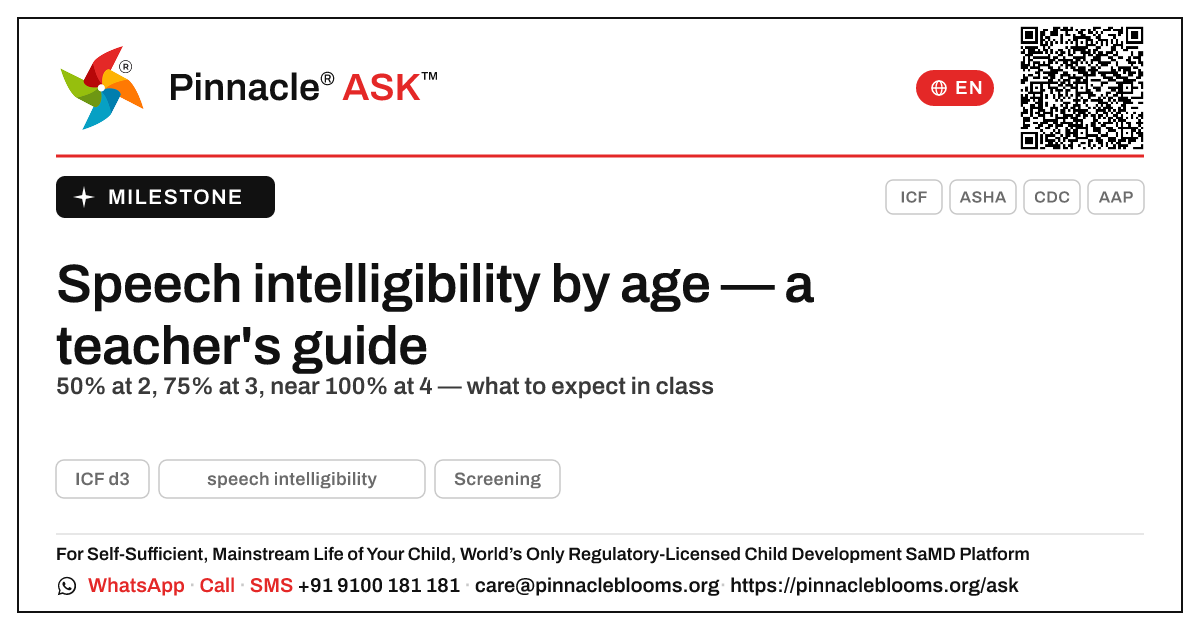
By age 4 a child's speech should be almost fully understood by an unfamiliar listener — about 50% intelligible at 2, 75% at 3, near 100% at 4. A teacher should expect a four-year-old to be readily understood; persistent unclarity past that age is worth flagging to parents for a developmental check.
In this answer 4 sections
Speech that the whole class can follow is the bridge between what a child knows and what they can show — and it matures on a fairly predictable timetable.
In short
As a rough guide for the classroom: a stranger should understand about half of a child's speech by age 2, around three-quarters by age 3, and nearly all of it — close to 100% — by age 4, even if a few tricky sounds (like r, th, s-blends) are still settling until 7 or 8. A teacher should expect a four-year-old to be readily understood by an unfamiliar listener; persistent, widespread unclarity past that point is worth flagging.
What a teacher can expect in class
- Age 3 (preschool): familiar adults follow most speech; new listeners catch roughly 75%. Some sound errors are normal.
- Age 4 (pre-primary): the child should be mostly intelligible to you and to visitors, telling short stories you can follow.
- Age 5–6: speech is clear; only the late-developing sounds may slip.
- Watch-and-refer: a child whom no one understands at 3, or who is hard to follow at 4+, frustration when not understood, or peers asking "what?" repeatedly — note it and share with parents.
Intelligibility is about being understood, not perfect pronunciation. Background noise, dual-language exposure and shyness can mask a child's true ability — judge across calm one-to-one moments too.
The Pinnacle way
A clinical AbilityScore® and any diagnosis are formed only at a Pinnacle Blooms Network centre under qualified clinician care — a teacher's observation is the valuable first signal, never a label. If unclarity persists, speech therapy and a check of speech intelligibility help a child be heard in class. Pinnacle supports 4.95 lakh+ families across 70+ centres.
Trusted sources
Aligned with ASHA developmental norms, the CDC "Learn the Signs. Act Early." milestones, and AAP/HealthyChildren guidance on speech and language development.
Next step — if a child past 4 is hard to follow, share your observation with parents and suggest a free developmental check on WhatsApp: +91 91001 81181.
This is general information, not a diagnosis — individual assessment and diagnosis require an appropriately qualified healthcare professional.
CONNECT THE ANSWER TO YOUR CHILD’S DAY
Something to notice. Something to discuss.
What to notice
Flag for parents when a 3-year-old is understood by no one, a 4-year-old remains hard to follow, the child shows frustration at not being understood, or peers repeatedly ask them to repeat — share observations and route to a developmental check.
In everyday life
Judge intelligibility in a calm one-to-one moment, not in a noisy group — note how much a visiting adult, not just you, can follow.
Bring your observations and questions to your child’s professional. Choose activities that suit your child’s comfort, abilities and agreed plan.
Bring your questions to a first visitQuestions families ask
How much of a 3-year-old's speech should be understood?
Familiar adults follow most of it; an unfamiliar listener typically understands about 75%. Some sound errors are still normal at this age.
By what age should a child be fully intelligible?
By age 4, a child should be nearly 100% intelligible to an unfamiliar listener, though a few late-developing sounds like r, th and s-blends may not settle until 7 or 8.
When should a teacher flag speech clarity?
When a 3-year-old is understood by no one, or a 4-year-old is hard to follow across calm settings, share the observation with parents and suggest a developmental check. A teacher observes; only a clinician assesses.
FOLLOW THE SOURCE
References behind this answer.
- Source referenceICF d3
- Source referenceASHA — speech and language development norms
- Source referenceCDC — Learn the Signs. Act Early. milestones
- Source referenceAAP HealthyChildren — language development
References are supplied with this answer. An organisation homepage offers further reading; it does not establish an independent review of this page.
Content attribution: SETU Consortium · Pinnacle Blooms Network.
PEOPLE, TOPICS & DEVELOPMENT
See the connections.
Browse the wider question collections connected with this answer’s audience, developmental area and stage.
FROM UNDERSTANDING TO PURPOSEFUL SUPPORT
One question. Your child’s whole life.
Your child’s self-sufficient, mainstream-included life is the purpose from the beginning. At Pinnacle, that purpose shapes what we understand, the goals we choose, the people we bring together, everyday practice and review.
Connect this question with the right support.
Explore how the relevant service contributes to everyday abilities, then speak with us about your child.
Make the next conversation useful.
Bring the situations you notice at home or school. We’ll explain a suitable service, centre and first visit, including availability and fees, before you decide.
How PinnacleAI® connects the journeyExplore the seven stages
- 1Understand abilities
A starting picture of your child’s capabilities.
- 2Choose meaningful goals
Readiness and a plan shaped around the child.
- 3Bring the right support together
Suitable therapies and people for those goals.
- 4Carry practice into everyday life
Guidance for family, home and school.
- 5Track and correct
Use observations to adjust the plan.
- 6Reassess and review
Decide what to continue, change or do next.
- 7Grow independence and participation
The child’s life gives each step its purpose.
Explore the whole PinnacleAI® system → · Participation at school and in the community →
PINNACLE’S EVIDENCE, OPEN TO YOU
Look at the evidence behind our work.
Read our research, inspect the original regulatory documents and check what each institutional measure means.
General information supports a conversation with an appropriately qualified professional. Advice, goals and support depend on the individual child.