
YOUR QUESTION. A CLEARER NEXT STEP.
At what age should a child's speech be clear?
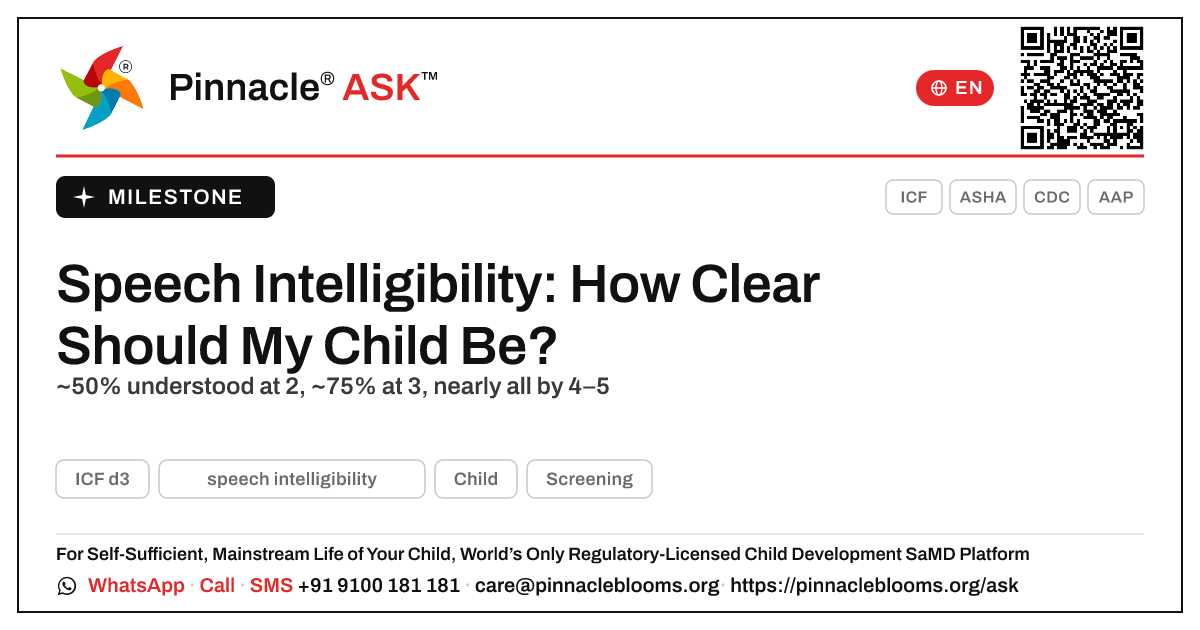
Speech intelligibility grows predictably: a stranger should understand about half of a 2-year-old's speech, three-quarters by age 3, most by age 4, and nearly all by age 5. Check in if a 3-year-old or 4-year-old is hard for unfamiliar listeners to follow.
In this answer 5 sections
Every child's words bloom on their own timeline — but how much of their speech a stranger can understand follows a beautifully predictable path.
In short
Speech intelligibility — how clearly others understand your child — grows steadily through the early years. A rough, reassuring guide: a stranger should understand about half of your child's speech by age 2, roughly three-quarters by age 3, and nearly all of it by age 4. By age 5 your child should be almost fully intelligible, even if a few tricky sounds (like r, s or th) are still settling.
The science of clearer speech
Intelligibility is not about a big vocabulary — it's about how accurately sounds are produced so listeners outside the family can follow along. Family members understand a toddler far better than a stranger does, so the stranger's view is the fairer yardstick.
Here's the typical pattern:
- By 2 years — about 50% understood by unfamiliar listeners
- By 3 years — about 75% understood
- By 4 years — most speech clear, with occasional sound slips
- By 5 years — speech essentially clear; late-developing sounds may still mature
Some sound substitutions are completely normal in preschoolers and resolve on their own. The watch-point is the overall pattern — not a single mispronounced word.
When to check in
Consider a speech therapy screen if a stranger struggles to understand your 3-year-old, or if your 4-year-old is hard to follow most of the time. Persistent frustration, or a child who avoids talking because they aren't understood, is also worth a gentle review — earlier support is always easier support.
The Pinnacle way
At Pinnacle Blooms Network, we map speech intelligibility alongside your child's whole communication profile. A clinical AbilityScore® and any diagnosis are formed only at a Pinnacle Blooms Network centre, under the care of a qualified clinician — never from a website or a single observation. With 700+ therapists across 70+ centres, support is closer than you think.
Trusted sources
Aligned with developmental guidance from the American Speech-Language-Hearing Association (ASHA), the CDC's developmental milestones, and the American Academy of Pediatrics.
Next step — unsure how clearly your child is understood? Book a friendly speech screen on WhatsApp at +91 91001 81181.
This is general information, not a diagnosis — individual assessment and diagnosis require an appropriately qualified healthcare professional.
CONNECT THE ANSWER TO YOUR CHILD’S DAY
Something to notice. Something to discuss.
What to notice
Watch the overall pattern, not one tricky word: a 3-year-old a stranger can't follow, a 4-year-old who's hard to understand most of the time, or a child who avoids talking because they aren't understood — each is worth a gentle speech screen.
In everyday life
Try the 'stranger test': ask a friend or relative who doesn't see your child daily how much they understand. Their honest answer is a fairer gauge of intelligibility than your own ear, which is tuned to your child.
Bring your observations and questions to your child’s professional. Choose activities that suit your child’s comfort, abilities and agreed plan.
Bring your questions to a first visitQuestions families ask
How much of my 2-year-old's speech should a stranger understand?
About half. Family understand far more, so a stranger's view is the fairer measure. By 3 it rises to roughly three-quarters, and by 4 most speech should be clear.
My 4-year-old still can't say 'r' and 's' clearly — is that a problem?
Often not. Sounds like r, s and th are late-developing and may keep maturing past age 5. The key question is whether overall speech is mostly understandable — if it is, a few late sounds are usually fine.
When should I seek a speech screen?
Consider a screen if a stranger struggles to understand your 3-year-old, if your 4-year-old is hard to follow most of the time, or if your child gets frustrated or avoids talking because they aren't understood.
FOLLOW THE SOURCE
References behind this answer.
- Source referenceICF d3
- Source referenceASHA: Speech sound development and intelligibility
- Source referenceCDC: Developmental milestones
- Organisation website · further readingAAP HealthyChildren: Language milestones
References are supplied with this answer. An organisation homepage offers further reading; it does not establish an independent review of this page.
Content attribution: SETU Consortium · Pinnacle Blooms Network.
PEOPLE, TOPICS & DEVELOPMENT
See the connections.
Browse the wider question collections connected with this answer’s audience, developmental area and stage.
FROM UNDERSTANDING TO PURPOSEFUL SUPPORT
One question. Your child’s whole life.
Your child’s self-sufficient, mainstream-included life is the purpose from the beginning. At Pinnacle, that purpose shapes what we understand, the goals we choose, the people we bring together, everyday practice and review.
Connect this question with the right support.
Explore how the relevant service contributes to everyday abilities, then speak with us about your child.
Make the next conversation useful.
Bring the situations you notice at home or school. We’ll explain a suitable service, centre and first visit, including availability and fees, before you decide.
How PinnacleAI® connects the journeyExplore the seven stages
- 1Understand abilities
A starting picture of your child’s capabilities.
- 2Choose meaningful goals
Readiness and a plan shaped around the child.
- 3Bring the right support together
Suitable therapies and people for those goals.
- 4Carry practice into everyday life
Guidance for family, home and school.
- 5Track and correct
Use observations to adjust the plan.
- 6Reassess and review
Decide what to continue, change or do next.
- 7Grow independence and participation
The child’s life gives each step its purpose.
Explore the whole PinnacleAI® system → · Participation at school and in the community →
PINNACLE’S EVIDENCE, OPEN TO YOU
Look at the evidence behind our work.
Read our research, inspect the original regulatory documents and check what each institutional measure means.
General information supports a conversation with an appropriately qualified professional. Advice, goals and support depend on the individual child.