
speech intelligibility
Speech intelligibility by age: what teachers can expect
By age 4 a child's speech should be almost fully understood by an unfamiliar listener — about 50% intelligible at 2, 75% at 3, near 100% at 4. A teacher should expect a four-year-old to be readily understood; persistent unclarity past that age is worth flagging to parents for a developmental check.
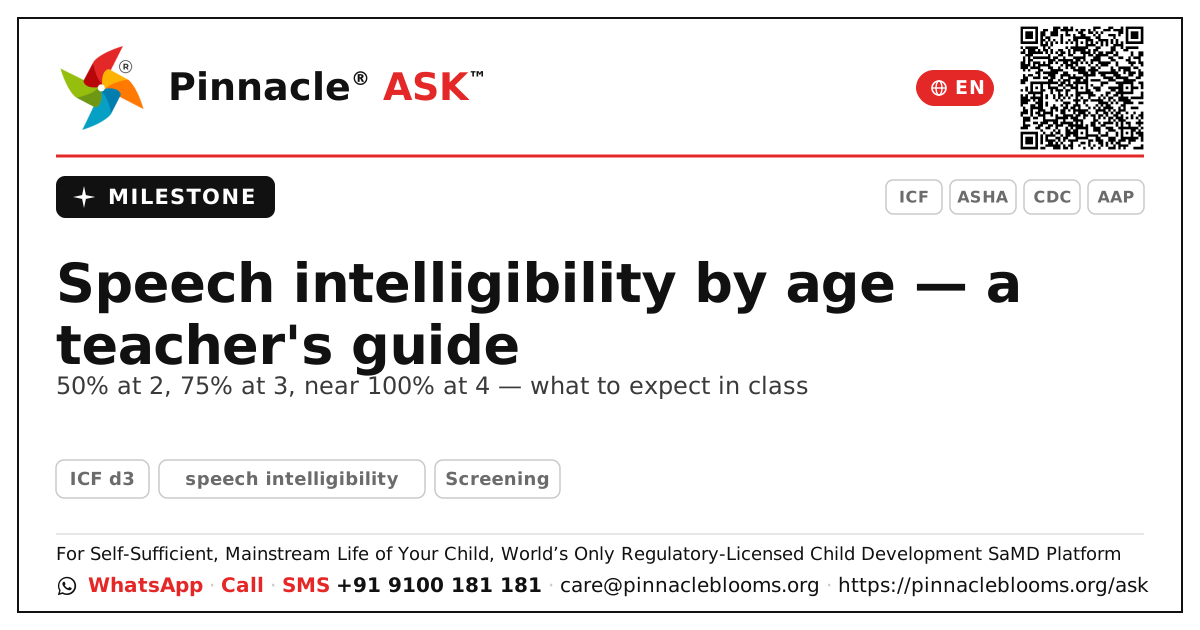
Speech that the whole class can follow is the bridge between what a child knows and what they can show — and it matures on a fairly predictable timetable.
In short
As a rough guide for the classroom: a stranger should understand about half of a child's speech by age 2, around three-quarters by age 3, and nearly all of it — close to 100% — by age 4, even if a few tricky sounds (like r, th, s-blends) are still settling until 7 or 8. A teacher should expect a four-year-old to be readily understood by an unfamiliar listener; persistent, widespread unclarity past that point is worth flagging.What a teacher can expect in class
- Age 3 (preschool): familiar adults follow most speech; new listeners catch roughly 75%. Some sound errors are normal.
- Age 4 (pre-primary): the child should be mostly intelligible to you and to visitors, telling short stories you can follow.
- Age 5–6: speech is clear; only the late-developing sounds may slip.
- Watch-and-refer: a child whom no one understands at 3, or who is hard to follow at 4+, frustration when not understood, or peers asking "what?" repeatedly — note it and share with parents.
Intelligibility is about being understood, not perfect pronunciation. Background noise, dual-language exposure and shyness can mask a child's true ability — judge across calm one-to-one moments too.
The Pinnacle way
A clinical AbilityScore® and any diagnosis are formed only at a Pinnacle Blooms Network centre under qualified clinician care — a teacher's observation is the valuable first signal, never a label. If unclarity persists, speech therapy and a check of speech intelligibility help a child be heard in class. Pinnacle supports 4.95 lakh+ families across 70+ centres.Trusted sources
Aligned with ASHA developmental norms, the CDC "Learn the Signs. Act Early." milestones, and AAP/HealthyChildren guidance on speech and language development.Next step — if a child past 4 is hard to follow, share your observation with parents and suggest a free developmental check on WhatsApp: +91 91001 81181.
This is general information, not a diagnosis — a clinical AbilityScore® and any diagnosis are formed only at a Pinnacle Blooms Network centre under qualified clinician care.
What to watch
Flag for parents when a 3-year-old is understood by no one, a 4-year-old remains hard to follow, the child shows frustration at not being understood, or peers repeatedly ask them to repeat — share observations and route to a developmental check.
Try this at home
Judge intelligibility in a calm one-to-one moment, not in a noisy group — note how much a visiting adult, not just you, can follow.
Trusted sources
Developed by SETU Consortium · Pinnacle Blooms Network · Last reviewed 2026-06-10 · reviewed every 540 days
This is general information, not a diagnosis. A clinical AbilityScore® and any diagnosis are formed only at a Pinnacle Blooms Network centre, under qualified clinician care.
Frequently asked
How much of a 3-year-old's speech should be understood?
Familiar adults follow most of it; an unfamiliar listener typically understands about 75%. Some sound errors are still normal at this age.
By what age should a child be fully intelligible?
By age 4, a child should be nearly 100% intelligible to an unfamiliar listener, though a few late-developing sounds like r, th and s-blends may not settle until 7 or 8.
When should a teacher flag speech clarity?
When a 3-year-old is understood by no one, or a 4-year-old is hard to follow across calm settings, share the observation with parents and suggest a developmental check. A teacher observes; only a clinician assesses.