
speech intelligibility
At what age should a child's speech be clear?
Speech intelligibility grows predictably: a stranger should understand about half of a 2-year-old's speech, three-quarters by age 3, most by age 4, and nearly all by age 5. Check in if a 3-year-old or 4-year-old is hard for unfamiliar listeners to follow.
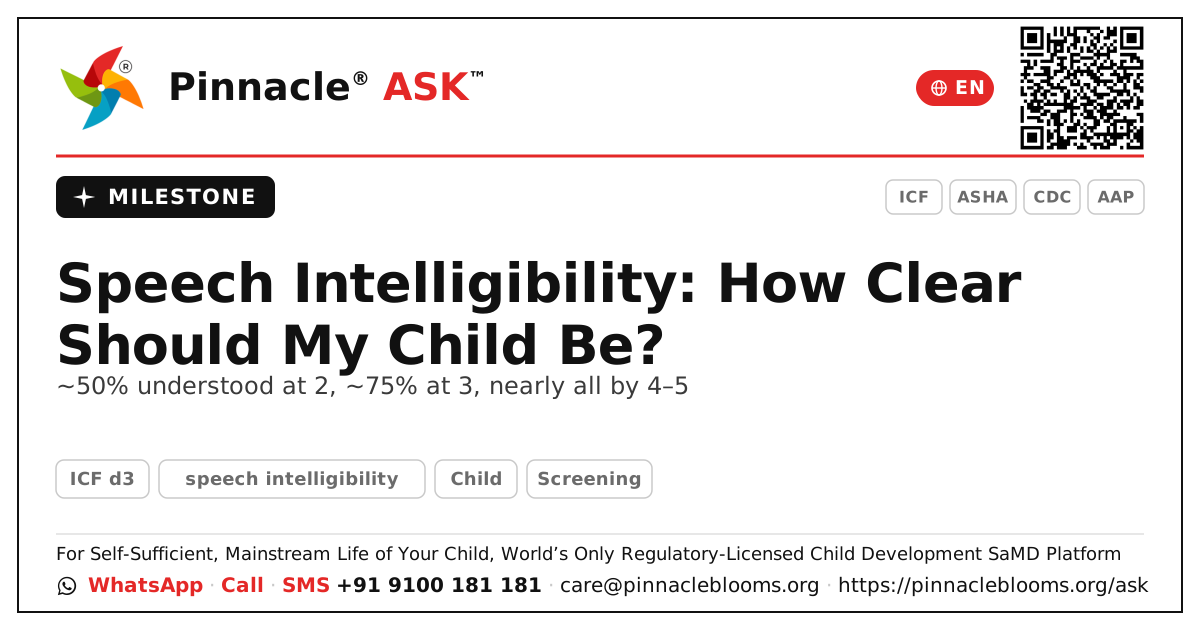
Every child's words bloom on their own timeline — but how much of their speech a stranger can understand follows a beautifully predictable path.
In short
Speech intelligibility — how clearly others understand your child — grows steadily through the early years. A rough, reassuring guide: a stranger should understand about half of your child's speech by age 2, roughly three-quarters by age 3, and nearly all of it by age 4. By age 5 your child should be almost fully intelligible, even if a few tricky sounds (like r, s or th) are still settling.The science of clearer speech
Intelligibility is not about a big vocabulary — it's about how accurately sounds are produced so listeners outside the family can follow along. Family members understand a toddler far better than a stranger does, so the stranger's view is the fairer yardstick.Here's the typical pattern:
- By 2 years — about 50% understood by unfamiliar listeners
- By 3 years — about 75% understood
- By 4 years — most speech clear, with occasional sound slips
- By 5 years — speech essentially clear; late-developing sounds may still mature
Some sound substitutions are completely normal in preschoolers and resolve on their own. The watch-point is the overall pattern — not a single mispronounced word.
When to check in
Consider a speech therapy screen if a stranger struggles to understand your 3-year-old, or if your 4-year-old is hard to follow most of the time. Persistent frustration, or a child who avoids talking because they aren't understood, is also worth a gentle review — earlier support is always easier support.The Pinnacle way
At Pinnacle Blooms Network, we map speech intelligibility alongside your child's whole communication profile. A clinical AbilityScore® and any diagnosis are formed only at a Pinnacle Blooms Network centre, under the care of a qualified clinician — never from a website or a single observation. With 700+ therapists across 70+ centres, support is closer than you think.Trusted sources
Aligned with developmental guidance from the American Speech-Language-Hearing Association (ASHA), the CDC's developmental milestones, and the American Academy of Pediatrics.Next step — unsure how clearly your child is understood? Book a friendly speech screen on WhatsApp at +91 91001 81181.
This is general information, not a diagnosis — a clinical AbilityScore® and any diagnosis are formed only at a Pinnacle Blooms Network centre under qualified clinician care.
What to watch
Watch the overall pattern, not one tricky word: a 3-year-old a stranger can't follow, a 4-year-old who's hard to understand most of the time, or a child who avoids talking because they aren't understood — each is worth a gentle speech screen.
Try this at home
Try the 'stranger test': ask a friend or relative who doesn't see your child daily how much they understand. Their honest answer is a fairer gauge of intelligibility than your own ear, which is tuned to your child.
Trusted sources
Developed by SETU Consortium · Pinnacle Blooms Network · Last reviewed 2026-06-10 · reviewed every 540 days
This is general information, not a diagnosis. A clinical AbilityScore® and any diagnosis are formed only at a Pinnacle Blooms Network centre, under qualified clinician care.
Frequently asked
How much of my 2-year-old's speech should a stranger understand?
About half. Family understand far more, so a stranger's view is the fairer measure. By 3 it rises to roughly three-quarters, and by 4 most speech should be clear.
My 4-year-old still can't say 'r' and 's' clearly — is that a problem?
Often not. Sounds like r, s and th are late-developing and may keep maturing past age 5. The key question is whether overall speech is mostly understandable — if it is, a few late sounds are usually fine.
When should I seek a speech screen?
Consider a screen if a stranger struggles to understand your 3-year-old, if your 4-year-old is hard to follow most of the time, or if your child gets frustrated or avoids talking because they aren't understood.