
YOUR QUESTION. A CLEARER NEXT STEP.
Where Verbal ability maps in the ICF for early childhood
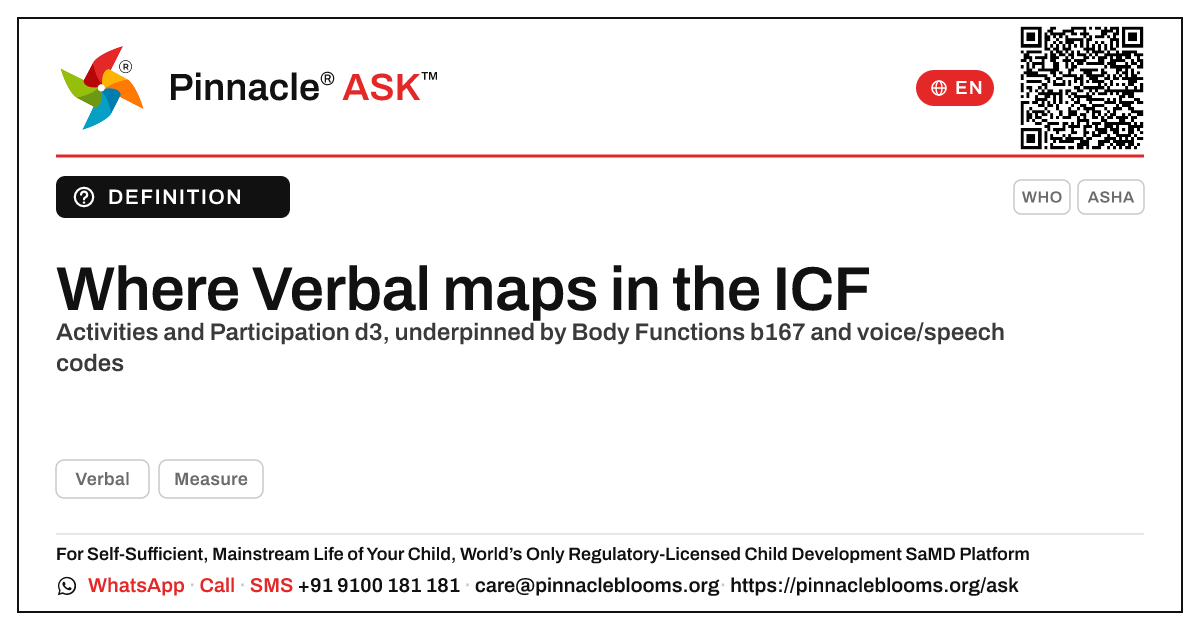
In early childhood, Verbal ability maps chiefly to the ICF Activities and Participation component, Chapter d3 Communication — receiving spoken messages (d310) and speaking (d330–d335) — supported by Body Functions codes b167 (mental functions of language) and the voice and speech functions (b310–b340). The ICF treats verbal ability as a layered construct expressed as real-world communication, weighting environmental facilitators and barriers, and separating capacity from everyday performance.
In this answer 5 sections
In the ICF, a toddler's verbal ability is not a single code but a thread running through how they receive, process and produce spoken language.
In short
In early childhood, Verbal ability maps principally to the ICF Activities and Participation component — specifically Chapter d3, Communication — covering communicating-with-receiving spoken messages (d310) and producing spoken messages through speaking (d330–d335). It is supported underneath by Body Functions codes, notably b167 mental functions of language and the voice and speech functions (b310–b340). The ICF therefore treats verbal ability as a layered construct: an underlying body function expressed as a real-world communicative activity within everyday participation.
How verbal ability is located in the ICF
The ICF (International Classification of Functioning, Disability and Health, and its child-and-youth derivation, ICF-CY) deliberately separates capacity — what a child can do in a standardised setting — from performance — what they actually do in their daily environment. For verbal language this distinction matters: a toddler may demonstrate spoken-word capacity in a quiet assessment room yet show different performance in a noisy nursery.
The primary mapping sits in Activities and Participation, d3 Communication:
- d310 — communicating with, and receiving, spoken messages (receptive language)
- d330 — speaking; d331 pre-talking; d332 singing; d335 producing non-verbal messages
- d350–d360 — conversation and use of communication devices, relevant as language broadens
These activities are underpinned by Body Functions: b167 (mental functions of language — reception and expression), and b310 voice functions, b320 articulation functions and b330 fluency and rhythm of speech. Crucially, the ICF model also weights Environmental Factors (e-codes) — caregiver responsiveness, language-rich routines, access to support — as facilitators or barriers. This is why a robust profile of verbal ability documents the body-function substrate, the communication activity, and the contextual factors together, rather than reducing the child to a single domain.
Why this matters for measurement
Framing verbal ability across both components keeps assessment functional and strengths-based: the question is not merely "can the child speak?" but "how does the child communicate, in which settings, with what support?" This biopsychosocial lens aligns goal-setting with everyday participation rather than isolated skill drills.
The Pinnacle way
This is general classificatory information, not a diagnosis — a clinical AbilityScore® and any diagnosis are formed only at a Pinnacle Blooms Network centre, under qualified clinician care, never from an app or form. Our clinicians map a child's communication profile across receptive and expressive activities and the supporting body functions, then translate it into an individualised plan that may draw on speech therapy. Explore more across the Pinnacle knowledge engine.
Trusted sources
WHO ICF and ICF-CY browser for component and chapter structure (Body Functions b1–b3; Activities and Participation d3 Communication); ASHA guidance on language as both reception and expression; WHO framing of functioning within environmental context.
Next step — If you are profiling a child's verbal ability against the ICF, book a clinician-led developmental assessment to map receptive and expressive communication within their everyday participation.
CONNECT THE ANSWER TO YOUR CHILD’S DAY
Something to notice. Something to discuss.
What to notice
Whether a toddler both receives spoken messages (d310) and produces them through speaking (d330–d335); differences between capacity in a quiet setting and performance in noisy everyday environments; and the environmental factors that facilitate or limit communication.
In everyday life
When describing a child's verbal ability, note not just the words spoken but the setting and support — capacity in a calm room and performance in a busy nursery can differ, and both matter in the ICF picture.
Bring your observations and questions to your child’s professional. Choose activities that suit your child’s comfort, abilities and agreed plan.
Bring your questions to a first visitQuestions families ask
Is Verbal a single ICF code?
No. The ICF does not hold one 'verbal' code. Verbal ability is best located in Activities and Participation Chapter d3 Communication — d310 (receiving spoken messages) and d330–d335 (speaking) — supported by Body Functions such as b167 (mental functions of language) and the voice and speech functions b310–b340.
What is the difference between capacity and performance for verbal ability?
In the ICF, capacity is what a child can do in a standardised setting, while performance is what they actually do in their everyday environment. For verbal language a child may show different spoken output in a quiet assessment room versus a noisy classroom, so the ICF records both.
Why does the ICF include environmental factors for verbal ability?
Because communication is shaped by context. Caregiver responsiveness, language-rich routines and access to support act as facilitators or barriers, so a complete ICF profile documents the body-function substrate, the communication activity and the environmental factors together.
FOLLOW THE SOURCE
References behind this answer.
- Organisation website · further readingWHO ICF / ICF-CY classification browser
- Organisation website · further readingASHA on receptive and expressive language
- Organisation website · further readingWHO functioning and disability framework
References are supplied with this answer. An organisation homepage offers further reading; it does not establish an independent review of this page.
Content attribution: SETU Consortium · Pinnacle Blooms Network.
PEOPLE, TOPICS & DEVELOPMENT
See the connections.
Browse the wider question collections connected with this answer’s audience, developmental area and stage.
FROM UNDERSTANDING TO PURPOSEFUL SUPPORT
One question. Your child’s whole life.
Your child’s self-sufficient, mainstream-included life is the purpose from the beginning. At Pinnacle, that purpose shapes what we understand, the goals we choose, the people we bring together, everyday practice and review.
Connect this question with the right support.
Start with your child’s strengths, your observations and what you want everyday life to become.
Make the next conversation useful.
Bring the situations you notice at home or school. We’ll explain a suitable service, centre and first visit, including availability and fees, before you decide.
How PinnacleAI® connects the journeyExplore the seven stages
- 1Understand abilities
A starting picture of your child’s capabilities.
- 2Choose meaningful goals
Readiness and a plan shaped around the child.
- 3Bring the right support together
Suitable therapies and people for those goals.
- 4Carry practice into everyday life
Guidance for family, home and school.
- 5Track and correct
Use observations to adjust the plan.
- 6Reassess and review
Decide what to continue, change or do next.
- 7Grow independence and participation
The child’s life gives each step its purpose.
Explore the whole PinnacleAI® system → · Participation at school and in the community →
PINNACLE’S EVIDENCE, OPEN TO YOU
Look at the evidence behind our work.
Read our research, inspect the original regulatory documents and check what each institutional measure means.
General information supports a conversation with an appropriately qualified professional. Advice, goals and support depend on the individual child.