
YOUR QUESTION. A CLEARER NEXT STEP.
Where Non-Verbal maps in the ICF in early childhood
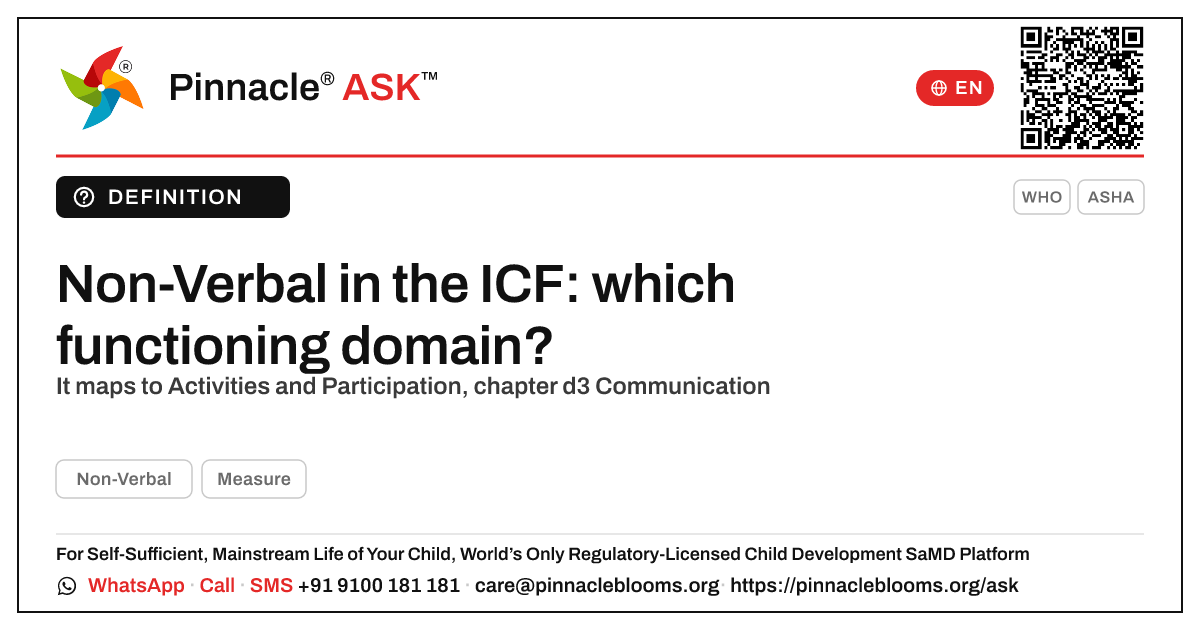
In early childhood the descriptor "Non-Verbal" maps principally to the ICF Activities and Participation component, chapter d3 Communication — closest to d330 Speaking and the producing-communication cluster (including d335 non-verbal messages and d360 communication devices). It also relates to Body Functions b167 (mental functions of language). ICF frames it as a functioning state and participation profile, not a fixed label, keeping focus on capacity, supports and environmental factors.
In this answer 5 sections
"Non-verbal" is a description of communication functioning, not a diagnosis — and in the ICF it maps cleanly to a specific functioning domain.
In short
In early childhood, Non-Verbal maps principally to the ICF (and ICF-CY) Activities and Participation component, chapter d3 — Communication, with its closest anchors being d330 Speaking and the broader Communicating–producing cluster (d330–d349). Where reduced spoken output reflects an underlying mental function, it also relates to Body Functions b167 (mental functions of language) and b1671 (expression of language). ICF deliberately frames "non-verbal" as a functioning state — what the child can do and participate in — rather than a label, which keeps the focus on capacity and supports rather than deficit.
The science: mapping non-verbal across ICF components
The ICF describes functioning across interacting components, so a single descriptor like "non-verbal" rarely sits in one box. The most direct mapping is within Activities and Participation, d3 Communication — specifically d330 Speaking (producing words and connected speech), supported by d331–d335 covering pre-speech, singing and producing non-verbal messages such as gesture and signs. Importantly, ICF-CY recognises that a child who does not yet use spoken words may still communicate richly through d335 (producing non-verbal messages) and d360 (using communication devices and techniques) — which is why AAC, gesture and pointing are coded as communication functioning, not as failure to speak.
At the Body Functions level, the relevant constructs are b167 mental functions of language, particularly b16710 expression of spoken language, and where relevant b320 articulation functions and b330 fluency and rhythm of speech. The clinical value of separating these layers is precision: it distinguishes a child whose expressive language is emerging slowly from one whose participation is limited by environmental or contextual factors (ICF Environmental Factors, e-codes), such as access to AAC or responsive communication partners.
When this matters clinically
For a researcher or clinician, the take-home is that "non-verbal" should be operationalised as an Activities-and-Participation communication profile, qualified across both capacity and performance, rather than recorded as a static trait. In early childhood this framing matters because expressive trajectories are highly plastic, and environmental codes (e1251 communication aids, e355 health professionals, e410 family attitudes) materially change the participation outcome.
The Pinnacle way
This is general information for professional use, not a diagnosis — a clinical AbilityScore® and any diagnosis are formed only at a Pinnacle Blooms Network centre, under qualified clinician care, through a clinician-administered structured assessment. Our communication pathway profiles spoken and non-verbal functioning together, drawing on speech therapy and AAC supports, and you can explore our wider approach at Pinnacle Blooms Network.
Trusted sources
WHO International Classification of Functioning, Disability and Health (ICF) and its Children & Youth version (ICF-CY), chapter d3 Communication and Body Functions b167; ASHA guidance on communication functioning and augmentative and alternative communication.
Next step — If you are profiling a child's communication functioning, map both spoken and non-verbal channels and book a developmental communication assessment to anchor capacity and participation accurately.
CONNECT THE ANSWER TO YOUR CHILD’S DAY
Something to notice. Something to discuss.
What to notice
Whether a child uses non-verbal channels — gesture, pointing, signs, AAC (ICF d335, d360) — even when spoken words (d330) are not yet emerging; and whether environmental codes such as communication-aid access (e1251) are limiting participation rather than capacity.
In everyday life
When documenting a child as non-verbal, record what they CAN do to communicate — gestures, signs, devices — under ICF d335 and d360, not only the absence of speech, so the profile reflects functioning and not deficit.
Bring your observations and questions to your child’s professional. Choose activities that suit your child’s comfort, abilities and agreed plan.
Bring your questions to a first visitQuestions families ask
Which ICF code best captures "non-verbal" in a young child?
The closest direct anchor is d330 Speaking within Activities and Participation chapter d3 Communication. The broader producing-communication cluster (d330–d349), including d335 producing non-verbal messages and d360 using communication devices, completes the profile.
Does non-verbal sit under Body Functions or Activities and Participation?
Primarily Activities and Participation (d3 Communication), because ICF emphasises what the child can do and participate in. It also relates to Body Functions b167 (mental functions of language) where reduced spoken output reflects an underlying function, but functioning is best expressed at the Activities-and-Participation level.
Why does ICF avoid treating non-verbal as a fixed trait?
ICF frames functioning as the interaction of capacity, performance and context. A child without spoken words may communicate richly through gesture, signs or AAC, and environmental factors (e-codes) such as device access shape participation — so non-verbal is a dynamic profile, not a static label.
FOLLOW THE SOURCE
References behind this answer.
- Organisation website · further readingWHO ICF — International Classification of Functioning, Disability and Health
- Source referenceWHO ICF and ICF-CY framework
- Organisation website · further readingASHA — communication and AAC guidance
References are supplied with this answer. An organisation homepage offers further reading; it does not establish an independent review of this page.
Content attribution: SETU Consortium · Pinnacle Blooms Network.
PEOPLE, TOPICS & DEVELOPMENT
See the connections.
Browse the wider question collections connected with this answer’s audience, developmental area and stage.
FROM UNDERSTANDING TO PURPOSEFUL SUPPORT
One question. Your child’s whole life.
Your child’s self-sufficient, mainstream-included life is the purpose from the beginning. At Pinnacle, that purpose shapes what we understand, the goals we choose, the people we bring together, everyday practice and review.
Connect this question with the right support.
Start with your child’s strengths, your observations and what you want everyday life to become.
Make the next conversation useful.
Bring the situations you notice at home or school. We’ll explain a suitable service, centre and first visit, including availability and fees, before you decide.
How PinnacleAI® connects the journeyExplore the seven stages
- 1Understand abilities
A starting picture of your child’s capabilities.
- 2Choose meaningful goals
Readiness and a plan shaped around the child.
- 3Bring the right support together
Suitable therapies and people for those goals.
- 4Carry practice into everyday life
Guidance for family, home and school.
- 5Track and correct
Use observations to adjust the plan.
- 6Reassess and review
Decide what to continue, change or do next.
- 7Grow independence and participation
The child’s life gives each step its purpose.
Explore the whole PinnacleAI® system → · Participation at school and in the community →
PINNACLE’S EVIDENCE, OPEN TO YOU
Look at the evidence behind our work.
Read our research, inspect the original regulatory documents and check what each institutional measure means.
General information supports a conversation with an appropriately qualified professional. Advice, goals and support depend on the individual child.